Learn first-rate techniques and tips from some of the best makeup artists in the business in the new edition of The Makeup Artist Handbook. Renown makeup pros Gretchen Davis and Mindy Hall bring an impressive set of experience in all areas to the book, including work on Teenage Mutant Ninja Turtles, Steve Jobs, The Wolf of Wall Street, Blue Jasmine, Star Trek, Pearl Harbor, HBO's Looking and many other films and TV shows. This full-color, comprehensive new edition offers brand new photographs and on-the-job examples to demonstrate makeup techniques and fundamentals on topics such as beauty, time periods, black and white photography and up-to-date information on cutting-edge techniques like computer-generated characters, makeup effects, mold-making, air brushing, and plenty of information on how to work effectively on set.

eBook - ePub
The Makeup Artist Handbook
Techniques for Film, Television, Photography, and Theatre
- 326 pages
- English
- ePUB (mobile friendly)
- Available on iOS & Android
eBook - ePub
The Makeup Artist Handbook
Techniques for Film, Television, Photography, and Theatre
About this book
Information
1

SHAPES

Proportions of the Face and Body in Art
Makeup artists are masters at illusion. We manipulate the shapes and features of the face and body with our artistry. We cannot achieve this without understanding how to correctly determine proportions, shapes, and the anatomical structure of the body.
In studying anatomy drawing, you learn, for example, individual skeletal or muscular size, shapes, and functions. The functions and proportions are key in creating realism. There are fundamental drawing skills that teach you value, form, light, and shadows, as well as how these elements fall onto the surface of the face and body. For example, if you do not understand the shape and function of a muscle, your placement of highlight and shadow, a tattoo, body paint, or prosthetic will be off and therefore unsuccessful.
Painting, drawing, and understanding the body will give you the skills and ability to understand how to change facial features and alter an individual’s features to look like something or someone else. Your artistry will move with the subject, making it look more authentic. It is a very important lesson used in all areas of makeup artistry. “Anatomy is an applied science which underpins fine art, the study of structure is essential for artistic representation. The skeleton, joints and muscular system of a creature determine its proportions and the movement of the body” (Fehér 7).
Value, Shadow, and Light
by Dan Gheno
The study of values is a complicated subject. When trying to draw in a tonal manner, it helps your ability to see value changes on the model if you learn the terminology of the subject.
Values: Each object, whether simple like a sphere or complex like the human figure, is composed of millions of tonal “value” changes. These range from the brightest bright (where the object most directly faces the light) to the darkest dark (where the object is turned away from the light source).
Halftones: A generic term that refers to all of the value variations within the light side of the model. The halftones are brightest where the form turns most directly toward the light source, and are darkest just before the form falls into complete shadow.
Dark and Light Halftones: To keep things simple, artists should class their halftones into two different categories: “light halftones” and “dark halftones.” Things can go wrong if these two types aren’t kept separate. Some artists make all of their halftones equally dark, creating muddy-looking drawings, while others insist on making their halftones equally bright, creating washed-out drawings. Note in the Watcher picture (Figure 1.1) that the halftone shapes are distinctly lighter on the side of the forehead most directly facing the light source, while they are dramatically darker near the shadow shapes on the forehead. Try squinting to test the validity of the value renditions. When you squint, the light halftones should fade away and disappear into the overall light shape, while the dark halftones should visually melt into the adjacent, general shadow shapes.
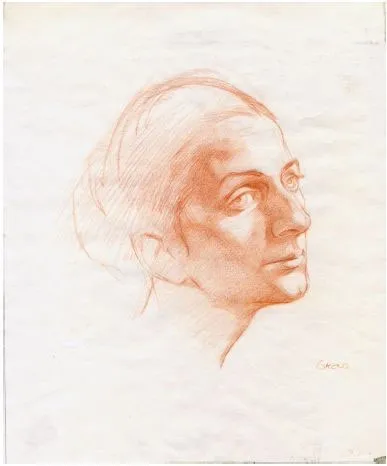
FIGURE 1.1: THE WATCHER WOMAN
Shadow: As the form of the model turns completely away from the light source, the dark halftone shapes get darker and darker, until the light completely terminates and the big shadow shape begins. Literally called the “terminator” by those who deal with light as a science, this shadow edge can look abrupt and contrast at times, or soft and fused at other times. It all depends upon the amount of reflected light bouncing into the shadow side of the model.
Reflected Light: Shadows are simply the absence of light. The only reason anything can be seen within the shadow shape is because of reflected light. The light source illuminates not just the model, but also the surrounding environment. The light bounces off the walls, floor, and ceiling, ricocheting into the shadows, and lighting (or filling) the dark side of the model. Indeed, even various body parts reflect light onto the other shadowed parts of the model. One very important rule to know: no reflected light in the shadow shape can be as bright as the direct light hitting the model.
Core Shadow: When the dark side of the face turns away from any source of reflected light, the shadow gradually darkens until the darkest part of the shadow, called the “core shadow,” is reached. This term refers to an area of the form that gets no direct light and very little reflected light. Even when drawn subtly or in a barely visible manner, the core shadow creates a cornering effect that helps to magnify the plane changes of the model.
Movement of the Head: To determine the correct proportions of facial features when the head has moved in different angles, use the vertical and horizontal axes (Figure 1.3). The centerline is the vertical axis. This line determines the movements made by the face from side to side. The horizontal axis defines the brow line.
PRO TIP
Makeup artists often need to match a likeness of a historical figure to an actor (Portrait Makeup), or from one actor to another actor (photo double), or from actor to stunt person (stunt double). These are examples of where your knowledge of shadow, shape, and their placement on the face is important (Figure 1.2).
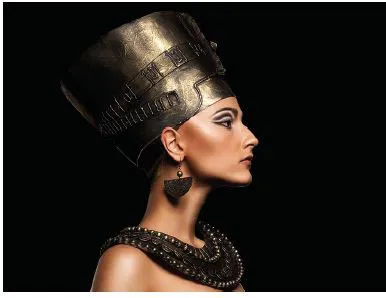
FIGURE 1.2: PORTRAIT MAKEUP EXAMPLE
If the human head is turned in any direction, the main vertical and horizontal axes become elliptical curves (Figure 1.4).
If the head turns in any direction, the parallel horizontal lines become parallel elliptical curves (Figure 1.5).
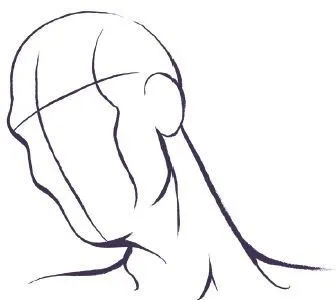
FIGURE 1.3: HORIZONTAL AND VERTICAL AXES
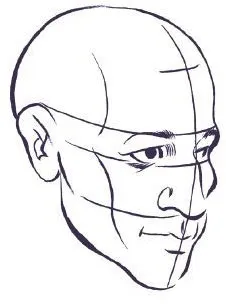
FIGURE 1.4: ELLIPTICAL CURVES

FIGURE 1.5: PARALLEL ELLIPTICAL CURVES
Body and face measurements help the artist correctly achieve the right proportions. Artist Leonardo da Vinci calculated the parts of the body that could be used as units, and was the first to adapt the head for units of measurement. He used the length of the face, but not the length of the whole head. His methods are still in use to...
Table of contents
- Cover
- Half Title
- Title Page
- Copyright Page
- Table of Contents
- About the Authors
- Preface
- Acknowledgments
- Chapter 1 Shapes
- Chapter 2 The Body
- Chapter 3 Color
- Chapter 4 Lighting
- Chapter 5 Technology
- Chapter 6 Foundations
- Chapter 7 Basics
- Chapter 8 Beauty
- Chapter 9 Design
- Chapter 10 Hair
- Chapter 11 Airbrush
- Chapter 12 Effects
- Chapter 13 How to Be a Pro
- Cosmetics, Tools, Labs, and Effects
- The Crew
- Glossary
- Professional Library
- The Pros
- Unions
- Index
Trusted by 375,005 students
Access to over 1.5 million titles for a fair monthly price.
Study more efficiently using our study tools.
Frequently asked questions
Yes, you can cancel anytime from the Subscription tab in your account settings on the Perlego website. Your subscription will stay active until the end of your current billing period. Learn how to cancel your subscription
No, books cannot be downloaded as external files, such as PDFs, for use outside of Perlego. However, you can download books within the Perlego app for offline reading on mobile or tablet. Learn how to download books offline
Perlego offers two plans: Essential and Complete
- Essential is ideal for learners and professionals who enjoy exploring a wide range of subjects. Access the Essential Library with 800,000+ trusted titles and best-sellers across business, personal growth, and the humanities. Includes unlimited reading time and Standard Read Aloud voice.
- Complete: Perfect for advanced learners and researchers needing full, unrestricted access. Unlock 1.5M+ books across hundreds of subjects, including academic and specialized titles. The Complete Plan also includes advanced features like Premium Read Aloud and Research Assistant.
We are an online textbook subscription service, where you can get access to an entire online library for less than the price of a single book per month. With over 1.5 million books across 990+ topics, we’ve got you covered! Learn about our mission
Look out for the read-aloud symbol on your next book to see if you can listen to it. The read-aloud tool reads text aloud for you, highlighting the text as it is being read. You can pause it, speed it up and slow it down. Learn more about Read Aloud
Yes! You can use the Perlego app on both iOS and Android devices to read anytime, anywhere — even offline. Perfect for commutes or when you’re on the go.
Please note we cannot support devices running on iOS 13 and Android 7 or earlier. Learn more about using the app
Please note we cannot support devices running on iOS 13 and Android 7 or earlier. Learn more about using the app
Yes, you can access The Makeup Artist Handbook by Gretchen Davis,Mindy Hall in PDF and/or ePUB format, as well as other popular books in Media & Performing Arts & Film & Video. We have over 1.5 million books available in our catalogue for you to explore.