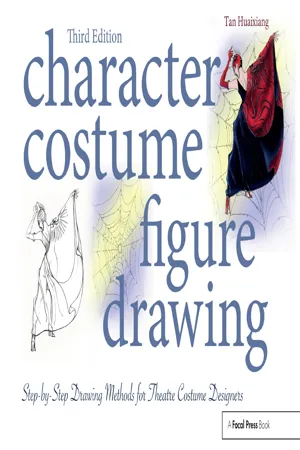
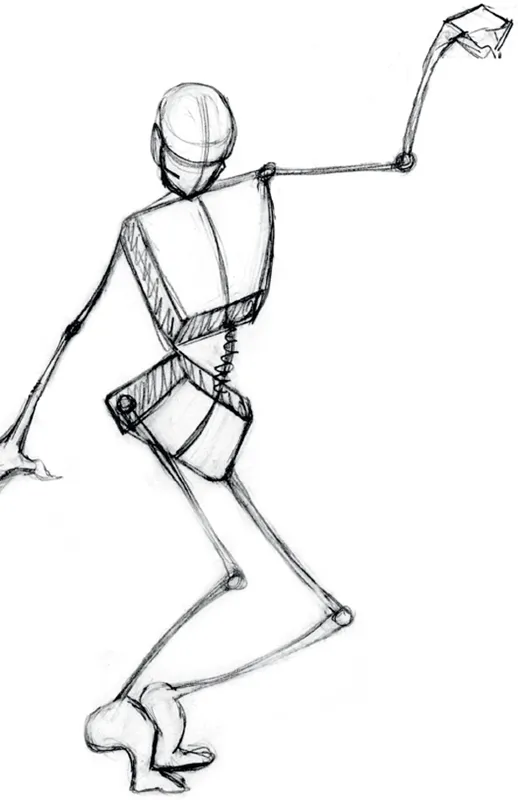
Character Costume Figure Drawing is an essential guide that will improve your drawing skills and costume renderings. Step-by-step visuals illustrate the how-tos of drawing body parts, costumes, accessories, faces, children, and different character archetypes, such as maternal, elderly, sassy, sexy, and evil. By focusing on the foundations of drawing bodies, including body proportion, bone structure, body masses, facial expressions, and appendages, this guide shows you how to develop sketches from stick figures to full-blown characters.
The third edition features a new chapter, Digital Mixed Media Costume Rendering. This chapter introduces the basic usages of Photoshop tools to enhance and improve costume designs, in order to provide easy delivery design ideas to the director and design team, provide easy changes and alterations during the design process, virtually apply actual fabric swatches over costume sketches, and help visualize lighting effects.
My objective in writing this book is to show how to draw figures using a simple and easy drawing method. Specifically, the book is intended to help theatre students improve their drawing skills so that they can give effective design presentations. Most theatre students do not have any solid drawing training, or any human anatomy or figure-drawing courses in their curricula. Drawing requires a lot of practice and knowledge of the proportions of the human body. I believe that with effort, anybody can draw.
Theatre students typically have to do production assignments and work in the shops, helping to build either scenery or costumes for the production. Their time is occupied with those assignments, leaving them little time to improve their drawing skills. That is why I am trying to find a short, easy, and fast way to help them improve their drawing abilities. The methods in this book can be used without a model. However, if theatre students have the opportunity to draw the human figure from live models, they should do so. Drawing live models is a tremendous help in understanding the human body.
PROPORTIONS OF THE BODY
There are many concepts or methods for measuring the divisions of the human body. The eight-heads-tall figure proportion method is often used by artists or fashion illustrators. Some fashion drawings may use eight-and-a-half- or nine-heads-tall figures to demonstrate the garments, using a slim, sophisticated image. Realism is not the intent of fashion designers or illustrators. Rather, their objective is to create a stylized or exaggerated version of reality, which today is a tall, slim, and athletic figure, with a long neck and long legs. Fashion illustrations emphasize the current ideals or trends of fashion beauty. The thin body and specific poses are designed to enhance the garments. Fashion illustrators are creating the images of fashionable products to stimulate customers to purchase the garments. Beautiful illustrations can impress and influence customers to buy and wear the advertised clothing.
Costume designs for theatrical productions are quite different from fashion illustrations. The costume designer uses the history of fashion as a reference for creating costumes for many varieties of characters or groups of characters in plays. The characters are everyday-life people: young or old, thin or heavy, short or tall, with different nationalities and particular personalities. Costume design for productions requires creating practical garments that are going to be worn on stage by believable characters who have well-defined personalities. Sometimes a well-defined character costume design can inspire the actors and enhance the design presentation for the production team. In my drawings and designs, I try to emphasize a realistic style of body proportions, but I use slightly exaggerated facial features and body language to create characters with personality. The real creative challenge is how to express personalities of characters.
Most of the proportions of the body that I used in this book are based on the theories of proportions used in many other art books. There are fantastic art books from which you can learn about the proportions of the body and about figure drawing techniques, such as Bridgman’s Complete Guide to Drawing from Life, by George B. Bridgman (Sterling, 2001); The Complete Book of Fashion Illustration, by Sharon Lee Tate and Mona Shafer Edwards (Prentice Hall, 1995); The Human Figure: An Anatomy for Artists, by David K. Rubins (Penguin, 1975); Drawing the Head and Figure, by Jack Hamm (Perigee, 1982); and Drawing on the Right Side of the Brain, by Betty Edwards (Tarcher, rev. ed. 1999). These books helped me improve my understanding of the human body and taught me how to present the body well. You can study the rules and principles of figure drawing, but you have to learn how to use them through practice.
To give my characters a realistic appearance, I slightly change the size of the head. Compared to the eight-heads-tall proportions, I enlarge the head to extend outside the usual boundary of the first head area. This enlarges the head in proportion to the top half of the body. I keep the feet within the bottom-half portion of the body. When I start the foundation of a figure, however, I still start with the eight-heads-tall method because it is an even number and easier to divide for calculation purposes. My divisions on the body may differ from other books, but the measurements work for my figure drawings. My primary intent is to have a system that is easy to use.
The key for developing a character figure drawing that is in proportion is to keep the top half (from the crotch up to the top of the skull) equal to the bottom half (from the crotch down to the bottom of the feet). The crotch is the main division point. The head can...
Table of contents
Cover
Half Title
Title Page
Copyright Page
Table of Contents
Foreword
Preface
Acknowledgments
Introduction
Chapter 1 Drawing the Figure
Chapter 2 Creating the Face
Chapter 3 Figure and Facial Variations
Chapter 4 Hands, Feet, and Accessories
Chapter 5 Character Costume Design Creation
Chapter 6 Rendering Techniques
Chapter 7 Character Costume Figures in Style
Chapter 8 Digital Mixed Media Costume Rendering
Chapter 9 Costume Rendering Gallery
Index
Trusted by 375,005 students
Access to over 1.5 million titles for a fair monthly price.
Study more efficiently using our study tools.
Frequently asked questions
Yes, you can cancel anytime from the Subscription tab in your account settings on the Perlego website. Your subscription will stay active until the end of your current billing period. Learn how to cancel your subscription
No, books cannot be downloaded as external files, such as PDFs, for use outside of Perlego. However, you can download books within the Perlego app for offline reading on mobile or tablet. Learn how to download books offline
Perlego offers two plans: Essential and Complete
Essential is ideal for learners and professionals who enjoy exploring a wide range of subjects. Access the Essential Library with 800,000+ trusted titles and best-sellers across business, personal growth, and the humanities. Includes unlimited reading time and Standard Read Aloud voice.
Complete: Perfect for advanced learners and researchers needing full, unrestricted access. Unlock 1.5M+ books across hundreds of subjects, including academic and specialized titles. The Complete Plan also includes advanced features like Premium Read Aloud and Research Assistant.
Both plans are available with monthly, semester, or annual billing cycles.
We are an online textbook subscription service, where you can get access to an entire online library for less than the price of a single book per month. With over 1.5 million books across 990+ topics, we’ve got you covered! Learn about our mission
Look out for the read-aloud symbol on your next book to see if you can listen to it. The read-aloud tool reads text aloud for you, highlighting the text as it is being read. You can pause it, speed it up and slow it down. Learn more about Read Aloud
Yes! You can use the Perlego app on both iOS and Android devices to read anytime, anywhere — even offline. Perfect for commutes or when you’re on the go. Please note we cannot support devices running on iOS 13 and Android 7 or earlier. Learn more about using the app
Yes, you can access Character Costume Figure Drawing by Tan Huaixiang in PDF and/or ePUB format, as well as other popular books in Media & Performing Arts & Theatre. We have over 1.5 million books available in our catalogue for you to explore.