![]()
Part 1
Setting the Scene
- 1 INTRODUCTION TO OPERATIONS MANAGEMENT
- 2 STRATEGIC OPERATIONS MANAGEMENTM
![]()
Chapter 1
Introduction to Operations Management
Learning Objectives
The purpose of this chapter is to introduce you to the scope of management activities involved in strategic operations management and to help you to:
- Understand some of the complexities and rate of change in business and the challenge this presents to managing modern-day operations.
- Appreciate the strategic importance of the role of operations management in supporting the organization's ability to compete.
Introduction
In this chapter we will discuss some of the responsibilities that operations managers have and why these are so critically important to the performance of any organization – whether it is in manufacturing, services, private or public sectors. We also examine some of the previous misconceptions that need to be corrected if an organization is to able to compete by using its operations’ capabilities; and we look at the importance of linking both manufacturing and services together in order to provide the total provision or offer, of goods and services to the end customer.
In the next chapter, we will develop some of these basics into the wider, strategic role and importance of operations management. One of the problems that organizations often have is in not seeing the strategic importance of their operations management capabilities. We will discuss why this is a problem and then, in the next chapter, we will build upon some of the areas of this chapter and develop insights into the strategic role and importance of operations management.
The World of Operations
Welcome to today’s business world, in which the rate of change far exceeds anything from the past and where the challenge for organizations is to embrace and lead change in order to compete successfully and stratify customers, clients and other key stakeholders. The last few years have seen an acceleration in the rate of change and an expansion of the stage on which it is taking place. Innovation is now taking place across all sectors and settings and is no longer the domain of high-tech firms like Apple. For example, we now use the word ‘google’ as a verb and talk about ‘googling’ for something ‘online’. ‘Cloud’ is no longer just something in the sky that causes rain to fall but is, also, something used by companies to store vast amounts of information and data internationally within very complex networks. Big Data is common across industries as part of the ‘Internet of Things’ and its adoption has changed the very business model of some organizations. 3-D printing has become the norm across many industries and its speed of adoption has been remarkable in some sectors, including healthcare and the military.
In years gone by strategy used to be quite simple as large, typically vertically integrated organizations staked out their own specific positions with their own firm-specific strategies to outperform other firms. Today, strategy is much more complex. Take a manufacturing company, for example. Twenty years ago most of the design and manufacture would be done in house in many Western firms. Today, a typical scenario is that the firm has its designs outsourced – and this may include, for example, to Taiwan; the product might then be made in China; it will then be distributed within a very complex network, aided by companies like Amazon and other logistics companies. The distinction between manufacturing and services has become blurred with firms providing an overall ‘offering’ to customers based on customers buying ‘an experience’; and the emergence of servitization, where firms bundle a range of services together, has been very important and common within many, what were formerly labelled purely manufacturing, firms.
It is this rate of change that operations managers have to deal with across a range of sectors – and it is not easy to manage in such volatile conditions. But if operations aren’t properly managed, the organization is not being supported in its markets and will not survive.
We may not always be aware of this but operations take place, in various forms, around us all the time. Operations take place when we have a meal in a restaurant; when we have a ‘service experience’ – for example, when we are patients involved in a whole range of healthcare provisions; when we attend school and university; and when we see products being assembled. So, operations aren’t just about production lines and high-value manufacturing. Operations take place in all kinds of settings – manufacturing and services, private and public sectors. Operations management is vitally important to any organization because, ultimately:
An organization is judged by how its operations perform and not what the organization says it is going to do!
As customers we pay a great deal of attention to the capabilities of operations that organizations provide – or sometimes do not provide! As we shall see in Chapter 3, where we focus specifically on service operations, once we form an opinion of how an organization has performed its operations, it is often difficult to change that opinion. So, managing operations is important – but what is operations management?
Developing a Definition of Operations Management
We offer the following as the basic definition of operations management:
Operations management is concerned with those activities that enable an organization (and not just one part of it) to transform a range of basic inputs (materials, energy, customers’ requirements, information, skills, finance, etc.) into outputs for the end customer.
We will see that operations is not really about a limited, specific function; rather, it is a company-wide and inter-firm activity embracing a number of different areas and utilizing these in order to satisfy customers and other important stakeholders. This is important because we must always bear in mind that operations do not take place in one, specifically confined, area of the organization. Rather, various forms of operations will take place simultaneously across the organization. For example, in a manufacturing plant we might assume that operations take place merely at the point of production or assembly – but this limits what is actually taking place. In reality, a range of operations will have taken place, or will be taking place, in addition to the actual manufacture of the product. These operations include inventory management, supply and logistics, capacity and scheduling; quality control; management of process technology; managing human resources by ensuring that the right skills base is in place and is developed; as well as a range of operations related to information processing and office administration.
Similarly, in services, the obvious point where we may think operations takes place is in the moment of direct contact and interaction between the service provider on the one hand, and the recipient of the service, on the other, in a series of touch points. These points of contact are sometimes called the ‘moment of truth’. However, behind the scenes (in services this is often called ‘back-office’ operations) there will be a number of operations that would have needed to be put in place prior to this point of contact. We discuss this in much more depth in Chapter 3.
The organization uses different kinds of inputs – the transformational inputs (such as plant, buildings, machinery and equipment), as well as less tangible but important inputs (such as learning, tacit knowledge and experience) and transforms these into outputs.
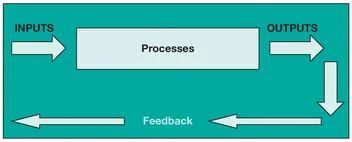
A basic, organization-specific model of operations is shown in Figure 1.1.
Figure 1.1 The basic operations system
As Hill (2004) explains:
The operations task . . . concerns the transformation process that involves taking inputs and converting them into outputs together with the various support functions closely associated with this basic task.
(p. 5)
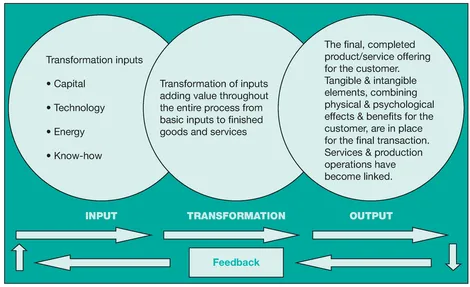
This basic model, which appears in similar forms in many management texts, can be expanded to identify main activities within operations as shown in Figure 1.2.
Although models like these are often used, we suggest that operations management in the modern era is more complex than this. The major issue is that operations management is not only organization-wide, but also includes activities across organizations. Obviously, an important part of the transformation process will include purchasing goods and services from other organizations.
Such transformation processes can be applied to three main categories: materials, customers and information. Material processing operations are typically associated with manufacturing; customer-processing operations with some sectors of the service industry; and information processing operations with other service sectors. In practice, most businesses rely on a combination of materials, customers and information processing. In a factory, processing materials is obvious and can be easily observed. These transformations (i.e. of parts into finished products) are not so obvious in many service operations. For example, banks, hospitals, social services and universities transform inputs into outputs, and thus all carry out operations management. There may well be differing views as to what the outputs are – and there may be several that are provided at the same time. For example, a university has a number of inputs (including staff expertise and experience, funding from the government, funding from students themselves or their sponsors, allocation of time, and so on) and these are then transformed by a number of operations (time spent in the classroom, scheduling students for particular courses, and so on) in order to provide outputs. The immediate output would be ‘successful students’ – those who have gained their intended qualifications. However, there would also be a number of, perhaps, harder to identify, beneficiaries or recipients of these outputs – including potential employers and society in general.
Figure 1.2 Factors within the input/output model of operations
Hill’s (2004) definition of the task of operations management, which we cited above, is useful because it indicates the important link that operational activities have with a wider, organizational base. As we indicated earlier, it is important to view operations as a core organization-wide activity rather than the prerogative of one department only. ...