Frost & Sullivan's 2014 Growth, Innovation, and Leadership Book of the Year
"EXPONENTIAL ORGANIZATIONS should be required reading for anyone interested in the ways exponential technologies are reinventing best practices in business." —Ray Kurzweil, Director of Engineering at Google
In business, performance is key. In performance, how you organize can be the key to growth.
In the past five years, the business world has seen the birth of a new breed of company—the Exponential Organization—that has revolutionized how a company can accelerate its growth by using technology. An ExO can eliminate the incremental, linear way traditional companies get bigger, leveraging assets like community, big data, algorithms, and new technology into achieving performance benchmarks ten times better than its peers.
Three luminaries of the business world—Salim Ismail, Yuri van Geest, and Mike Malone—have researched this phenomenon and documented ten characteristics of Exponential Organizations. Here, in EXPONENTIAL ORGANIZATIONS, they walk the reader through how any company, from a startup to a multi-national, can become an ExO, streamline its performance, and grow to the next level.
"EXPONENTIAL ORGANIZATIONS is the most pivotal book in its class. Salim examines the future of organizations and offers readers his insights on the concept of Exponential Organizations, because he himself embodies the strategy, structure, culture, processes, and systems of this new breed of company." —John Hagel, The Center for the Edge
Chosen by Benjamin Netanyahu, Prime Minister of Israel, to be one of Bloomberg's Best Books of 2015
eBook - ePub
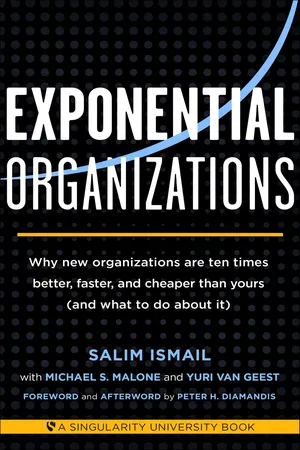
Exponential Organizations
Why new organizations are ten times better, faster, and cheaper than yours (and what to do about it)
- 249 pages
- English
- ePUB (mobile friendly)
- Available on iOS & Android
eBook - ePub
Exponential Organizations
Why new organizations are ten times better, faster, and cheaper than yours (and what to do about it)
About this book
Information
Part One
Exploring the Exponential Organization
In this segment, we’ll explore the characteristics, attributes and implications of Exponential Organizations.
CHAPTER ONE
Illuminated by Information
While the original Iridium Moment caused enormous embarrassment for the satellite industry, you may be surprised to learn that there have been many similar but less-publicized Iridium moments in the mobile phone industry.
For example, because mobile phones in the early 80s were bulky and expensive to use, renowned consulting firm McKinsey & Company advised AT&T not to enter the mobile telephone business, predicting there would be fewer than one million cellular phones in use by 2000. In fact, by 2000, there were one hundred million mobile phones. Not only was McKinsey’s prediction off by 99 percent, its recommendation also resulted in AT&T missing out on one of the biggest business opportunities of modern times.
In 2009, yet another major market research firm, the Gartner Group, forecast that by 2012 Symbian would be the top operating system for mobile devices, with a 39 percent market share and two hundred three million units shipped—a leadership position Gartner anticipated the company would hold through 2014. Gartner also predicted in the same report that Android would hold just a 14.5 percent market share.
The reality? Symbian shut its doors at the end of 2012 after shipping only 2.2 million units in Q4. Android, on the other hand, has overtaken even the Apple iPhone OS and today dominates the mobile world, with over one billion Android OS shipments just in 2014.
Venture capitalist Vinod Khosla conducted an insightful piece of research in which he reviewed predictions made by mobile phone industry analysts from 2000 to 2010. He studied major research firms such as Gartner, Forrester, McKinsey and Jupiter to see how they predicted the growth of the mobile phone industry in two-year increments over the course of that decade.
Khosla’s research showed that in 2002 experts predicted, on average, 16 percent year-to-year growth. In fact, by 2004, the industry had seen a 100 percent increase. In 2004, their collective predictions called for an increase of 14 percent; by 2006, growth had once again climbed 100 percent. In 2006, the analysts estimated sales would increase just 12 percent—and they doubled again. Despite three previous—and notable—failures, in 2008 these very same experts forecast a measly 10 percent growth, only to see the number double yet again—another 100 percent leap. It is hard to imagine how anyone could be more wrong than to be off by 10x—and yet these were the mobile phone industry experts upon whom corporations and governments worldwide relied for their long-term strategic planning. Nowhere does the phrase “missed by a country mile” seem more appropriate.
What makes this failure valuable for our purposes is that at each point of exponential growth in mobile phones over the last decade, the world’s top prognosticators predicted largely linear change. Again, we would label it Iridium thinking.
Khosla’s research proved particularly compelling and valuable when he went on to show that such prediction errors weren’t unique just to the mobile phone industry, but also to the oil industry and a host of other sectors. It seemed that, when facing exponential growth, the experts in almost every field always projected linearly, despite the evidence before their eyes.
Brough Turner, a noted entrepreneur in VOIP and mobile telephony, has been building companies in that industry since 1990. Having kept close track of industry predictions since the early 90s, he concurs with Khosla’s analysis. In a recent interview with Salim, Turner noted that while the initial projections were always aggressive, the experts inevitably expected a tapering after the first eighteen to twenty-four months. Nonetheless, he said, the same rates of growth continued for twenty years. David Frigstad, CEO of research firm Frost & Sullivan, explains at least part of the problem thusly: “Predicting a technology when it’s doubling is inherently tricky. If you miss one step, you’re off by 50 percent!”
A final example should drive the point home. In 1990, the Human Genome Project was launched with the aim of fully sequencing a single human genome. Estimates called for the project to take fifteen years and cost about $6 billion. In 1997, however, halfway through the estimated time frame, just 1 percent of the human genome had been sequenced. Every expert labeled the project a failure, pointing out that at seven years for just 1 percent, it would take seven hundred years to finish the sequencing. Craig Venter, one of the principal researchers, received calls from friends and colleagues imploring him to stop the project and not embarrass himself further. “Save your career,” he recalls them saying. “Return the money.”
When Ray Kurzweil was asked his perspective, however, his view of the “impending disaster” was quite different. “1 percent,” he said. “That means we’re halfway done.” What Kurzweil got that no one else did was that the amount sequenced was doubling every year. 1 percent doubling seven times is 100 percent. Kurzweil’s math was correct, and in fact the project was completed in 2001, early and under budget. The so-called experts had missed the end point by 696 years.
What is going on here? How can intelligent and well-read analysts, entrepreneurs and investors so consistently get things wrong? And not just a little wrong, but wrong by as much as 99 percent?
If such predictions had been just a little bit off, it would be easy to dismiss them as based on bad data, or even simple incompetence. But no, mistakes this great are almost always due to a complete misinterpretation of the rules defining the nature of the marketplace. They come from relying on a paradigm that performed perfectly up until the moment it didn’t, and that is suddenly, often inexplicably, out of date.
But if there is a new paradigm assuming a central role in the modern economy, one that will define how we live and work, what is it?
The answer lies within the anecdotes cited in the introduction to this book. Consider, for example, the Eastman Kodak story. Was its failure simply a case of a once-great company that had grown complacent and lost its innovative edge, as was suggested by the media at the time? Or was there something larger at work?
Think back, if you are old enough to remember, to the days of film photography. Each photograph cost an incremental amount of money. The cost of the film, the cost of mailing or hand-delivering the film, the cost of processing that film—in the end, it all added up to about a dollar per photograph. Photography was based upon a scarcity model and we carefully conserved and managed our photos and film rolls to ensure no wasted shots.
With the shift to digital photography, something important—indeed something revolutionary—happened. The marginal cost of taking an extra photograph didn’t just diminish, as it would with a linear improvement in the technology; instead, it essentially sank to zero. It didn’t matter if you took five pictures or five hundred. The cost was the same. Eventually, even the storage of the photos themselves became all but free.
And that wasn’t the only technological leap. Once you had these digital photographs, you could apply computations to them in the form of image recognition, artificial intelligence, social technologies, filtering, editing, and machine learning. Now anyone with minimal training could become a “darkroom wizard” like Edward Weston or Ansel Adams. You could also manipulate, move and copy a digital photograph infinitely more quickly and easily than a physical one—and as such you became a publisher as well as a print and wire service. And all these things could be done with a camera that was a fraction the cost and size of the traditional analog versions it replaced.
In other words, what happened in the world of photography wasn’t just a major improvement. It wasn’t even just a single evolutionary leap. Eastman Kodak might have managed to stay competitive had that been the only challenge. But Kodak (and Polaroid, among other giants in the field) was hit by revolutionary technological change coming at it from multiple directions: cameras, film, processing, distribution, retailing, marketing, packaging, storage and, ultimately and most decisively, a radical change in the perceptions of the marketplace.
That is the very definition of a paradigm shift. There’s an important and foundational lesson illustrated in each of these anecdotes, which is that an information-based environment delivers fundamentally disruptive opportunities.
There are thousands of similar disruptions taking place across the global economy, where just such a profound shift is occurring from a physical substrate to an information substrate. That is, at the heart of every one of these disruptions—these evolutionary leaps—can be found a fundamental change in the role of information: semiconductor chips assuming the role of image capture, display, storage and controller; the Internet transforming supply, distribution and retail channels; and social networks and groupware reorganizing institutions. Together, all indications are that we are shifting to an information-based paradigm.
In his book The Singularity is Near: When Humans Transcend Biology, Kurzweil identified a hugely important and fundamental property of technology: when you shift to an information-based environment, the pace of development jumps onto an exponential growth path and price/performance doubles every year or two.
As everyone in technology knows, this pace of change was first discovered and described in 1964 by Intel Corporation co-founder Gordon Moore. His discovery, immortalized as Moore’s Law, has seen the doubling of price/performance in computing continue uninterrupted for a half-century. As noted in the Introduction, Kurzweil took Moore’s Law several steps further, noting that every information-based paradigm operates in the same way, something he called the Law of Accelerating Returns (LOAR).
There is a growing recognition that the pace of change formerly seen in computing is now mapping into other technologies with the same effect. For example, the first human genome was sequenced in 2000 at a cost of $2.7 billion. Because of the underlying accelerations in computing, sensors and new measurement techniques, the cost of DNA sequencing has been moving at five times the pace of Moore’s Law. In 2011, Dr. Moore had his own genome sequenced for $100,000. Today that very same sequencing costs about $1,000, a figure that is expected to drop to $100 by 2015, and ...
Table of contents
- Exponential Organizations
- Copyright
- Table of Contents
- Foreword
- Introduction
- Part One: Exploring the Exponential Organization
- Chapter One: Illuminated by Information
- Chapter Two: A Tale of Two Companies
- Chapter Three: The Exponential Organization
- Chapter Four: Inside the Exponential Organization
- Chapter Five: Implications of Exponential Organizations
- Part Two: Building the Exponential Organization
- Chapter Six: Starting an ExO
- Chapter Seven: ExOs and Mid-Market Companies
- Chapter Eight: ExOs for Large Organizations
- Chapter Nine: Big Companies Adapt
- Chapter Ten: The Exponential Executive
- Epilogue: A New Cambrian Explosion
- Afterword
- Appendix A: What is your Exponential Quotient?
- Appendix B: Sources and Inspirations
- About the Authors
- Acknowledgements
- Connect with Diversion Books
Trusted by 375,005 students
Access to over 1.5 million titles for a fair monthly price.
Study more efficiently using our study tools.
Frequently asked questions
Yes, you can cancel anytime from the Subscription tab in your account settings on the Perlego website. Your subscription will stay active until the end of your current billing period. Learn how to cancel your subscription
No, books cannot be downloaded as external files, such as PDFs, for use outside of Perlego. However, you can download books within the Perlego app for offline reading on mobile or tablet. Learn how to download books offline
Perlego offers two plans: Essential and Complete
- Essential is ideal for learners and professionals who enjoy exploring a wide range of subjects. Access the Essential Library with 800,000+ trusted titles and best-sellers across business, personal growth, and the humanities. Includes unlimited reading time and Standard Read Aloud voice.
- Complete: Perfect for advanced learners and researchers needing full, unrestricted access. Unlock 1.5M+ books across hundreds of subjects, including academic and specialized titles. The Complete Plan also includes advanced features like Premium Read Aloud and Research Assistant.
We are an online textbook subscription service, where you can get access to an entire online library for less than the price of a single book per month. With over 1.5 million books across 990+ topics, we’ve got you covered! Learn about our mission
Look out for the read-aloud symbol on your next book to see if you can listen to it. The read-aloud tool reads text aloud for you, highlighting the text as it is being read. You can pause it, speed it up and slow it down. Learn more about Read Aloud
Yes! You can use the Perlego app on both iOS and Android devices to read anytime, anywhere — even offline. Perfect for commutes or when you’re on the go.
Please note we cannot support devices running on iOS 13 and Android 7 or earlier. Learn more about using the app
Please note we cannot support devices running on iOS 13 and Android 7 or earlier. Learn more about using the app
Yes, you can access Exponential Organizations by Salim Ismail,Michael S. Malone,Yuri van Geest in PDF and/or ePUB format, as well as other popular books in Business & Entrepreneurship. We have over 1.5 million books available in our catalogue for you to explore.