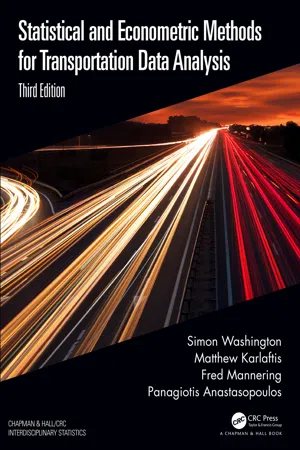
Statistical and Econometric Methods for Transportation Data Analysis
eBook - ePub

Statistical and Econometric Methods for Transportation Data Analysis

  1. 478 pages
  2. English
  3. ePUB (mobile friendly)
  4. Available on iOS & Android
eBook - ePub

Statistical and Econometric Methods for Transportation Data Analysis

About this book

The book's website (with databases and other support materials) can be accessed here.

Praise for the Second Edition:

The second edition introduces an especially broad set of statistical methods … As a lecturer in both transportation and marketing research, I find this book an excellent textbook for advanced undergraduate, Master's and Ph.D. students, covering topics from simple descriptive statistics to complex Bayesian models. … It is one of the few books that cover an extensive set of statistical methods needed for data analysis in transportation. The book offers a wealth of examples from the transportation field. —The American Statistician


Statistical and Econometric Methods for Transportation Data Analysis, Third Edition

offers an expansion over the first and second editions in response to the recent methodological advancements in the fields of econometrics and statistics and to provide an increasing range of examples and corresponding data sets. It describes and illustrates some of the statistical and econometric tools commonly used in transportation data analysis. It provides a wide breadth of examples and case studies, covering applications in various aspects of transportation planning, engineering, safety, and economics. Ample analytical rigor is provided in each chapter so that fundamental concepts and principles are clear and numerous references are provided for those seeking additional technical details and applications.

New to the Third Edition

  • Updated references and improved examples throughout.
  • New sections on random parameters linear regression and ordered probability models including the hierarchical ordered probit model.
  • A new section on random parameters models with heterogeneity in the means and variances of parameter estimates.
  • Multiple new sections on correlated random parameters and correlated grouped random parameters in probit, logit and hazard-based models.
  • A new section discussing the practical aspects of random parameters model estimation.
  • A new chapter on Latent Class Models.
  • A new chapter on Bivariate and Multivariate Dependent Variable Models.


Statistical and Econometric Methods for Transportation Data Analysis, Third Edition

can serve as a textbook for advanced undergraduate, Masters, and Ph.D. students in transportation-related disciplines including engineering, economics, urban and regional planning, and sociology. The book also serves as a technical reference for researchers and practitioners wishing to examine and understand a broad range of statistical and econometric tools required to study transportation problems.

Tools to learn more effectively

Saving Books

Saving Books

Keyword Search

Keyword Search

Annotating Text

Annotating Text

Listen to it instead

Listen to it instead

Section II

Continuous Dependent Variable Models

3

Linear Regression

Linear regression is one of the most widely studied and applied statistical and econometric techniques, for numerous reasons. First, linear regression is suitable for modeling a wide variety of relationships between variables. In addition, the assumptions of linear regression models are often suitably satisfied in many practical applications. Furthermore, regression model outputs are relatively easy to interpret and communicate to others, numerical estimation of regression models is relatively easy, and software for estimating models is readily available in numerous “non-specialty” software packages. Linear regression can also be overused or misused. In some cases, the assumptions are not strictly met, and suitable alternatives are not known, understood, or applied. Moreover, more advanced techniques may require specialized software and knowledge to estimate.
It should not be surprising that linear regression serves as an excellent starting point for illustrating statistical model estimation procedures. Although it is a flexible and useful tool, applying linear regression when other methods are more suitable should be avoided.
This chapter illustrates the estimation of linear regression models, explains when linear regression models are appropriate, describes how to interpret linear regression model outputs, and discusses how to select among a competing set of linear regression models. Matrix algebra is used throughout the chapter to illustrate the concepts, but only to the extent necessary to illustrate the most important analytical aspects.

3.1 Assumptions of the Linear Regression Model

Linear regression is used to model a linear relationship between a continuous dependent variable and one or more independent variables. Most regression applications seek to identify a set of explanatory variables that are thought to co-vary with the dependent variable. In general, explanatory or “causal” models are based on data obtained from well-controlled experiments (e.g., those conducted in a laboratory), predictive models are based on data obtained from observational studies, and quality control models are based on data obtained from a process or system being controlled. Whether explanatory variables cause or are merely associated with changes in the dependent variable depends on numerous factors and cannot be determined on the basis of statistical modeling alone.
There are numerous assumptions (or requirements) of the linear regression model. When any of the requirements are not met, remedial actions should be taken, and in some cases, alternative modeling approaches adopted. The following are the assumptions of the linear regression model.

3.1.1 Continuous Dependent Variable Y

An assumption in regression is that the dependent or response variable is continuous; that is, it can take on any value within a range of values. A continuous variable is measured on either ...

Table of contents

  1. Cover
  2. Half Title
  3. Series Page
  4. Title Page
  5. Copyright Page
  6. Table of Contents
  7. Preface
  8. Authors
  9. Section I Fundamentals
  10. Section II Continuous Dependent Variable Models
  11. Section III Count and Discrete-Dependent Variable Models
  12. Section IV Other Statistical Methods
  13. Appendix A: Statistical Fundamentals
  14. Appendix B: Statistical Tables
  15. Appendix C: Variable Transformations
  16. References
  17. Index

Frequently asked questions

Yes, you can cancel anytime from the Subscription tab in your account settings on the Perlego website. Your subscription will stay active until the end of your current billing period. Learn how to cancel your subscription
No, books cannot be downloaded as external files, such as PDFs, for use outside of Perlego. However, you can download books within the Perlego app for offline reading on mobile or tablet. Learn how to download books offline
Perlego offers two plans: Essential and Complete
  • Essential is ideal for learners and professionals who enjoy exploring a wide range of subjects. Access the Essential Library with 800,000+ trusted titles and best-sellers across business, personal growth, and the humanities. Includes unlimited reading time and Standard Read Aloud voice.
  • Complete: Perfect for advanced learners and researchers needing full, unrestricted access. Unlock 1.4M+ books across hundreds of subjects, including academic and specialized titles. The Complete Plan also includes advanced features like Premium Read Aloud and Research Assistant.
Both plans are available with monthly, semester, or annual billing cycles.
We are an online textbook subscription service, where you can get access to an entire online library for less than the price of a single book per month. With over 1 million books across 990+ topics, we’ve got you covered! Learn about our mission
Look out for the read-aloud symbol on your next book to see if you can listen to it. The read-aloud tool reads text aloud for you, highlighting the text as it is being read. You can pause it, speed it up and slow it down. Learn more about Read Aloud
Yes! You can use the Perlego app on both iOS and Android devices to read anytime, anywhere — even offline. Perfect for commutes or when you’re on the go.
Please note we cannot support devices running on iOS 13 and Android 7 or earlier. Learn more about using the app
Yes, you can access Statistical and Econometric Methods for Transportation Data Analysis by Simon Washington,Matthew G. Karlaftis,Fred Mannering,Panagiotis Anastasopoulos in PDF and/or ePUB format, as well as other popular books in Technology & Engineering & Probability & Statistics. We have over one million books available in our catalogue for you to explore.