'This has always been the definitive text for PR in Australia. Public Relations: Theory and Practice is the complete companion for new and not-so-new practitioners. I'll be keeping a copy on my bookshelf.' - Tracy Jones, FPRIA former president, Public Relations Institute of Australia
Public relations is a dynamic and rapidly growing field which offers a variety of career paths. Whether you're building the public image of an organisation, developing news and social media strategies, or managing issues for a company or political party, you need strong communication skills and a sound understanding of public relations processes.
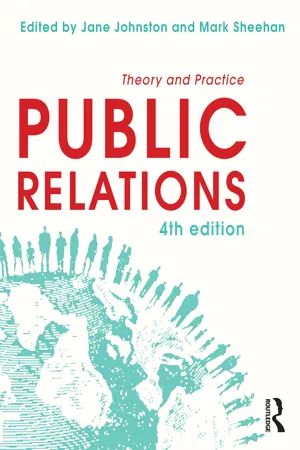
In this widely used introduction to professional practice, leading academics and practitioners outline the core principles of public relations in business, government and the third sectors. They show how to develop effective public relations strategies and explain how to research, run and evaluate a successful public relations campaign. Drawing on a range of communication and public relations theories, they discuss how to work with key publics, using all forms of media for maximum impact. It is richly illustrated with examples and case studies from Australia, New Zealand, Asia and other countries.
Public Relations has been substantially revised and includes newly written chapters on social media, tactics, integrated marketing communication, risk and crisis communication, public relations history, corporate and investor public relations, and law, as well as a new glossary of theoretical terms.
- 440 pages
- English
- ePUB (mobile friendly)
- Available on iOS & Android
eBook - ePub
About this book
Part 1
Foundations of public relations
1
An overview of public relations
Jane Johnston and Clara Zawawi
In this chapter
- What is public relations?
- Defining public relations
- The role of public relations practitioners
- Public relations activities
- Relationship to marketing and advertising
- From publics to markets
- Skills needed in public relations
- University curricula
- Growth and change
- Conclusion
What is public relations?
Popular films and television shows present a patchy image of the profession of public relations. Samantha in Sex and the City, C. J. in The West Wing, Bridget in Bridget Jones’s Diary and The Thick of It’s Malcolm Tucker depict public relations practitioners as widely varying types, from manipulative to airheaded, hard-working to party professionals. Indeed, popular culture presents public relations as an especially diverse profession. But while some of these portrayals include popularised truths, others are almost in a different universe to real life public relations, illustrating how widely understood and misunderstood the profession is. It is a diverse, multifaceted and exciting field, and it can take many forms, under many titles. This book aims to explain what public relations is and also expand readers’ understanding of the field. This chapter defines the profession and helps position its role in society, and the rest of the book discusses key areas of practice while providing a range of theoretical frameworks, as well as case studies to illustrate how it works.
A common question from first-time public relations students is: ‘What is public relations?’, and students are not the only ones unsure of what the profession is all about. Even management at all levels can be unsure of the exact nature of the role. One reason for the confusion is that it is often used as a catch-all for people who ‘work with people’ or in any type of communication or goodwill occupation. Dedicated websites can also sell the industry short: MyCareer (2013) uses the following description to explain public relations and communication roles: ‘People talk to each other, but businesses communicate. Find PR jobs and exciting roles in communications including community relations, publicity jobs and roles in media relations. Work for one of Australia’s leading PR firms or with a top communications team managing corporate affairs or internal communications.’ This is all true of public relations, but it gives only part of the story. Not only do businessescommunicate; so too do governments, not-for-profit organisations and non-governmental organisations. In 1994 an Australian public relations scholar counted seventy-four different titles used in job advertisements for people performing public relations roles (Foster 1995: 6). Some of the more common terms used were corporate affairs manager, public affairs executive, corporate communication director and media manager. These show that public relations can have specialisations, like other industries. Take medicine, for instance. Doctors may be general practitioners; orthopaedic surgeons; ear, nose and throat specialists; cardiologists; or obstetricians. Similarly, public relations provides for the specialist and the generalist working within all sectors of society, from corporate, government and politics to community and not-for-profits.
Defining public relations
Public relations practitioners and academics have been explaining the term ‘public relations’ for a long time. In 1967, Don Barnes (1967), then president of the New South Wales chapter of the Public Relations Institute of Australia (PRIA), published a paper entitled ‘What Is Public Relations?’. He described the purpose of public relations officers and consultants as maintaining an organisation’s relations with its various publics—the groups of people who are important to it. He further described the functions of public relations practitioners as (Barnes 1967: 2):
- advising management on policy and its effect on public relations
- channelling and coordinating within an organisation the activities that affect public relations
- providing the mechanics for explaining an organisation and its policies to its various publics through communication media
- ascertaining and explaining to management what various publics think about the organisation
Twenty years later, the chairman of one of the world’s largest public relations firms, Harold Burson of Burson-Marsteller, listed what he believed to be the four most important functions of public relations in society (Burson 1987). His list, which is reproduced in the box below, showed that basically little had changed, and that same list still holds true today.
Definitions of public relations tasks
- Sensor of social change The public relations professional perceives the rumblings at the heart of society that augur good or ill for the organisation, and helps management prepare for the onslaught and impact of those issues.
- Corporate conscience Henry David Thoreau wrote: ‘It is truly enough said that a corporation has no conscience; but a corporation of conscientious men is a corporation with a conscience.’ These are powerful words—ones that the public relations professional should always bear in mind. Such qualities are basic to the job description of public relations officers.
- Communicator Many people think communication is the main public relations role. Most likely, this is because they have spent a lot of time mastering communication skills and little time honing their social judgment. Communication is not the main role: it is one of four important roles.
- Corporate monitor This function seeks to make corporate policies and programs match public expectations. The spirit of the ombudsman should pervade the public relations worker’s job. This is perhaps the best reason for the senior public relations officer to report to the highest level of management.
- Source: H. Burson, ‘Tips and tactics’, PR Reporter, 23 March 1987.
With the growth of public relations education, academic definitions have developed. Grunig and Hunt (1984: 6), while acknowledging that a single definition can be problematic, explained public relations as the ‘management of communication between an organisation and its publics’. More than a decade later, McElreath (1996: 3) described it as a ‘management function that uses communications to facilitate relationships and understanding between an organisation and its publics’. While these are excellent ways of understanding the public relations function from the point of view of an organisation, they do not take into account the growing trend in the democratisation of communication. In addition, the very use of the words ‘organisation’ or ‘corporation’ in these definitions tends to place public relations practice too firmly within the corporate context.
These traditional definitions are no longer adequate. The advent of cheap mass and personal communication, and the growing sophistication of the smallest community groups and individuals to leverage this, have extended our understanding of the range and depth of public relations activity. Developments such as the growth of anti-globalisation coalitions, which by their very nature are anti-organisational but which use these same tools against corporations, have broadened the parameters of public relations, making a more contemporary definition necessary. Other factors that have increasingly been incorporated into public relations are the importance of relationships and the value of corporate social responsibility. Taking all these factors into consideration, we define public relations as:
the development and managementof ethical strategies using communicationto build relationships with stakeholders or publics.
This activity can be carried out by organisations, groups or individuals as they interact with their various publics, or stakeholders, to pursue objectives and goals. This view recognises that communication may be strategic, insofar as it is carefully considered, but should not take advantage of imbalances of power between the communicator and the recipient. Ethical parameters require the practitioner to ensure that public relations programs and activities remain fair to those involved in the communication relationship. Like Burson (1987) before us, our definition goes beyond those given above by suggesting that communication, while central and important, is only part of the scope of public relations. We might consider communication as the 20 per cent of the iceberg that can be seen—the other 80 per cent exists under the surface. Our definition also explains the way in which practitioners, whether in government, corporations or working for a community group, can use the same basic sets of skills and techniques, even though their use may occur for widely different purposes.
The role of public relations practitioners
Public relations work for an organisation may be undertaken by either a consultant or an in-house employee. As consultants, practitioners have several or many clients, or accounts, and balance their time between them. One obvious benefit is the variety of work this allows, in terms of job locations, people to work with and development of different accounts. In-house practitioners, on the other hand, work solely for one organisation. The major benefits of this type of employment are the chance to get to know an organisation ‘from the inside out’ and the ease of access to management, facilities and resources.
Both an organisation’s nature and the position of its public relations practitioners influence the type of public relations it practises. While we readily acknowledge that public relations may not be undertaken in a traditional way, two primary roles held by public relations practitioners are as technicians and problem solvers or managers. Technicians provide services such as producing publications—for example, news releases and newsletters—and social media management. They generally hold lower positions within organisations than problem solvers, who help clients or senior management to address problems and find solutions. Problem solvers belong to management, with accompanying responsibility for decision making and policy formation. They are part of what is known as the dominant coalition of management.
In some cases, such as smaller organisations and consultancies, all staff may be required to perform both technician and problem-solver functions simultaneously, but where organisations employ a team of practitioners, the more junior staff member will tend to perform the technician’s role, and the more senior the problem solver’s role. In large organisations like local government, there may be a dozen or more people performing a range of public relations activities, with appointments at junior, middle and senior levels. An organisation’s employment pattern of problem solvers and technicians will depend not only on its size and complexity, however, but also on the number and range of publics, or stakeholders, with which it needs to communicate, the volume of work required, and its budget.
Public relations activities
In either a consultant or an in-house capacity, the public relations practitioner’s job is multifaceted, and many roles overlap within it. These roles may be broadly situated in the following areas.
- cause or relationship marketing establishing and maintaining relationships to engender customer loyalty and support
- communication imparting or exchanging thoughts, opinions or messages through visual, oral or written means
- community relations establishing and maintaining relationships between organisations and community groups affected by each other
- crisis management dealing with a crisis, disaster or unplanned negative events, and maximising any positive outcomes these might have
- event management preparing, planning and carrying out significant events spanning a limited timeframe
- financial and investor relations dealing with and communicating information to shareholders, the investment community and relevant regulatory bodies
- fundraising establishing and maintaining relationships on behalf of the not-for-profit sector to stimulate public donations and support
- industry relationsestablishing and maintaining relationships with, or on behalf of, companies within an industry group
- integrated marketing communication (IMC) using public relations, marketing and advertising functions to achieve a uniform approach
- internal relations establishing and maintaining relationships with the people involved in the same organisation
- issues management identification, monitoring of and action on public policy matters of concern to an organisation
- media relations establishing and maintaining relationships between the traditional media and an organisation
- minority relations establishing and maintaining relationships with, or on behalf of, minority groups and individuals
- press agentry generation of ‘soft news’ stories—sometimes through stunts—usually associated with the entertainment industry
- press secretary or public information officer acting as lia...
Table of contents
- Cover
- Title
- Copyright
- Contents
- Contributors
- Preface
- Part 1 Foundations of public relations
- Part 2 Process and application of public relations
- Part 3 Working with key publics and fields of practice
- Part 4 Navigating the challenges of public relations
- Glossary of theories
- Index
Trusted by 375,005 students
Access to over 1.5 million titles for a fair monthly price.
Study more efficiently using our study tools.
Frequently asked questions
Yes, you can cancel anytime from the Subscription tab in your account settings on the Perlego website. Your subscription will stay active until the end of your current billing period. Learn how to cancel your subscription
No, books cannot be downloaded as external files, such as PDFs, for use outside of Perlego. However, you can download books within the Perlego app for offline reading on mobile or tablet. Learn how to download books offline
Perlego offers two plans: Essential and Complete
- Essential is ideal for learners and professionals who enjoy exploring a wide range of subjects. Access the Essential Library with 800,000+ trusted titles and best-sellers across business, personal growth, and the humanities. Includes unlimited reading time and Standard Read Aloud voice.
- Complete: Perfect for advanced learners and researchers needing full, unrestricted access. Unlock 1.5M+ books across hundreds of subjects, including academic and specialized titles. The Complete Plan also includes advanced features like Premium Read Aloud and Research Assistant.
We are an online textbook subscription service, where you can get access to an entire online library for less than the price of a single book per month. With over 1.5 million books across 990+ topics, we’ve got you covered! Learn about our mission
Look out for the read-aloud symbol on your next book to see if you can listen to it. The read-aloud tool reads text aloud for you, highlighting the text as it is being read. You can pause it, speed it up and slow it down. Learn more about Read Aloud
Yes! You can use the Perlego app on both iOS and Android devices to read anytime, anywhere — even offline. Perfect for commutes or when you’re on the go.
Please note we cannot support devices running on iOS 13 and Android 7 or earlier. Learn more about using the app
Please note we cannot support devices running on iOS 13 and Android 7 or earlier. Learn more about using the app
Yes, you can access Public Relations by Mark Sheehan,Jane Johnston in PDF and/or ePUB format, as well as other popular books in Business & Marketing. We have over 1.5 million books available in our catalogue for you to explore.