In Blood and Boundaries, Stuart B. Schwartz takes us to late medieval Latin America to show how Spain and Portugal's policies of exclusion and discrimination based on religious origins and genealogy were transferred to their colonies in Latin America. Rather than concentrating on the three principal divisions of colonial society—Indians, Europeans, and people of African origins—as is common in studies of these colonial societies, Schwartz examines the three minority groups of moriscos, conversos, and mestizos. Muslim and Jewish converts and their descendants, he shows, posed a special problem for colonial society: they were feared and distrusted as peoples considered ethnically distinct, but at the same time their conversion to Christianity seemed to violate stable social categories and identities. This led to the creation of "cleanliness of blood" regulations that explicitly discriminated against converts. Eventually, Schwartz shows, those regulations were extended to control the subject indigenous and enslaved African populations, and over time, applied to the growing numbers of mestizos, peoples of mixed ethnic origins. Despite the efforts of civil and church and state institutions to regulate, denigrate, and exclude, members of these affected groups often found legal and practical means to ignore, circumvent, or challenge the efforts to categorize and exclude them, creating in the process the dynamic societies of Latin America that emerged in the nineteenth century.
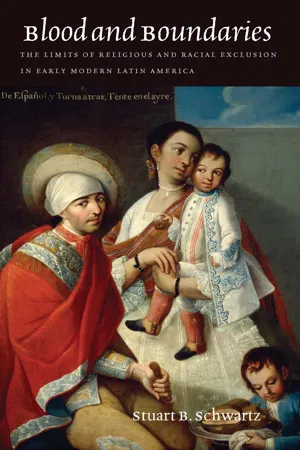
eBook - ePub
Blood and Boundaries
The Limits of Religious and Racial Exclusion in Early Modern Latin America
- English
- ePUB (mobile friendly)
- Available on iOS & Android
eBook - ePub
Blood and Boundaries
The Limits of Religious and Racial Exclusion in Early Modern Latin America
About this book
Information
Publisher
Brandeis University PressYear
2020Print ISBN
9781684580200
9781684580194
eBook ISBN
9781684580217
1
Moriscos
Real, Occasional, and Imaginary Muslims
High in the Andes, each year in celebration of the day of Santiago (the patron saint of the great silver rich mining center of Potosí), the town council of that city unfurled a faded silk banner. Supposedly, this flag had been carried by the troops of the Catholic monarchs, Ferdinand of Aragon and Isabella of Castile, when Muslim Granada had fallen to them in 1492. It had subsequently been transferred to the Indies, where the companions of Francisco Pizarro carried it in the conquest of Peru, later in the battles of the civil wars that followed, and then again in the final victories of conquest. Its possession had been disputed by three cities, but the flag had been awarded finally to Potosí, and in the seventeenth century its citizens took great pride in the image of Santiago, the Moor slayer, that had seemingly miraculously survived on the threadbare standard. The banner symbolized the triumph of the faith and the continuity of the reconquest of Iberia from the Muslims to the conquest of the Indies from its native infidels. Santiago matamoros (Moor killer) had become Santiago mataindios (Indian killer), a transformation that was often represented in colonial Andean art.1 See images 1 and 2 in the insert. History, religion, and political reality had transformed Muslims (moros) and eventually former Muslims baptized in the Church (Moriscos) into the archtypical enemy of Christian Iberia.2
This was a trope and a symbol of enmity that was carried to the New World, where it was reinforced continually from pulpits; in religious processions; and in street performances of moros y cristianos—folk enactments, dances, and parades brought from Andalucia to celebrate and commemorate past victories, and to serve as examples as well as entertainment.3 But even in these presentations, the messaging was always a complex mixture of animosity and admiration. The Moors were often depicted as chivalric and noble adversaries, and variants of the performances emphasized not their defeat, but their conversion to and acceptance by the Church. In America, the complexities intensified in the parallel dances of the conquest, which represented the combat between Indians and Spaniards, and in both forms indigenous participants often took part and played the central roles, subverting behind their masks and costumes whatever may have been the original didactic intent or messages of these festive displays.4 Decoding the message of the moros y cristiano has long challenged scholars in a number of fields, but the ambivalence inherent in them is in some ways also a reflection of the ambivalent attitudes about moros and Moriscos in early modern Latin America.5
From the moment of Columbus’s arrival in the New World, the perception of Muslims and of Islam juxtaposed reality, prophetic expectations, and analogies that in most times and places far exceeded the actual presence of Muslims or former Muslims. Still, that perception often shaped attitudes, missionary activities, and governmental policies. Over the course of three centuries, the threat of Islam and the attitude toward Muslims did not remain unchanged but vacillated between the negative perception of an eternal enemy and respect for a civilized and powerful rival, according to the reality of the threat and the predominant cultural fashion of the time. During the early modern era, opposition to Islam and the so-called Turk played a central role in various Christian millenarian projects to reestablish a world united under the cross, but commerce, diplomacy, and personal contacts had also generated a less hostile vision at various times. By the mid-nineteenth century, Hispanic orientalism could present Islamic culture either in terms of a romanticized Alhambra or as the quintessential model of despotism and moral laxity.6
In some ways, such ambiguity had existed long before the fall of Granada in 1492, but thereafter the first concern of Ferdinand and Isabella was to ensure the unity of faith in all their territories, including the newly claimed “islands and mainlands in the Ocean Sea.”7 As early as 1501, the Catholic monarchs instituted a religious exclusionary policy that prohibited Muslims, Jews, heretics, those punished by the Church, and anyone recently converted (reconciliados) from migrating to the New World.8 Occasionally royal licenses were sought that permitted the arrival of Moriscos—for example, during the sixteenth century when Bishop Juan de Zumárraga, New Spain’s first prelate, tried to start a silk industry using Morisco specialists but was prevented from doing so by peninsular silk producers.9 Despite opposition in that case, until 1578 licenses could be obtained to circumvent these restrictions under certain conditions. Further legislation followed throughout the sixteenth century, especially during the reign of Carlos V, and subsequently the specific prohibition against importing slaves bought in the Mediterranean or Africa who might introduce Islam made that policy even more restrictive.10
But policy was one thing and reality another, and as we know, restrictions against the emigration of the prohibited groups like judeoconversos were often more honored in the breach than in the observance. In fact, such exclusionary practices against prohibited categories of people designed in Spain were not always welcomed in the Indies. In April 1545, the audiencia (appeals court) of Santo Domingo wrote to the king that it had received both the order prohibiting the reading of “printed books of profane stories like that of Amadis de Gaula” and the restrictions on slaves and free persons converted from Islam, as well as their descendants.11 But there was a local negative reaction to both. In a city like Santo Domingo which had some 100 male and female Barbary slaves to say nothing of those in the countryside, the city council reported many people complained that such a restriction on moros or Moriscos might be justified in New Spain or Peru where there were lots of Indians who might be influenced by the Islamic heresies, but since there were hardly any Indians left in Española, the presence of moros had never caused any problem. Moreover, the North African (Berberisco) and moro slaves had come with royal licenses, and their children who were now free had become masons or carpenters, and other tradesmen useful to everyone. The citizens of Santo Domingo felt that these laws were harmful, they asked the audiencia to express their discontent. The judges asked the crown for further royal instruction.12 This incident underlines the existence of a certain dichotomy between the detested and feared moros or Moriscos as the traditional enemy of Spain and the reality of those moros who lived and worked within Christian society and alongside Christians.13 This was a tension that troubled Hispanic societies in both Iberia and America from the fall of Granada in 1492 to long after the expulsion of the Moriscos from Spain in 1609–14, and it generated heated theological and political debates between those who viewed Muslims and their descendants as an unassimilable domestic enemy whose negative character was carried in their blood (thus representing a cyst in the Christian body politic) and those who believed that the Moriscos had much to offer, true conversion was possible, and expelling Moriscos to non-Christian lands would condemn true Christians to perdition.14
Inquisition cases in the American tribunals of Lima; Mexico City; and Cartagena, Colombia, reveal that crypto-islamism was rare, and that while some moros and Moriscos certainly did reach the Indies, until the late eighteenth and early nineteenth centuries—when the slave trade began to bring in large numbers of Muslim captives from West Africa—converts from Islam coming from Iberia seem to have been far fewer than the converts from Judaism and their descendants.15 Nevertheless, in a careful review of the administrative history of the restrictions on Morisco emigration, the French scholar Louis Cardaillac directly questioned the effectiveness of the exclusionary policies. More recent scholarly work has also carefully documented the limitations and inconsistency of the prohibitions and has identified a few hundred individuals who were able to evade the restrictions.16
They turn up at times in unexpected places and situations. Estebanico (Mustafa Azemmouri) the Moorish companion of Alvar Nuñez Cabeza de Vaca who traveled across the southwestern borderlands of Texas and New Mexico and eventually died at Zuni pueblo, is a famous case in point. However, in the early conquest period there are others with fascinating tales—including a few who, like Cristóbal de Burgos and Francisco de Talavera among Pizarro’s men in the conquest of Peru, later became encomenderos (holders of grants of Indians who were required to pay tribute to them in the form of money, goods, or labor) despite the probably true rumors about their Morisco origins. A number of Moriscos, especially women, who arrived as “white slaves” accompanied the conquest expeditions. Some of the women bore their master’s children, and one—Beatriz de Salcedo—married her master on his deathbed and inherited his grant of Indian laborers in Peru.17 In in a somewhat parallel case in Chile, Juana de Lezcano, a former Morisca slave, bore her owner’s child who was legitimized and inherited his father’s encomienda (grant of indigenous laborers) on the frontier. As guardian of her son, de Salcedo had to defend his interests against a lawsuit in 1563 by another encomendero, who claimed that the boy’s Morisco blood invalidated his claim to the grant.18
Still, we can never be too sure of the dimension of the presence of moros or Moriscos in colonial society. Being a Morisco or moro (or a member of any other social category, for that matter) was always a matter of more than lineage: it depended on self-perception and identification as well as the perception and definition imposed or attempted to be imposed by others. A negative image of Muslims and Moriscos formed during the era of the reconquest and intensified by their various rebellions against forced assimilation during the first decades of the sixteenth century had become an integral aspect of popular culture in Spain, although always with some ambiguity.19 The religion, dress, language, food, character, and blood of the Moriscos all became subjects of distain, disgust, and distrust in popular refrains and learned treatises, and these attitudes were carried to the New World.20 Because the most common deprecatory accusations were to call someone a converso or Morisco, or a perro judío or perro moro (Jewish dog or Muslim dog), such accusations were often part of the constant personal and political squabbling that often marked the period of the conquest, as well as of life thereafter. Suggestions of Muslim or Jewish origin or behavior could be used as an insult against any group or person.21 One could sink no lower than to be a Turk or a moro. As the Catalans said during their rebellion in the seventeenth century, it was preferable “to be a vassal of the Turk and to live with the Moors than to live with the Castilians.”22 In the Indies a similar use was made of the Moors as a measure of disrespect or criticism. For example, secular authorities in Santo Domingo complained about the resident clergy—who, they claimed, “go about very freely, exempt [from control] like a “moro without a king.” In a bitter legal dispute between Juan Suárez de Peralta, the Mexican criollo author and chronicler of New Spain, and the Gómez family, the latter accused the former and his relatives of being Jews, while they retaliated by claiming that their opponents were recent converts from Islam.23
As noted above, the epithet “moro” or “Morisco” was a common weapon in disputes and conflicts, and it generated lawsuits, complaints to the Inquisition, and personal violence from Potosí to New Spain. We have a number of colorful colonial examples of such denunciations—including that of Pedro Ruiz Delgado, a doctor and tax collector in Puerto Rico, who in 1567 ran afoul of the grandson of Ponce de León, the former governor; and the case of the encomendero Diego Romero in New Granada, both of whom were accused by their political rivals of being Moriscos.24 These cases involved questions of limpieza de sangre (purity of blood) and of vox publica (hearsay) and of defenses emphasizing services to the king. In both cases the accusations aimed at denigrating these men as moros—whether factually true or not—failed to be upheld, but such indictments were always a useful tool against rivals or enemies. Thus, while historians in the past certainly erred in assuming that the exclusion of those excluded (prohibidos) was generally effective, the new generation of historians, anxious to uncover a Muslim presence in the New World, must be wary of accepting every identification or accusation of Muslim background as valid evidence.
This was a challenge not only for modern historians, but also for Old Christian Spaniards and Portuguese at the time. Once the cultural markers, language, and dress of the Muslims had been prohibited and the expulsions had taken place, determining who was or was not a Muslim became something of an ethnographic test that sometimes involved cultural confusion and faux ethnography.25 An interesting example is that of a black man called Pedro Moreno, who in 1640 showed up on a ship in the southeastern Spanish province of Murcia.26 Moreno was denounced to local inquisitors because he was retajado (circumcised), which in Murcia immediately implied that he was either a Muslim or a renegade Christian who had converted to Islam.27 Moreno denied the charge. He explained that he was a native of Nabangongo in Angola and had been captured by other Africans and eventually been sold as a slave to a Portuguese ship captain, who had converted him to Christianity.28 Later, the ship on which he sailed had been captured by the Moors. But although he had lived among them, he had never swayed from his Christian faith. He insisted that his circumcision dated from his youth, saying that “the gentiles of Angola circumcised their sons when they were born.”
To decide if he was a Muslim or a renegade depended on an ethnological understanding not only of African practices, but also of Christian customs far from Spain. The inquisitors called for witnesses. Someone who had sailed to Angola was called to testify, but he seemed to miss the point that Moreno had been born to pagan parents, so his testimony that Christians in Angola did no such thing and baptized their children as Catholics did everywhere—and, therefore, that Moreno must be a Jew or a moro—was unconvincing. Other informants were needed. Three more witnesses testified, two of them Angolan slaves who could give much more specific information. The final witness was a Spaniard who argued that although in the Kongo kingdom and Luanda (where all were Christians) everyone was baptized according to the “usages of Spain,” in “the kingdom of Ndongo and other coasts of Guinea as far as the Cape of Good Hope, they are all inhuman gentiles without law, and they eat human flesh, and when they are children they are circumcised as in Barbary, and later as captives they become Christians and are baptized.”29 Thus while Moreno was retajado, that did not mean that he was a renegade. The ethnography was defective, but however biased or wrong it was, the argument about his missing foreskin won Moreno’s release by defining him as a member of the community and not as a Muslim “other”—and for many Christians that was enough.

American Fears of Moros and Islam
Early Spanish conquerors and missionaries had seen many resemblances and parallels between the culture and practices of the indigenous peoples of the New World and Christian Iberia’s ancient Muslim enemies. Perhaps for that reason, they feared that any contact between Muslims and Native Americans could have terrible consequences for the evangelical goals of the colonial project. The justification for the exclusionary policies was always the protection of the nascent faith of the newly converted indigenous populations, but there was also a geopolitical dimension to these restrictions. Foreigners, even Catholics, were always considered suspect and dangerous. Thus at various moments, other ethnic groups such as the French and the Greeks were added to the list of suspicious categories—the French as potential Protestants, and the Greeks as schismatics and subjects of the O...
Table of contents
- Cover Page
- Title Page
- Copyright Page
- Dedication
- Contents
- Foreword
- Acknowledgments
- Introduction
- 1. Moriscos: Real, Occasional, and Imaginary Muslims
- 2. Conversos: The Mestizos of Faith
- 3. Mestizos: “A Monster of . . . Many Species”
- Notes
- Index
- Illustrations
Trusted by 375,005 students
Access to over 1.5 million titles for a fair monthly price.
Study more efficiently using our study tools.
Frequently asked questions
Yes, you can cancel anytime from the Subscription tab in your account settings on the Perlego website. Your subscription will stay active until the end of your current billing period. Learn how to cancel your subscription
No, books cannot be downloaded as external files, such as PDFs, for use outside of Perlego. However, you can download books within the Perlego app for offline reading on mobile or tablet. Learn how to download books offline
Perlego offers two plans: Essential and Complete
- Essential is ideal for learners and professionals who enjoy exploring a wide range of subjects. Access the Essential Library with 800,000+ trusted titles and best-sellers across business, personal growth, and the humanities. Includes unlimited reading time and Standard Read Aloud voice.
- Complete: Perfect for advanced learners and researchers needing full, unrestricted access. Unlock 1.5M+ books across hundreds of subjects, including academic and specialized titles. The Complete Plan also includes advanced features like Premium Read Aloud and Research Assistant.
We are an online textbook subscription service, where you can get access to an entire online library for less than the price of a single book per month. With over 1.5 million books across 990+ topics, we’ve got you covered! Learn about our mission
Look out for the read-aloud symbol on your next book to see if you can listen to it. The read-aloud tool reads text aloud for you, highlighting the text as it is being read. You can pause it, speed it up and slow it down. Learn more about Read Aloud
Yes! You can use the Perlego app on both iOS and Android devices to read anytime, anywhere — even offline. Perfect for commutes or when you’re on the go.
Please note we cannot support devices running on iOS 13 and Android 7 or earlier. Learn more about using the app
Please note we cannot support devices running on iOS 13 and Android 7 or earlier. Learn more about using the app
Yes, you can access Blood and Boundaries by Stuart B. Schwartz in PDF and/or ePUB format, as well as other popular books in History & Latin American & Caribbean History. We have over 1.5 million books available in our catalogue for you to explore.