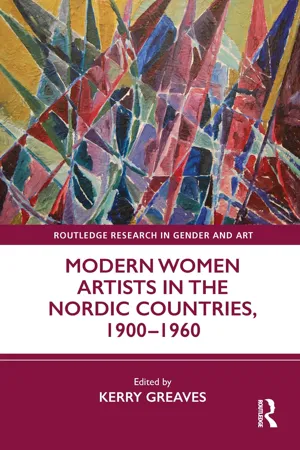
This transnational volume examines innovative women artists who were from, or worked in, Denmark, Finland, Greenland, Iceland, Norway, Sápmi, and Sweden from the emergence of modernism until the feminist movement took shape in the 1960s.
The book addresses the culturally specific conditions that shaped Nordic artists' contributions, brings the latest methodological and feminist approaches to bear on Nordic art history, and engages a wide international audience through the contributors' subject matter and analysis. Rather than introducing a new history of "rediscovered" women artists, the book is more concerned with understanding the mechanisms and structures that affected women artists and their work, while suggesting alternative ways of constructing women's art histories. Artists covered include Else Alfelt, Pia Arke, Franciska Clausen, Jessie Kleemann, Hilma af Klint, Sonja Ferlov Mancoba, Greta Knutson, Aase Texmon Rygh, Hannah Ryggen, Júlíana Sveinsdóttir, Ellen Thesleff, and Astri Aasen.
The target audience includes scholars working in art history, cultural studies, feminist studies, gender studies, curatorial studies, Nordic studies, postcolonial studies, and visual studies.
Section 1 Critical Reconsiderations, New Languages of Interpretation
1 The Work of Júlíana Sveinsdóttir Engaging Issues of Gender and Colonial Subjectivity
Hlynur Helgason
Júlíana Sveinsdóttir (1889–1966) was a prominent Icelandic-Danish painter and textile artist. She moved from Iceland, where she grew up in the remote Westman Islands, to Copenhagen in 1911 to study painting. There, towards the end of World War I, she exhibited at the Autumn Exhibition at Den Frie Udstilling (The Free Exhibition) and took part in the movement for increased influence of women artists. Sveinsdóttir gained recognition as a painter in the late 1920s for her expressionist and formally reductive landscapes and nature morte paintings. Her woven textile works, which began as a sideline to make a living in the earlier part of that decade, gradually changed in character, from being a design-related source of income to being an integral element of her art practice, gaining her recognition as a pioneer in Danish textile art.
As was the case with most women at the time, managing her life as an artist was not an easy task, but Sveinsdóttir steadily gained prominence in the Danish art world. She remained in Denmark for most of her life, unsuccessfully trying to move back to Iceland in 1928. She continued to visit Iceland during summertime, however, to paint landscapes, although she had to disrupt this habit from 1937 to 1946. She also made a number of trips to Italy in order to study Italian art of previous ages, which interested her greatly.
The art historical narrative of Sveinsdóttir’s life, while acknowledging her importance as an artist, has focused on her recurring reservations about her career, her dependence upon male colleagues, and an ambiguous relationship between her Danish life and Icelandic nationality. Thus her subjective history has become a narrative of lack, where her male colleagues, on one hand, and national identity, on the other, have been used to justify her distinctive talents. Her work has thus been viewed through a double bind of subjectification in terms of patriarchal norms and the post-colonial situation of Icelandic and Scandinavian art.
To gain a better understanding of this controversial narrative, this essay proposes a critical re-examination of Sveinsdóttir’s career. This involves examining important focal points in her history as an artistic subject and how her narrative has been formed by herself in conjunction with others. The following will demonstrate how the narrative of subjectification, which contrasts with the reality of her oeuvre, can be seen as symptomatic of complex gendered and national power relations in art history.
Oeuvre
Painted in the summer of 1922 in Iceland, Eiríksjökull (oil on canvas, 62.5 × 80 cm, National Gallery of Iceland) is an example of Sveinsdóttir’s early work. It is topographically accurate, depicting the contours and aspects of the famous glacier in natural colors so that it is easily recognizable. Expressionistic qualities are evident in the way the foreground forms a pattern of waves, emphasizing turbulent nature through a repetitive quality. These attributes are also evident in Íslenskt landslag (Icelandic Landscape) from 1925 (Figure 1.1). Here she concentrated on foreground areas of grey lava, turquoise moss, and green foliage enmeshed in a flowing, repetitious composition of irregular intertwining shapes, which contrasts with the sober and topographically recognizable crater beyond and featureless clouds above.
Figure 1.1 Júlíana Sveinsdóttir. Íslenskt landslag (Icelandic Landscape), ca.1925. Oil on canvas. 55.5 × 63.5 cm. National Gallery of Iceland, LÍ-6303. Photo: Sigurður Gunnarsson.
In the late 1920s and early 1930s, Sveinsdóttir’s work underwent a significant change. During this period her textile art was becoming more expressive and she became interested in art made for architectural settings, studying fresco technique with the Danish painter Elof Risebye (1892–1961) and weaving with the Danish painter and textile artist Astrid Holm (1876–1937) at the Royal Danish Academy of Fine Arts in Copenhagen. This interest was further fuelled by her trips to Italy, where she researched pre-Renaissance art, frescoes, and mosaics. These experiences led to a gradual simplification of her compositions, which is evident in works she made in Denmark in the late 1930s and early 1940s, such as Sumarmorgunn í Horneby (Summer Morning in Horneby) (Figure 1.2). Unlike the aforementioned Icelandic paintings, this work is not recognizably topographical: the scene could be any field anywhere. The color scheme, meanwhile, is based on different shades of green, forming distinct fields of fairly unmodulated color within the frame. Beneath a light lemon-yellow sky, there is a suggestion of a canopy of trees which are bright green on the top and shaded underneath. The central area of the composition consists of a bright yellow-green field, upon which stands a dark-brown abstract bull. The scene is framed on the left by a large tree trunk painted in thick strokes that reach from the bottom to the top of the frame. The composition is rendered with little interest in a naturalistic depiction of distance, but instead emphasizes planarity through color and the materiality of the brushstroke. Space is vaguely suggested, with the trunk representing foreground, the bull the middle field, and a smaller animal shape in the background creating a limited sense of distance. The vivid fluidity of the brushstrokes offsets the rigidity of the composition, transforming this rendering of a landscape into a representation of light.
Figure 1.2 Júlíana Sveinsdóttir. Sumarmorgunn í Horneby (Summer Morning in Horneby), 1944. Oil on canvas. 55.5 × 63.5 cm. National Gallery of Iceland, LÍ-4821. Photo: Sigurður Gunnarsson.
When Sveinsdóttir’s returned to Iceland in 1946, she used the same approach in her Icelandic landscapes. Frá Vestmannaeyjum (Elliðaey) (From the Westman Islands [Elliðaey]), of the same year (Figure 1.3), portrays a location close to the coast. The distinct shape of the uninhabited island Elliðaey in the background localizes the image, even though it is a greatly simplified composition rendered in broad strokes. The island dominates the upper part of the scene and appears to float above a turquoise-grey ocean, the earthy brown and green tones framed by a light grey slab of sky. At left a dark brown cliff face juts into the sky and ocean. The lower half of the painting consists of a rough area in shades of black, brown, and dark grey—a dark rocky coastline and abstract field that contrasts the lighter turbulent sea. As in Summer Morning in Horneby, energized brushstrokes emphasize the materiality of the surface, while space is suggested by roughly rendered forms in the foreground. This suggested spatiality keeps the composition from plunging into complete abstraction, since it is still, though barely, a recognizable landscape.
Figure 1.3 Júlíana Sveinsdóttir. Frá Vestmannaeyjum (Elliðaey) (From the Westman Islands [Elliðaey]), 1946. Oil on canvas. 82 × 90 cm. National Gallery of Iceland, LÍ-778. Photo: Sigurður Gunnarsson.
Sveinsdóttir’s textiles were always more abstract than her paintings. However, on occasion, elements that hint at landscape crop up in these works and thus relate her different working methods. This can be seen in Untitled, a large tapestry from 1957 (National Gallery of Iceland). Here, a cliff edge transforms into an abstract black form that crosses the composition diagonally, while white dots break up the otherwise unmodulated field of black. Behind this shape is a grey horizon line, which creates a sense of dimension by appearing to be located behind the black form. Straight below this is a red line, which seems closer to us by virtue of its color. In the upper left hand of the composition, a grey disk covers a white circle in a manner resembling a moon and thus signifying a sky. All of these elements are semiotic, suggestive of a landscape within the reduced abstract visual vocabulary of the work. And yet, the all-encompassing flat yellow ground counteracts any sense of distance, and the landscape signifiers become abstract forms. Thus, in contrast to the paintings that stay landscapes but approach abstraction, this textile work remains abstract but suggests a landscape.
Critical Reception
Sveinsdóttir’s first mention in the press was a critique of her work in Listasýningin, the first general exhibition of Icelandic art held in 1919 at the elementary school in Reykjavík: “First when I saw her pictures, I was filled with disgust for all her works and all her actions … it is all ugly … Peculiar eccentricity and certainly not to be imitated in any way.”1 Not a very encouraging review for a young artist trying to establish herself, although one does wonder whether this is indicative of the way her colleagues in Denmark at the time were criticized for their radical views.2 The critical reception of Sveinsdóttir’s work would improve, however. When she exhibited the second time in Iceland in 1922, the reception was more positive. One critic complimented her on her use of color, although he found her topographical accuracy lacking, “one may assume that, over time and with training she will be able to describe the natu...
Table of contents
Cover
Half Title
Series Page
Title Page
Copyright Page
Table of Contents
List of Figures
List of Contributors
Copyrights and Credits
Introduction
She Is No Gentle Lamb in the Cave of the Werewolf: Modern Women Artists in the Nordic Countries
Section 1 Critical Reconsiderations, New Languages of Interpretation
Section 2 Interventions, Transmissions, Networks
Section 3 Subversive Spaces, Collaborations, and Reclamations
Section 4 Subjectivities, Identity, and Self-Fashioning
Section 5 Alternative Practices of Agency and Resistance
Index
Trusted by 375,005 students
Access to over 1.5 million titles for a fair monthly price.
Study more efficiently using our study tools.
Frequently asked questions
Yes, you can cancel anytime from the Subscription tab in your account settings on the Perlego website. Your subscription will stay active until the end of your current billing period. Learn how to cancel your subscription
No, books cannot be downloaded as external files, such as PDFs, for use outside of Perlego. However, you can download books within the Perlego app for offline reading on mobile or tablet. Learn how to download books offline
Perlego offers two plans: Essential and Complete
Essential is ideal for learners and professionals who enjoy exploring a wide range of subjects. Access the Essential Library with 800,000+ trusted titles and best-sellers across business, personal growth, and the humanities. Includes unlimited reading time and Standard Read Aloud voice.
Complete: Perfect for advanced learners and researchers needing full, unrestricted access. Unlock 1.5M+ books across hundreds of subjects, including academic and specialized titles. The Complete Plan also includes advanced features like Premium Read Aloud and Research Assistant.
Both plans are available with monthly, semester, or annual billing cycles.
We are an online textbook subscription service, where you can get access to an entire online library for less than the price of a single book per month. With over 1.5 million books across 990+ topics, we’ve got you covered! Learn about our mission
Look out for the read-aloud symbol on your next book to see if you can listen to it. The read-aloud tool reads text aloud for you, highlighting the text as it is being read. You can pause it, speed it up and slow it down. Learn more about Read Aloud
Yes! You can use the Perlego app on both iOS and Android devices to read anytime, anywhere — even offline. Perfect for commutes or when you’re on the go. Please note we cannot support devices running on iOS 13 and Android 7 or earlier. Learn more about using the app
Yes, you can access Modern Women Artists in the Nordic Countries, 1900–1960 by Kerry Greaves in PDF and/or ePUB format, as well as other popular books in Art & European Art. We have over 1.5 million books available in our catalogue for you to explore.