Reflective Writing provides concise and practical guidance on how students can improve their academic writing through self-reflective thinking, reading and writing. Covering a range of frameworks and strategies, it includes advice on applying reflective practices to personal and CV development.
- English
- ePUB (mobile friendly)
- Available on iOS & Android
eBook - ePub
Reflective Writing
About this book
Information
PART 1 UNDERSTANDING REFLECTIVE WRITING
Part 1 starts to unpack what is meant by ‘reflection’ and ‘reflective writing’:

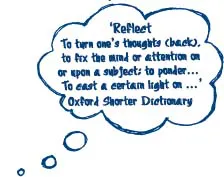
1 About reflection
Reflection starts with thinking about something. As Jenny Moon (2005 p. 1) observes, we don’t reflect on ‘simple’ things like the route to the corner shop, but on ‘things for which there is not an obvious or immediate solution’.
You could say that reflection is not about what you’re going to have for dinner this evening as you whizz round the shops. But it could be. If you are thinking about who will be eating it, what happened last time, then something as apparently simple as a shopping list could involve a lot of reflection.
It is not just to do with the subject matter of what you are thinking about or learning, but how you think about it and how you learn.
Being reflective involves being:
Why reflect?
A very good reason to reflect is because it helps you to learn.
Students on an MA course explained what they learnt through reflection:
Reflection has helped me recognise …
Reflection in a programme of study or a professional context is a purposeful activity. Purposeful reflection can change how we think about things, what we do, how we do it, and can lead to specific changes in planning for what we do next.
Reflection for life
The power of reflection in learning doesn’t stop after studies. Increasingly, employers and professions encourage people to become ‘reflective practitioners’. Reflecting on an experience and learning from it is the basis of professional and personal development that continues throughout life (see Part 6).
Starting out on reflection
The following illustration shows some of the outcomes of the reflections on a group task of some Product Design students in the first weeks of their course.
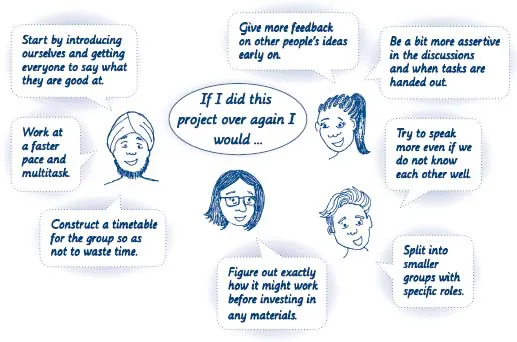
By looking back on their experience and refle...
Table of contents
- Cover Page
- Halftitle Page
- Series Editor
- Title Page
- Copyright Page
- Contents
- Acknowledgements
- Introduction
- Part 1 Understanding reflective writing
- Part 2 Language in reflective writing
- Part 3 Forms and contexts for reflective writing
- Part 4 Reflection in reading and writing
- Part 5 Using frameworks in reflective writing
- Part 6 Reflection for life
- Conclusion: the habit of reflection
- References
- Useful sources
- Index
Trusted by 375,005 students
Access to over 1.5 million titles for a fair monthly price.
Study more efficiently using our study tools.
Frequently asked questions
Yes, you can cancel anytime from the Subscription tab in your account settings on the Perlego website. Your subscription will stay active until the end of your current billing period. Learn how to cancel your subscription
No, books cannot be downloaded as external files, such as PDFs, for use outside of Perlego. However, you can download books within the Perlego app for offline reading on mobile or tablet. Learn how to download books offline
Perlego offers two plans: Essential and Complete
- Essential is ideal for learners and professionals who enjoy exploring a wide range of subjects. Access the Essential Library with 800,000+ trusted titles and best-sellers across business, personal growth, and the humanities. Includes unlimited reading time and Standard Read Aloud voice.
- Complete: Perfect for advanced learners and researchers needing full, unrestricted access. Unlock 1.5M+ books across hundreds of subjects, including academic and specialized titles. The Complete Plan also includes advanced features like Premium Read Aloud and Research Assistant.
We are an online textbook subscription service, where you can get access to an entire online library for less than the price of a single book per month. With over 1.5 million books across 990+ topics, we’ve got you covered! Learn about our mission
Look out for the read-aloud symbol on your next book to see if you can listen to it. The read-aloud tool reads text aloud for you, highlighting the text as it is being read. You can pause it, speed it up and slow it down. Learn more about Read Aloud
Yes! You can use the Perlego app on both iOS and Android devices to read anytime, anywhere — even offline. Perfect for commutes or when you’re on the go.
Please note we cannot support devices running on iOS 13 and Android 7 or earlier. Learn more about using the app
Please note we cannot support devices running on iOS 13 and Android 7 or earlier. Learn more about using the app
Yes, you can access Reflective Writing by Kate Williams, Mary Woolliams, Jane Spiro in PDF and/or ePUB format, as well as other popular books in Study Aids & Study Guides. We have over 1.5 million books available in our catalogue for you to explore.