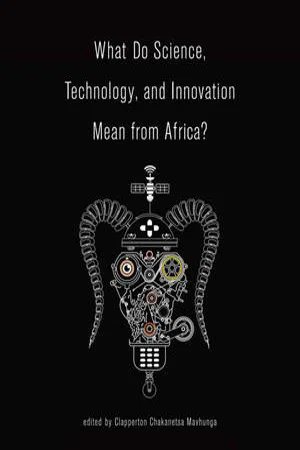
Clapperton Mavhunga's collection of essays about science, technology, and innovation (STI) from an African perspective opens with the idea, "Things do not (always) mean the same from everywhere; when we insist that only 'our' meaning is the meaning, we silence other people's meanings." Mavhunga and his contributors argue that our contemporary definitions of STI are those of countries and cultures that have acquired their dominance of others through global empires, and as a counter to that, Mavhunga seeks to put the concepts of STI into question, exploring what the technological, scientific, and innovative might mean from Africa in lieu of outside introductions or influences. We strongly feel that this book is suited to the Knowledge Unlatched program because of the difficulty of reaching markets and readers in Africa with print books. We feel unlatching would go a long way toward helping Mavhunga reach an important audience for this work that we have been previously unable to reach.
eBook - ePub
What Do Science, Technology, and Innovation Mean from Africa?
- English
- ePUB (mobile friendly)
- Available on iOS & Android
eBook - ePub
What Do Science, Technology, and Innovation Mean from Africa?
About this book
Information
Subtopic
SociologyIndex
Social Sciences1 The Place of Science and Technology in Our Lives: Making Sense of Possibilities
Those of us who have the relative advantage of age will remember that in the early years of formal school in Africa we were taught a subject under the general rubric of “domestic artisanry,” in which we were taught to carve cooking sticks and to weave baskets and other little utility tools familiar to all of us from their regular household uses. These lessons were regularly taught at a time in the school day calendar when it was considered that the “important” subjects, such as math, English, European history, and European literature, had been learned. “Domestic artisanry” was taught alongside the vernacular, and both soon gave way as the number or depth of “important” disciplines became more demanding. The temporal and incremental trajectory of the separation between the local and the “new and important” knowledge became a visible process of mental and finally also social “dépaysement.” Home and school gradually became two vastly different worlds: one ruled by important knowledge about a world that was distant physically, socially, and theoretically and the other by an array of knowledge regarded to be simple and domestic. The disconnect between these two realms has defined how many of us have grown to classify knowledge, claiming sometimes that indeed they are and ought to be kept apart. The recent controversy over the concept of ethnophilosophy or whether the indigenous can incubate and produce philosophy stems at least in significant part from the heredity of this dichotomization between domestic and simple on the one hand and new and sophisticated on the other. One needs a quantum leap to transition from the former to the latter.
In his controversial essay “Le Décollage conceptuel: conditions d’une philosophie bantoue” (1965), Franz Crahay suggested as much—that in order to transition to philosophy, African thought required a takeoff or aerial lift from the mundane and familiar realm of myth to a flight into the higher echelons of abstraction. Whether in philosophy or in the everyday making of tools and other forms of transforming the material world, knowledge is a mental characterization of the sense and usefulness of the familiar for the management of the complex world value. From a pragmatic point of view, mind is an extension of nature; hence, its growth is commensurate with the exigencies of adjustment to the variety and changing character of the environment. In other words, mind is always part of place. Hence, in a significant correction of Crahay, while remaining faithful to keeping the “indigenous” and the “scientific” separate in the ensuing pejorative characterization of ethnophilosophy, Paulin Hountondji rightly pointed out that myths are already forms of abstraction—suggesting that the difference between the philosophical and the nonphilosophical had to be sought elsewhere other than in differences between abstraction and nonabstraction. That is, thought of any kind, including the construction of myth, is always an abstraction (Hountondji 1970). Hountondji’s charge, in turn, was that indigenous modes of thought were not philosophical for two major reasons: First, philosophy is a mode of thought that is individually owned, which is quite distinct from the anonymous and shared beliefs of ethnic communities as exposed only in the works of the authors who describe them. Second, and perhaps even more importantly, philosophy is a body of knowledge that is driven solely by critical considerations of thought. Due to this second characteristic, philosophy is a kind of thought that is always changing, meaning it is expanding and growing in understanding, and this implies that philosophy is about thought, and therefore general—it supersedes communal acceptance—in its character.
In the years subsequent to the Crahay-Hountondji debate over the philosophical relevance of indigenous modes of thought, and as the idea of modernity and its relation to indigenous knowledge systems grew, the debate over ethnophilosophy extended beyond philosophy. Despite sharp opposition, Hountondji’s point about growth driven by critique as the character of philosophical knowledge has spawned new critical considerations of the nature of knowledge at indigenous levels. As intimated earlier, the fresh looks pose critical questions, including whether or not indigenous knowledge systems lack capacity for innovation and growth or whether, as brought into question in the idioms of the separation between the domain of modern school and that of home, indigenous knowledge has any place in contemporary society.
Indigenous Knowledge and Innovation
More recently, Hountondji (2009b) has softened his critique of indigenous knowledge systems as stagnant, perhaps realizing that no human knowledge bears that description. From a purely pragmatic view, toward which his recent stand has shifted, the human mind as an adaptive tool transforms commensurably with the transformations in the rest of nature around it, thus suggesting a plurality of applications to varieties of contexts in the place of a universalistic and conservative notion of truth, such as is espoused in the mid-twentieth-century analytic tradition (Hountondji 2009b, 13–15). Not only do people adjust their principles of rights in relation to changing circumstances of availability of resources, they also adjust them in relation to changing conditions of foreign relations, meaning that when encounters with people from other ethnicities or distant lands occur, they demand redrawing of boundaries to allow access to basic resources like water for pastoralists. Settlement of such issues may not always come easily, nor does it occur quickly enough for all involved, but it does occur as part of social dynamics. Continued land or boundary reclamations and sometimes conflicts around the continent are some of the indications of matters not settled by past agreements, at least not to the satisfaction of everyone affected. In light of these and other considerations, Hountondji now thinks that the more enlightening approach to understanding indigenous knowledge is to ask how today differs from yesterday, meaning the past in general, or how the manner of doing things today differs from how they were done yesterday—meaning in the past, the ever-recessing dimension of time.
Here is an example: The Maasai, the proud pastoralist people who inhabit the plains of East Africa (southern Kenya and northern mainland Tanzania), are admired for, among other things, some of their material cultural possessions, especially the spear that most adult men carry almost ubiquitously. The spear is the symbol of adulthood among the Maasai and is a major protective weapon. Although the spear is a widely used tool across Africa, the Maasai spear occupies a special place by itself for its fame. The most famous among an assortment of types (see figure 1.1) is the variety known as the “Lion spear” (figure 1.2), and a well-made one is a visual beauty. On one end is a double-sided, shiny, razor-sharp blade that usually measures at least three feet long and about two inches wide. It is both decorative and functional (figure 1.3). It is mounted on a wooden handle measuring between one and one and a half feet long, and on the end opposite the blade a differently shaped spear of roughly the same length as the blade is mounted, but with a long, round, and pointed end.
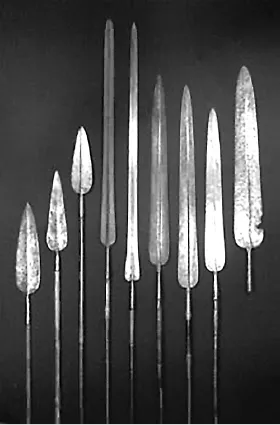
Figure 1.1 A display of Maasai spear designs. The first three on the left are the everyday spears that the Moran (warriors) and elders carry at all times. The rest are different ceremonial spears designed for different age groups. The last two on the right are generally carried by elders, while the long-bladed ones in the middle are carried by younger adults.
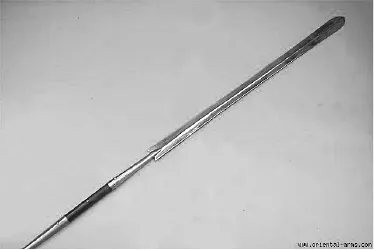
Figure 1.2 The ceremonial spear with a short handle in the middle, a long blade on the one end, and a long, sharp rounded other side.
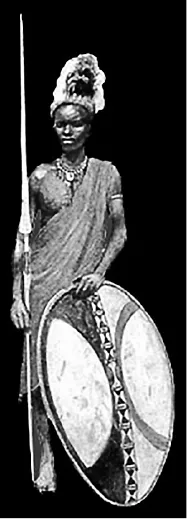
Figure 1.3 A young adult from the Elgon Maasai community along the western Kenyan border in ceremonial gear. He is holding the ceremonial spear and a decorated buffalo hide shield, and he wears special ceremonial headgear.
The Maasai have not always had this variety of spear. Historians and archeologists date its appearance to the mid-twentieth century or perhaps a little earlier. One would be led to believe from this dating that its appearance coincided with the sudden abundance of iron and other metals as a result of building the East African railway lines across Kenya and mainland Tanganyika during this period. Thus, although the Maasai had probably limited the production of spears and other metal-based tools to cultural needs, relative excess of availability of iron—usually obtained in raids on the field depots of the railway-building company—drove many a smith’s imagination to new and innovative styles that became symbols of status in the community. The uses of these aesthetically rather than functionally driven objects became part of the occasional or periodic social gatherings at which individuals showed off what they could afford as a result of their large holdings of cattle.
Maasai culture has been especially exposed to tourist observation as well as commodification, partly due to Maasai territorial habitation of lands that generally border some of Africa’s plains rich in wide-ranging wildlife. Cordoned off as national game-viewing national parks, the status of these vast territories as tourist destinations has exposed Maasai culture to tourists who have to pass through Maasai manyattas (homes or villages) en route to the parks. This exposure and the foreigners’ curiosity that accompanies it has pushed Maasai smiths to produce partly for the relatively lucrative tourist market. This, argues Sidney Littlefield Kasfir (2007), is only one aspect of the constant variation of the Maasai spear design that reflects the generational succession of age groups and the egalitarian set the specific design symbolizes and also distinguishes them by rank (younger or older) from other age groups. Her point applies more to the functional rather than the decorative (Lion) spear. Also, her study analyzes the spear tradition among the Samburu, a more northern (Mount Kenya) group that is also a Maa-speaking group related to the group conventionally referred to as Maasai to the south. For most practically comparative purposes, except in dialect and other details unnoticeable to the outsider, Samburu and Maasai are nearly identical, including in their spear traditions.
The making and social role (age grading) of the spear among the Maa-speaking peoples of East Africa are marks of ideas central to the general concept of innovation related to material culture. Because it is constantly modified to suit the role of symbolizing time and social identity of different age-based subgroups, the Maasai spear evinces innovative imagination across time in the ethnic history of the Maasai. Beyond this, the dynamics in the design appearances and variations evince the presence of communal concurrence following possibly protracted debates on design choices that do not repeat the past. In other words, the process involves a dialogue between individual citizens whose proposals are critically discussed on the way toward a selection that reflects agreement on a communal identity in its transition through time.
But the drawing of the symbols of a collective historical progression is not the only factor that stands out in the example of the Maasai spear stylistics and design. In addition to the imaginations and symbolizations of time, the management of the history of the spear in its relation to the history of the community is built on the sustainability of the process itself. Driven by an endogenous sense of value and of goals, the community marshals available resources, or seeks their supply, in service of their endogenously defined goals. In other words, because the goals are not imposed from the outside, they can be managed—changed, modified—from within the community itself based on the prevailing circumstances and challenges of any time.
It would be misleading to suggest that the view of the spear as depicted thus far is not without its own discontent. Like every tool, the spear or the notion of technology in its general sense is created to reflect a society’s more complex view of value, within which the valuation and focus given to a specific object finds its own position in the complete puzzle of things. Not only am I trying to say here that technology is not amoral, I am also saying that the morals under which a technological implement finds its acceptance are neither necessarily nor always unquestionable. The Maasai, for example, are a male-dominated society in which the image of society is designed to appear through the image of its male members. Women do not handle the spear—something that applies to most spear-wielding communities across the continent—the most important and visible symbol of the community’s public identity. Through an intricately defined curriculum vitae, the male is expected to go through stages that will finally lead him to be proclaimed a moran (warrior) of his community. This is the ultimate goal and image of every Maasai male child; it is the social rank he aspires to. A moran is expected to be fit and fierce, the ultimate protector or defender of the manyatta and finally the entire community. Carrying a spear (for adult males) and a round-headed wooden rungu (club) completes the outward appearance of a Maasai male, and every male child grows up learning and absorbing the values of these characteristics—that they represent the security and integrity of the manyatta and community at large. Their collective duty is to protect their people and their sacred possessions—the cattle. Given the predator-infested nature of their traditional territory, it is the duty of Maasai morans to take their cattle to pastures, and there was a time when killing a lion was part of a boys’ rite of passage to mark entry into adulthood or rank of moran. This resolute sense of identity has made it possible for members of the Maasai community to proudly withstand the influences of newcomers while the unity that it spawns made it possible for the Maasai to ward off any challenges of the more numerous neighboring communities.
By contrast, Maasai women, trusting their sense of safety to the unquestioned loyalty of the men to the integrity and values of their community, need to carry no more than a stick with which to shoo goats or other young domestic animals (sheep, calves, etc.) in a desired direction or to shoo a snake during an undesired encounter. The duties of women include the construction and taking care of the manyatta as well as taking care of other domestic needs, such as fetching water and firewood. As issues related to gender parity or disparity in how access to resources and distribution of roles and responsibility in society have risen and dominated how people analyze and assess social progress as a global discourse, they have influenced an increase in Maasai women’s participation in socially visible activities, including serving in roles that include participation in local and national leadership and in professional fields.
The case of the Maasai serves two purposes here: First, it provides a path to understanding an important aspect of the Maasai’s material culture independently as it relates to innovation understood as a constant modification of tools. Second, it serves as a microwindow for identifying, on a more general and broader scale of development and planning goals, what African governments have persistently failed to appreciate and do—that the everyday person, the ordinary folks, both understand technology and know selectively what kind of technology can be positively incorporated into their value systems. The Maasai, and any or all other peoples or communities who use art or other form of product as markers of specific information in social history and structural arrangements, have shown, as evidenced by the history of their use and constant modification of technology, that they are ...
Table of contents
- Cover
- Title page
- Copyright page
- Dedication
- Table of Contents
- Preface
- Introduction: What Do Science, Technology, and Innovation Mean from Africa?
- 1 The Place of Science and Technology in Our Lives: Making Sense of Possibilities
- 2 The Language of Science, Technology, and Innovation: A Chimurenga Way of Seeing from Dzimbahwe
- 3 The Metalworker, the Potter, and the Pre-European African “Laboratory”
- 4 Plants of Bondage, Limbo Plants, and Liberation Flora: Diasporic Reflections for STS in Africa and Africa in STS
- 5 Smartness from Below: Variations on Technology and Creativity in Contemporary Kinshasa
- 6 On the Politics of Generative Justice: African Traditions and Maker Communities
- 7 Making Mobiles African
- 8 Innovation for Development: Africa
- 9 Science, Technology, and Innovation in Africa: Conceptualizations, Relevance, and Policy Directions
- References
- Contributors
- Index
Trusted by 375,005 students
Access to over 1.5 million titles for a fair monthly price.
Study more efficiently using our study tools.
Frequently asked questions
Yes, you can cancel anytime from the Subscription tab in your account settings on the Perlego website. Your subscription will stay active until the end of your current billing period. Learn how to cancel your subscription
No, books cannot be downloaded as external files, such as PDFs, for use outside of Perlego. However, you can download books within the Perlego app for offline reading on mobile or tablet. Learn how to download books offline
Perlego offers two plans: Essential and Complete
- Essential is ideal for learners and professionals who enjoy exploring a wide range of subjects. Access the Essential Library with 800,000+ trusted titles and best-sellers across business, personal growth, and the humanities. Includes unlimited reading time and Standard Read Aloud voice.
- Complete: Perfect for advanced learners and researchers needing full, unrestricted access. Unlock 1.5M+ books across hundreds of subjects, including academic and specialized titles. The Complete Plan also includes advanced features like Premium Read Aloud and Research Assistant.
We are an online textbook subscription service, where you can get access to an entire online library for less than the price of a single book per month. With over 1.5 million books across 990+ topics, we’ve got you covered! Learn about our mission
Look out for the read-aloud symbol on your next book to see if you can listen to it. The read-aloud tool reads text aloud for you, highlighting the text as it is being read. You can pause it, speed it up and slow it down. Learn more about Read Aloud
Yes! You can use the Perlego app on both iOS and Android devices to read anytime, anywhere — even offline. Perfect for commutes or when you’re on the go.
Please note we cannot support devices running on iOS 13 and Android 7 or earlier. Learn more about using the app
Please note we cannot support devices running on iOS 13 and Android 7 or earlier. Learn more about using the app
Yes, you can access What Do Science, Technology, and Innovation Mean from Africa? by Clapperton Chakanetsa Mavhunga in PDF and/or ePUB format, as well as other popular books in Social Sciences & Sociology. We have over 1.5 million books available in our catalogue for you to explore.