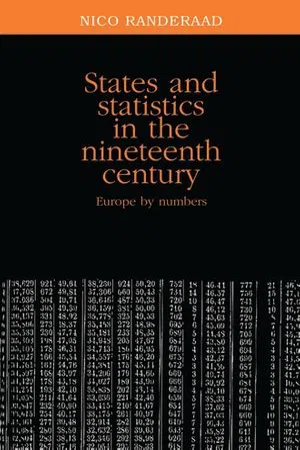
This book is a history of an illusion. It is also a history of the dream that preceded the illusion. The book discusses statistics as the field of tension between the scientific claims of neutrality and universality on the one hand and the political and economic reality of the conflicting interests of nation-states on the other. The various paths of state- and nation-building that European countries traversed in the nineteenth century are recognisable in the objectives of government statistics and are reflected in the topics selected for statistical study and in the categories used in the research. Each congress was clearly dominated by the specific interests of the country in which the statisticians convened. The book shows in each case how the organisation of government statistics and national concerns influenced the international agenda. It describes the perceptions, goals and dilemmas of the protagonists and their contact with each other, and in so doing unravels the complex relationships between science, government and society, wherever possible from their point of view. The genesis of international statistics was inspired by a desire for reform. Belgium's pioneering role in the European statistical movement was informed both by its liberal polity and the special status of statistics within it, and by Adolphe Quetelet's key position as an intellectual. The consolidation of the Grand Duchy of Baden, a new medium-sized state in the Rhine Confederation and later in the German Confederation, offered great opportunities for the development of official statistics.
- 215 pages
- English
- PDF
- Available on iOS & Android
eBook - PDF
States and statistics in the nineteenth century : Europe by numbers
About this book
Information
Subtopic
European HistoryIndex
HistoryTable of contents
- Front matter
- Contents
- Introduction
- The first meeting: Brussels 1853
- All the world’s a stage: Paris 1855
- The expansion of Europe: Vienna 1857
- On waves of passion: London 1860
- The German phoenix: Berlin 1863
- Unbounded nationalism: Florence 1867
- Small gestures in a big world: The Hague 1869
- ‘Sadder and wiser’: St Petersburg 1872 and Budapest 1876
- Afterword
- Bibliography
- Index
Trusted by 375,005 students
Access to over 1.5 million titles for a fair monthly price.
Study more efficiently using our study tools.
Frequently asked questions
Yes, you can cancel anytime from the Subscription tab in your account settings on the Perlego website. Your subscription will stay active until the end of your current billing period. Learn how to cancel your subscription
No, books cannot be downloaded as external files, such as PDFs, for use outside of Perlego. However, you can download books within the Perlego app for offline reading on mobile or tablet. Learn how to download books offline
Perlego offers two plans: Essential and Complete
- Essential is ideal for learners and professionals who enjoy exploring a wide range of subjects. Access the Essential Library with 800,000+ trusted titles and best-sellers across business, personal growth, and the humanities. Includes unlimited reading time and Standard Read Aloud voice.
- Complete: Perfect for advanced learners and researchers needing full, unrestricted access. Unlock 1.5M+ books across hundreds of subjects, including academic and specialized titles. The Complete Plan also includes advanced features like Premium Read Aloud and Research Assistant.
We are an online textbook subscription service, where you can get access to an entire online library for less than the price of a single book per month. With over 1.5 million books across 990+ topics, we’ve got you covered! Learn about our mission
Look out for the read-aloud symbol on your next book to see if you can listen to it. The read-aloud tool reads text aloud for you, highlighting the text as it is being read. You can pause it, speed it up and slow it down. Learn more about Read Aloud
Yes! You can use the Perlego app on both iOS and Android devices to read anytime, anywhere — even offline. Perfect for commutes or when you’re on the go.
Please note we cannot support devices running on iOS 13 and Android 7 or earlier. Learn more about using the app
Please note we cannot support devices running on iOS 13 and Android 7 or earlier. Learn more about using the app
Yes, you can access States and statistics in the nineteenth century : Europe by numbers by Nico Randeraad in PDF and/or ePUB format, as well as other popular books in History & European History. We have over 1.5 million books available in our catalogue for you to explore.