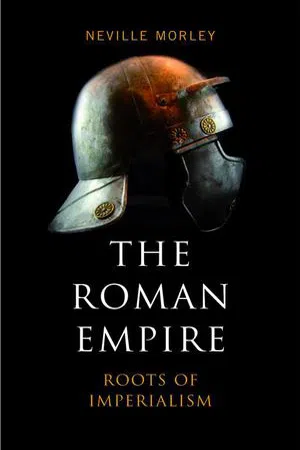
A millennium and a half after the end of the period of its unquestioned dominance, Rome remains a significant presence in western culture. This book explores what the empire meant to its subjects. The idea of Rome has long outlived the physical empire that gave it form, and now holds sway over vastly more people and a far greater geographical area than the Romans ever ruled. It continues to shape our understanding of the nature of imperialism, and thus, however subtly, to influence the workings of the world. Unlike most works on Roman history, this book does not offer a simplistic narrative, with military triumph followed by decline and fall. Instead, it analyses the origins and nature of Roman imperialism, its economic, social and cultural impact on the regions it conquered, and its continuing influence in discussions and debates about modern imperialism.
- English
- ePUB (mobile friendly)
- Available on iOS & Android
eBook - ePub
The Roman Empire : Roots of Imperialism
About this book
Information
Subtopic
Roman Ancient HistoryIndex
History1
‘Carthage Must Be Destroyed’:
The Dynamics of Roman Imperialism
‘Carthage Must Be Destroyed’:
The Dynamics of Roman Imperialism
It is said that Cato contrived to drop a Libyan fig in the middle of the Senate, as he shook out the folds of his toga, and then, as the senators were admiring its size and beauty, said that the country where it grew was only three days’ sailing from Rome. And in one thing he was even more savage, namely, in concluding his opinion on any question whatsoever with the words: ‘In my opinion, Carthage must be destroyed’.
(Plutarch, Life of Cato the Elder, 27.1)
In 149 BCE, the Roman senate despatched an army to Africa: the city of Carthage had broken the terms of the peace treaty it had signed 60 years earlier, by starting a war with the neighbouring kingdom of Numidia without Roman permission, and therefore had to be punished.1 The Carthaginians, having failed to persuade the senate of the justice of their grievances against the Numidians (having, indeed, endured 60-odd years of unprovoked harassment, with Rome almost invariably deciding against them whenever they complained), sought to avert catastrophe by committing themselves to the faith of the Romans, an unconditional surrender of their whole territory and population. Their ambassadors were told that the proposal was acceptable, and that the Carthaginians would be granted their freedom and the possession of their whole territory, provided that they handed over 300 hostages, the sons of leading citizens, and obeyed the orders of the consuls who were commanding the army. Those unspecified orders, it transpired, were firstly to hand over all the weapons in the city; when that had been done, the Carthaginians were then ordered to abandon their city and establish a new settlement, at least ten miles from the sea.
The motive for this was transparent, as was made clear in the speech that the Greek historian Appian placed in the mouth of the Roman general: the absolute destruction of Carthage and the basis of its historic power.
If we were addressing you as enemies, people of Carthage, it would be necessary only to speak and then use force, but since this is a matter of the common good (somewhat of our own, and still more of yours), I have no objection to giving you the reasons, if you may thus be persuaded instead of being coerced. The sea reminds you of the dominion and power you once acquired by means of it. It prompts you to wrong-doing, and brings you to grief. By means of the sea you invaded Sicily and lost it again. Then you invaded Spain and were driven out of it. While a treaty was in force you plundered merchants on the sea, and ours especially, and in order to conceal the crime you threw them overboard, until finally you were caught at it and then gave us Sardinia by way of penalty. Thus you lost Sardinia also by means of this sea, which always begets a grasping disposition by the very facilities which it offers for gain. (Appian, The Punic Wars, 86)
As Appian certainly assumed his readers knew, a Carthaginian or a Greek would have offered a very different account of the events of the previous century and a half. The two earlier Punic Wars between Rome and Carthage, 264–241 BCE and 218–201 BCE, could equally well be seen as the inevitable result of two major powers coming into direct contact with one another, each fearing the other. The first war broke out after a group of mercenaries seized control of Messana in Sicily, and appealed to both Rome and Carthage for assistance against the attempts of the powerful city of Syracuse to re-take it; the Carthaginians responded promptly by installing a garrison in Messana, whereupon the Romans feared that Carthaginian dominance of Sicily might threaten their own hegemony in Italy and belatedly decided to send their own forces. In Roman accounts, this was a purely defensive move, in response to a request for help; the eventual acquisition of Sicily and Sardinia as overseas territories was more or less an accidental outcome of their concern to defend justice and protect their own rights. A Carthaginian would have emphasised the way in which the upstart Italian power was clearly seeking to extend its reach into areas that were traditionally part of their own sphere of influence in the western Mediterranean, inciting proxy wars and finding pretexts for military intervention.
The outbreak of the Second Punic War offers an example. Carthage was above all a naval power, founded by the Phoenicians whose ships had traded across the Mediterranean for centuries; it sought to establish colonies in regions, such as southern Spain, which could supply timber and metal for its ships. During the uneasy peace after 241 BCE, it increased its hold on this area. The Roman response to the threat of a revival in their rival’s power was initially to make an agreement that the Carthaginians would remain south of the river Ebro; then, in the late 220s BCE, they established a relationship with the town of Saguntum, in the heart of that territory. With the promise of Roman protection, the Saguntines seized the opportunity to attack a neighbouring community and were punished by Hannibal, whereupon the Romans issued a blanket ultimatum: hand over the general or face war. The immediate consequences were disastrous for Rome, as Hannibal crossed the Alps and defeated a series of Roman generals in Italy, but the conclusion of the war was the reduction of Carthage from a world power to a minor state, forbidden to make war without Roman permission and required to pay a hefty indemnity to Rome for 60 years, while Rome added Spain to its overseas territories and now enjoyed undisputed mastery of the western Mediterranean.
Carthage remained a prosperous city, with rich agricultural resources and thriving trade connections; some Romans became convinced that, despite the loss of its empire, it would always be a threat to their security. According to the contemporary Greek historian Polybius (36.2), they simply waited for a suitable pretext that would persuade other nations that they acted honourably; the Carthaginians’ breach of the treaty conditions presented the opportunity to destroy their naval capacity, the basis of their old empire and of the future empire that the Romans feared or professed to fear, once and for all. Faced with the prospect of having their city destroyed in order to save it from itself, the Carthaginian response to the ultimatum was to fight; despite having given up their weapons, they successfully resisted the Roman army until 146 BCE. By then, the majority of the population had died of starvation or in battle; the remainder – numbers are notoriously unreliable in ancient sources, but the figure of 50,000 is cited – were sold into slavery, as was customary. The city burned for days and was then abandoned. The story that the fields were then sown with salt, to destroy their fertility and prevent anyone from living there, is a fabrication first encountered in the nineteenth century; the Romans, rather more practically, declared the territory to be public land, redistributed it to a mixture of local farmers and Italian settlers, and established it as the new province of Africa, paying a regular tribute to Rome.2
APPROACHING ROMAN IMPERIALISM
The Third Punic War was one of many fought by Rome in the course of its rise to the status of a world empire, from the conquest of its immediate neighbour Veii in 396 BCE, through the subjugation of the rival empires of Carthage, Macedon (168 BCE), Syria (63 BCE) and Egypt (30 BCE), to the invasion of Britain in 43 CE. While not every war resulted in the expansion of its power, let alone in the acquisition of new territory, the long-term trend was unmistakable. The obvious line of investigation is the nature of this persistent aggression and drive to conquer, the origins and dynamics of Roman imperialism. Surprisingly, however, a number of objections have been raised to thinking about the subject in these terms.
There is no Latin equivalent of ‘imperialism’.3 The word imperium, from which both ‘imperialism’ and ‘empire’ derive, referred originally to the power possessed by a Roman magistrate to command and expect obedience. It came, in time, to be extended to the power of the Roman people as a whole and then to that of the emperor, and took on a further meaning as the area within which Rome expected to exert its dominance without any opposition: its empire. However, the development of ideas about the nature of Rome’s overseas dominions followed long after they had actually been acquired, rather than preceding or influencing the process of conquest and annexation. Even in retrospect, Roman authors did not conceive of their city’s rise to dominance as the result of a policy, let alone as the result of greed or ambition, but rather as the reward of virtue and wise decision-making, along with the favour of the gods and the occasional piece of good fortune.4 According to Cicero, Rome fought only just wars undertaken in the face of provocation and in defence of its safety or its honour (for example, defending one of its allies), having always first offered the enemy an opportunity to make reparations instead. The acquisition of an empire was simply the result of Roman success in such virtuous endeavours, from its dominance of the league of local powers in Latium in the fourth century and triumph over Carthage in the third, to the acquisition of vast domains in Gaul and the eastern Mediterranean thereafter: ‘our people, by defending their allies, have gained dominion over the whole world’ (Republic, II.34).
The absence of any Roman term for a policy or ideology of expansion persuaded some modern historians to take such self-serving claims, and the rituals which the Romans undertook before a formal declaration of war – above all, the issuing of a non-negotiable ultimatum – entirely at face value.5 Roman behaviour was thus characterised as ‘defensive imperialism’, a view which also allowed Rome to be taken as a positive model and justification for empire-building. In sixteenth-century Spanish debates about the justice of the conquests in America, ‘the example of the Romans, whose rule over other peoples was just and legitimate’ was cited regularly in defence of Spanish imperialism, and this argument rested on the assertion that Rome had expanded ‘by taking over by law of war the cities and provinces of enemies from whom they had received an injury’.6 Centuries later, the Earl of Cromer, identifying various analogies between the Roman and British empires, noted:
That in proceeding from conquest to conquest each step in advance was in ancient, as it has been in modern, times accompanied by misgivings, and was often taken with a reluctance that was by no means feigned; that Rome, equally with the modern expansive powers, more especially Great Britain and Russia, was impelled onwards by the imperious and irresistible necessity of acquiring defensible frontiers; that the public opinion of the world scoffed 2,000 years ago, as it does now, at the alleged necessity; and that each onward move was attributed to an insatiable lust for extended dominion.7
Because Roman imperialism had, according to unimpeachable ancient sources, been defensive and reasonable, it was entirely credible to ignore the criticism and to believe that British imperialism might be the same.
Although few historians would now hold the view that Roman wars were invariably or even frequently defensive, the use of the term ‘imperialism’ in the analysis of Roman expansion remains controversial; it may be mentioned only to be rejected, or omitted altogether, even if the author is happy to attribute less than noble motives to the Romans.8 The reasons for this vary and are not always stated. Some historians understand ‘imperialism’ strictly as an ideology of expansionism that must be consciously held and explicitly proclaimed by the conquering state, conditions which clearly did not apply to Rome. For others, the modern connotations of the term, pejorative and highly political, imply that its application to the ancient world will inevitably result in anachronism. There is a long-standing tradition in ancient history of rejecting all modern concepts and theories as misleading, claiming that they force the reality of the past into conformity with modern assumptions and expectations, and ignore its specificity and detail in favour of broad generalisations.9 To think about Roman history in terms of ‘imperialism’ is, according to this argument, to see it solely in terms of the dynamics of modern empires, driven by capitalist over-accumulation, or nationalism and racism, or competition between modern states. Rather, we should focus on the detail of events – the reasons why the Romans went to war in individual cases and the outcomes of those wars – without any suggestion that this was a coherent or directed process and without recourse to modern concepts.
If, therefore, we hope to understand the groping, stumbling, accidental expansion of Rome, we must rid ourselves of anachronistic generalizations and ‘remote causes’ and look instead for the specific accidents that led the nation unwittingly from one contest to another until, to her own surprise, Rome was mistress of the Mediterranean.10
The flaws in such arguments are obvious. The fact that Roman expansionism was not an explicit policy clearly does not mean that the growth of the empire was entirely accidental; on the contrary, the fact that the Romans consistently failed to get on with their neighbours, and as a result steadily accumulated more territory, suggests that it was anything but. Doing away with modern terms of analysis does not enable historians to escape from the way that, consciously or subconsciously, their interpretations are inevitably shaped by contemporary conceptions and concerns. It is certainly the case that ‘imperialism’ has political connotations, generally but not invariably negative, and that applying the term to Rome is intended to establish links between past and present – but an insistence on avoiding the word, refusing to draw any connections between comparable historical events and denying the existence of the phenomenon can be equally political, offering an alibi for Roman imperialism and for imperialism in general. The idea of an ‘accidental’ empire, acquired ‘in a fit of absence of mind’ or as the entirely unforeseen consequence of entirely reasonable actions, was just as useful to apologists for the British Empire as the idea of an empire acquired in justifiable self-defence.11
The Roman Empire was founded upon military considerations… This does not mean that their Empire was purely the outcome of deliberate conquest and annexation on a preconceived plan. They were drawn on in the path of Empire, as we have been drawn on, by force of circumstances.12
At the same time, of course, there are certainly risks in taking too simplistic or monolithic a view of ‘imperialism’, obscuring all historical difference; in many important respects, the process of Roman expansion was significantly different from that of the Spanish or British, or late-twentieth-century United States hegemony. This may be a concern not only for historians but also for studies of contemporary imperialism. Writers in the Marxist tradition have long been aware of the dangers of understanding ‘imperialism’ in excessively general, transhistorical terms, as a ‘policy of conquest in general’, defined above all by its past historical manifestations and thus obscuring the specific nature, roots and dynamics of the modern phenomenon. As Nikolai Bukharin argued,
From this point of view one can speak with equal right of Alexander the Macedonian’s and the Spanish conquerors’ imperialism, of the imperialism of Carthage and Ivan III, of ancient Rome and modern America, of Napoleon and Hindenburg. Simple as this theory may be, it is absolutely untrue. It is untrue because it ‘explains’ everything, i.e. it explains absolutely nothing!13
‘Publicists and scholars attempt to paint modern imperialism as something akin to the policies of the heroes of antiquity with their “imperium”’, ignoring the fundamental differences between ancient slave society and modern capitalism.14 The theory of imperialism developed by J.A. Schumpeter, which sees it as an atavistic survival of the aggression and lust for conquest of primitive warrior states, exemplifies one of the problems with this approach by obscuring the connection between modern economic structures and modern imperialism.15 Another is the pseudo-Darwinian idea that aggression and the drive to maximise reproductive opportunities, resulting in empire, are universal traits of human behaviour and hence can never be changed.16 However, the solution is not to restrict the term ‘imperialism’ to a specific and strictly modern phenomenon, but rather to strike a balance between sameness and difference, with regard both to the variations between different historical imperialisms and to the contexts within which they developed. Lenin’s account of imperialism, for all its indebtedness to Bukharin, offers a more moderate line in this regard:
Colonial policy and imperialism existed before this latest stage of capitalism, and even before capitalism. Rome, founded on slavery, pursued a colonial policy and practised imperialism. But ‘general’ disquisitions on imperialism, which ignore, or put into the background, the fundamental difference between social-economic systems, inevitably degenerate into the most vapid banality or bragging, like the comparison ‘Greater Rome and Greater Britain’.17
Similarly, understanding the overall process of Roman expansion is a matter of balancing generalisations with specifics: drawing on modern theories as a source of ideas about how societies work and therefore how the ancient evidence might (rather than must) be interpreted, and modifying the understanding of ‘imperialism’ as a more general historical phenomenon in the light of the Roman experience.
The study of Roman imperialism seeks to identify patterns and consistencies in the mass of detail and individual events, and to evaluate their significance. Inevitably it involves questions of how far, and in what respect, a particular episode might be seen as typical or representative. The events of the Third Punic War, for example, fit very poorly with the idea that Roman imperialism was defensive, but they are also difficult to reconcile with any theory that sees Roman expansion as fully rational; on the contrary, the main motive (epitomised by Cato’s fig-dropping performance) appears to be an entirely irrational fear and hatred of the old enemy Carthage, even after it had been thoroughly defeated and stripped of any significant power. The episode might, then, be seen as an aberration (and the choice of it as the opening example for this chapter regarded as tendentious, designed to present the Roman Em...
Table of contents
- Cover
- Title Page
- Copyright
- Dedication
- Contents
- Acknowledgements
- Timeline
- Introduction: ‘Empire Without End’
- 1 ‘Carthage Must Be Destroyed’: The Dynamics of Roman Imperialism
- 2 ‘They Make a Desert and Call it Peace’: The Nature of Roman Rule
- 3 ‘The Emporium of the World’: The Economic Impact of Empire
- 4 ‘They Called it “Civilisation”’: The Dynamics of Cultural Change
- Envoi: ‘Decline and Fall’
- Further Reading
- Notes
- Index
Trusted by 375,005 students
Access to over 1.5 million titles for a fair monthly price.
Study more efficiently using our study tools.
Frequently asked questions
Yes, you can cancel anytime from the Subscription tab in your account settings on the Perlego website. Your subscription will stay active until the end of your current billing period. Learn how to cancel your subscription
No, books cannot be downloaded as external files, such as PDFs, for use outside of Perlego. However, you can download books within the Perlego app for offline reading on mobile or tablet. Learn how to download books offline
Perlego offers two plans: Essential and Complete
- Essential is ideal for learners and professionals who enjoy exploring a wide range of subjects. Access the Essential Library with 800,000+ trusted titles and best-sellers across business, personal growth, and the humanities. Includes unlimited reading time and Standard Read Aloud voice.
- Complete: Perfect for advanced learners and researchers needing full, unrestricted access. Unlock 1.5M+ books across hundreds of subjects, including academic and specialized titles. The Complete Plan also includes advanced features like Premium Read Aloud and Research Assistant.
We are an online textbook subscription service, where you can get access to an entire online library for less than the price of a single book per month. With over 1.5 million books across 990+ topics, we’ve got you covered! Learn about our mission
Look out for the read-aloud symbol on your next book to see if you can listen to it. The read-aloud tool reads text aloud for you, highlighting the text as it is being read. You can pause it, speed it up and slow it down. Learn more about Read Aloud
Yes! You can use the Perlego app on both iOS and Android devices to read anytime, anywhere — even offline. Perfect for commutes or when you’re on the go.
Please note we cannot support devices running on iOS 13 and Android 7 or earlier. Learn more about using the app
Please note we cannot support devices running on iOS 13 and Android 7 or earlier. Learn more about using the app
Yes, you can access The Roman Empire : Roots of Imperialism by Neville Morley in PDF and/or ePUB format, as well as other popular books in History & Roman Ancient History. We have over 1.5 million books available in our catalogue for you to explore.