The Silence
eBook - ePub

The Silence

A Novel

  1. 128 pages
  2. English
  3. ePUB (mobile friendly)
  4. Available on iOS & Android
eBook - ePub

The Silence

A Novel

About this book

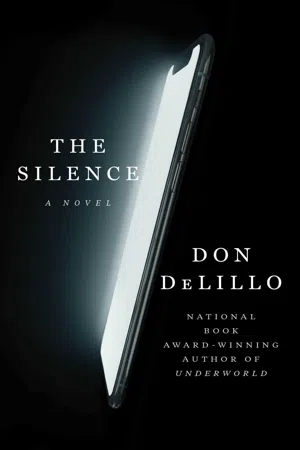
From the National Book Award–winning author of Underworld, a “daring…provocative…exquisite” (The Washington Post) novel about five people gathered together in a Manhattan apartment, in the midst of a catastrophic event.

It is Super Bowl Sunday in the year 2022. Five people, dinner, an apartment on the east side of Manhattan. The retired physics professor and her husband and her former student waiting for the couple who will join them from what becomes a dramatic flight from Paris. The conversation ranges from a survey telescope in North-central Chile to a favorite brand of bourbon to Einstein’s 1912 Manuscript on the Special Theory of Relativity.

Then something happens and the digital connections that have transformed our lives are severed.

What follows is a “brilliant and astonishing…masterpiece” (Chicago Tribune) about what makes us human. Don DeLillo completed this novel just weeks before the advent of the Covid pandemic. His language, the dazzle of his sentences offer a kind of solace in our bewildering world. “DeLillo’s shrewd, darkly comic observations about the extravagance and alienation of contemporary life can still slice like a scalpel” (Entertainment Weekly).

“In this wry and cutting meditation on collective loss, a rupture severs us, suddenly, from everything we’ve come to rely on. The Silence seems to absorb DeLillo’s entire body of work and sand it into stone or crystal.” —Rachel Kushner
Frequently asked questions

Yes, you can cancel anytime from the Subscription tab in your account settings on the Perlego website. Your subscription will stay active until the end of your current billing period. Learn how to cancel your subscription.
At the moment all of our mobile-responsive ePub books are available to download via the app. Most of our PDFs are also available to download and we're working on making the final remaining ones downloadable now. Learn more here.
Perlego offers two plans: Essential and Complete
  • Essential is ideal for learners and professionals who enjoy exploring a wide range of subjects. Access the Essential Library with 800,000+ trusted titles and best-sellers across business, personal growth, and the humanities. Includes unlimited reading time and Standard Read Aloud voice.
  • Complete: Perfect for advanced learners and researchers needing full, unrestricted access. Unlock 1.4M+ books across hundreds of subjects, including academic and specialized titles. The Complete Plan also includes advanced features like Premium Read Aloud and Research Assistant.
Both plans are available with monthly, semester, or annual billing cycles.
We are an online textbook subscription service, where you can get access to an entire online library for less than the price of a single book per month. With over 1 million books across 1000+ topics, we’ve got you covered! Learn more here.
Look out for the read-aloud symbol on your next book to see if you can listen to it. The read-aloud tool reads text aloud for you, highlighting the text as it is being read. You can pause it, speed it up and slow it down. Learn more here.
Yes! You can use the Perlego app on both iOS or Android devices to read anytime, anywhere — even offline. Perfect for commutes or when you’re on the go.
Please note we cannot support devices running on iOS 13 and Android 7 or earlier. Learn more about using the app.
Yes, you can access The Silence by Don DeLillo in PDF and/or ePUB format, as well as other popular books in Literature & Literature General. We have over one million books available in our catalogue for you to explore.

Information

Publisher
Scribner
Year
2020
Print ISBN
9781982164560
eBook ISBN
9781982164577

PART ONE

-1-

Words, sentences, numbers, distance to destination.

The man touched the button and his seat moved from its upright position. He found himself staring up at the nearest of the small screens located just below the overhead bin, words and numbers changing with the progress of the flight. Altitude, air temperature, speed, time of arrival. He wanted to sleep but kept on looking.
Heure Ć  Paris. Heure Ć  London.
ā€œLook,ā€ he said, and the woman nodded faintly but kept on writing in a little blue notebook.
He began to recite the words and numbers aloud because it made no sense, it had no effect, if he simply noted the changing details only to lose each one instantly in the twin drones of mind and aircraft.
ā€œOkay. Altitude thirty-three thousand and two feet. Nice and precise,ā€ he said. ā€œTempĆ©rature extĆ©rieure minus fifty-eight C.ā€
He paused, waiting for her to say Celsius, but she looked at the notebook on the tray table in front of her and then thought a while before continuing to write.
ā€œOkay. Time in New York twelve fifty-five. Doesn’t say a.m. or p.m. Not that we have to be told.ā€
Sleep was the point. He needed to sleep. But the words and numbers kept coming.
ā€œArrival time sixteen thirty-two. Speed four seventy-one m.p.h. Time to destination three thirty-four.ā€
ā€œI’m thinking back to the main course,ā€ she said. ā€œI’m also thinking about the champagne with cranberry juice.ā€
ā€œBut you didn’t order it.ā€
ā€œSeemed pretentious. But I’m looking forward to the scones later in the flight.ā€
She was talking and writing simultaneously.
ā€œI like to pronounce the word properly,ā€ she said. ā€œAn abbreviated letter o. As in scot or trot. Or is it scone as in moan?ā€
He was watching her write. Was she writing what she was saying, what they were both saying?
She said, ā€œCelsius. Cap C. It was someone’s name. Can’t recall his first name.ā€
ā€œOkay. What about vitesse. What does vitesse mean?ā€
ā€œI’m thinking about Celsius and his work on the centigrade measurement.ā€
ā€œThen there’s Fahrenheit.ā€
ā€œHim too.ā€
ā€œWhat does vitesse mean?ā€
ā€œWhat?ā€
ā€œVitesse.ā€
ā€œVitesse. Speed,ā€ she said.
ā€œVitesse. Seven hundred forty-eight k per hour.ā€
His name was Jim Kripps. But for all the hours of this flight, his name was his seat number. This was the rooted procedure, his own, in accordance with the number stamped on his boarding pass.
ā€œHe was Swedish,ā€ she said.
ā€œWho?ā€
ā€œMr. Celsius.ā€
ā€œDid you sneak a look at your phone?ā€
ā€œYou know how these things happen.ā€
ā€œThey come swimming out of deep memory. And when the man’s first name comes your way, I will begin to feel the pressure.ā€
ā€œWhat pressure?ā€
ā€œTo produce Mr. Fahrenheit’s first name.ā€
She said, ā€œGo back to your sky-high screen.ā€
ā€œThis flight. All the long flights. All the hours. Deeper than boredom.ā€
ā€œActivate your tablet. Watch a movie.ā€
ā€œI feel like talking. No headphone. We both feel like talking.ā€
ā€œNo earbuds,ā€ she said. ā€œTalk and write.ā€
She was Jim’s wife, dark-skinned, Tessa Berens, Caribbean-European-Asian origins, a poet whose work appeared often in literary journals. She also spent time, online, as an editor with an advisory group that answered questions from subscribers on subjects ranging from hearing loss to bodily equilibrium to dementia.
Here, in the air, much of what the couple said to each other seemed to be a function of some automated process, remarks generated by the nature of airline travel itself. None of the ramblings of people in rooms, in restaurants, where major motion is stilled by gravity, talk free-floating. All these hours over oceans or vast landmasses, sentences trimmed, sort of self-encased, passengers, pilots, cabin attendants, every word forgotten the moment the plane sets down on the tarmac and begins to taxi endlessly toward an unoccupied jetway.
He alone would remember some of it, he thought, middle of the night, in bed, images of sleeping people bundled into airline blankets, looking dead, the tall attendant asking if she could refill his wineglass, flight ending, seatbelt sign going off, the sense of release, passengers standing in the aisles, waiting, attendants at the exit, all their thank-yous and nodding heads, the million-mile smiles.
ā€œFind a movie. Watch a movie.ā€
ā€œI’m too sleepy. Distance to destination, one thousand six hundred and one miles. Time in London eighteen o four. Speed four hundred sixty-five m.p.h. I’m reading whatever appears. DurĆ©e du vol three forty-five.ā€
She said, ā€œWhat time is the game?ā€
ā€œSix-thirty kickoff.ā€
ā€œDo we get home in time?ā€
ā€œDidn’t I read it off the screen? Arrival time whatever whatever.ā€
ā€œWe land in Newark, don’t forget.ā€
The game. In another life she might be interested. The flight. She wanted to be where she was going without this intermediate episode. Does anyone like long flights? She clearly was not anyone.
ā€œHeure Ć  Paris nineteen o eight,ā€ he said. ā€œHeure Ć  London eighteen o eight. Speed four hundred sixty-three m.p.h. We just lost two miles per hour.ā€
ā€œOkay I’ll tell you what I’m writing. Simple. Some of the things we saw.ā€
ā€œIn what language?ā€
ā€œElementary English. The cow jumped over the moon.ā€
ā€œWe have pamphlets, booklets, entire volumes.ā€
ā€œI need to see it in my handwriting, perhaps twenty years from now, if I’m still alive, and find some missing element, something I don’t see right now, if we’re all still alive, twenty years, ten years.ā€
ā€œFilling time. There’s also that.ā€
ā€œFilling time. Being boring. Living life.ā€
ā€œOkay. TempĆ©rature extĆ©rieure minus fifty-seven F,ā€ he said. ā€œI’m doing my best to pronounce elementary French. Distance to destination one thousand five hundred seventy-eight miles. We should have contacted the car service.ā€
ā€œWe’ll jump in a taxi.ā€
ā€œAll these people, a flight like this. They have cars waiting. The huge scramble at the exits. They know exactly where to go.ā€
ā€œThey checked their baggage, most of them, some of them. We did not. Our advantage.ā€
ā€œTime in London eighteen eleven. Arrival time sixteen thirty-two. That was the last arrival time. Reassuring, I guess. Time in Paris nineteen eleven. Altitude thirty-three thousand and three feet. DurĆ©e du vol three sixteen.ā€
Saying the words and numbers, speaking, detailing, allowed these indicators to live a while, officially noted, or voluntarily noted—the audible scan, he thought, of where and when.
She said, ā€œClose your eyes.ā€
ā€œOkay. Speed four hundred seventy-six miles per hour. Time to destination.ā€
She was right, let’s not check our bags, we can squeeze them into the overhead. He watched the screen and thought about the game, briefly, forgetting who the Titans were playing.
Arrival time sixteen thirty. TempƩrature extƩrieure minus forty-seven C. Time in Paris twenty thirteen. Altitude thirty-four thousand and two feet. He liked the two feet. Definitely worth noting. Outside air temperature minus fifty-three F. Distance de parcours.
The Seahawks, of course.
Kripps was a tall man’s name and he was tall, yes, but noncommittally so, and had no trouble meeting his need to be nondescript. He was not a proud head bobbing above a crowd but a hunched figure blessed by anonymity.
Then he thought back to the boarding process, all passengers seated finally, meal soon to appear, warm wet towels for the hands, toothbrush, toothpaste, socks, water bottle, pillow to go with the blanket.
Did he feel an element of shame in the presence of these features? They’d decided to fly business class despite the expense because the cramped space in tourist on a long flight was a challenge they wanted to avoid this one time.
Eye mask, face moisturizer, the cart with wines and liquors that an attendant pushes along the aisle now and then.
He watched the dangling screen and what he felt was the nudge of dumb indulgence. He thought of himself as strictly tourist. Planes, trains, restaurants. He never wanted to be well-dressed. It seemed the handiwork of a fraudulent second self. Man in the mirror, how impressed he is by the trimness of his image.
ā€œWhich was the rainy day?ā€ she said.
ā€œYou’re noting the rainy day in your book of memories. The rainy day, immortalized. The whole point of a holiday is to live it outstandingly. You’ve said this to me. To keep the high points in mind, the vivid moments and hours. The long walks, the great meals, the wine bars, the nightlife.ā€
He wasn’t listening to what he was saying because he knew it was stale air.
ā€œJardin du Luxembourg, Ile de la CitĆ©, Notre-Dame, crippled but living. Centre Pompidou. I still have the ticket stub.ā€
ā€œI need to know the rainy day. It’s a question of looking at the notes years from now and seeing the precision, the detail.ā€
ā€œYou can’t help yourself.ā€
ā€œI don’t want to help myself,ā€ she said. ā€œAll I want to do is get home and look at a blank wall.ā€
ā€œTime to destination one hour twenty-six. I’ll tell you what I can’t remember. The name of this airline. Two weeks ago, starting out, different airline, no bilingual screen.ā€
ā€œBut you’re happy about the screen. You like your screen.ā€
ā€œIt helps me hide from the noise.ā€
Everything predetermined, a long flight, what we think and say, our immersion in a single sustained overtone, the engine roar, how we accept the need to accommodate it, keep it tolerable even if it isn’t.
A seat that adapts to the passenger’s wish for a massage.
ā€œSpeaking of remember. I remember now,ā€ she said.
ā€œWhat...

Table of contents

  1. Cover
  2. Title Page
  3. Dedication
  4. Epigraph
  5. Part One
  6. Part Two
  7. ā€œMan at the Windowā€ Essay
  8. About the Author
  9. Copyright