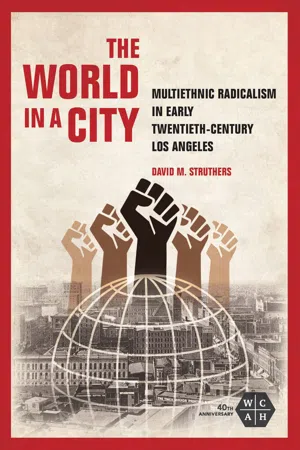
David M. Struthers draws on the anarchist concept of affinity to explore the radicalism of Los Angeles's interracial working class from 1900 to 1930. Uneven economic development created precarious employment and living conditions for laborers. The resulting worker mobility led to coalitions that, inevitably, remained short lived. As Struthers shows, affinity helps us understand how individual cooperative actions shaped and reshaped these alliances. It also reveals social practices of resistance that are often too unstructured or episodic for historians to capture. What emerges is an untold history of Los Angeles and a revolutionary movement that, through myriad successes and failures, produced powerful examples of racial cooperation.
eBook - ePub
The World in a City
Multiethnic Radicalism in Early Twentieth-Century Los Angeles
- English
- ePUB (mobile friendly)
- Available on iOS & Android
eBook - ePub
About this book
A massive population shift transformed Los Angeles in the first decades of the twentieth century. Americans from across the country relocated to the city even as an unprecedented transnational migration brought people from Asia, Europe, and Mexico. Together, these newcomers forged a multiethnic alliance of anarchists, labor unions, and leftists dedicated to challenging capitalism, racism, and often the state.
Trusted by 375,005 students
Access to over 1.5 million titles for a fair monthly price.
Study more efficiently using our study tools.
Information
Publisher
University of Illinois PressYear
2019Print ISBN
9780252084256
9780252042478
eBook ISBN
9780252051319
CHAPTER 1
ECONOMIC DEVELOPMENT, IMMIGRATION, AND THE “LABORS OF EXPROPRIATION”
Aurelio Vincente Azuara left his native Spain in 1907 at age twenty-two for Mexico before relocating to the United States in 1912 through El Paso, Texas. Unable to find work in the border town, he joined a construction and piling crew for the Santa Fe Railroad near San Bernardino, California, through a labor contractor. He earned $1.50 per day for up to twelve hours of work. Typifying the power of construction companies and railroads over workers in rural areas, his employer forced him to return 75¢ for each day’s room and board. He quit after a short time and remembered being “given a slip of paper telling me that I could go to San Bernardino to the road master’s office to get my pay.” He walked the eighteen miles back to San Bernardino. Once in town he waited for three days to collect $5, upon which he reflected, “I don’t suppose that the road master realized that I could not live on hopes waiting.”
From there Vincente Azuara made his way sixty miles west to Los Angeles. He recalled: “I worked around in the suburbs of the city and I [have] been able to find work in a construction camp. They were paving some kind of highway, that were [sic] going from Los Angeles to San Fernando.” His foreman fired him after a few months because he had too many workers for the job. Vincente Azuara stayed in Los Angeles, where he “was able to wander around the city” finding work. He remembered that “you have to walk all around the town to put a couple of days work sometimes, in some construction building or in paving the street or working on the Edison Company and the gas, on the pipe line.” Vincente Azuara remembered railcars of Mexican workers arriving in Los Angeles, supposedly to work on the tracks, but contractors brought more workers than needed for any given project. He stated simply that these people supplied “the agricultural need” for cheap labor. Eventually he signed on to work in the Alaska canning industry through another labor contractor. He worked one season processing salmon before returning to Los Angeles through San Francisco. Vincente Azuara joined the Industrial Workers of the World in California in the fall of 1913.1
The rural economy in California developed in advance of Los Angeles’s economy, where urban economic growth, especially in the manufacturing sector, occurred slowly until the 1920s. This condition combined with the seasonal nature of agricultural work to produce a set of labor patterns typified by urban–rural and rural–rural movement. The rural economy relied on a similar labor pool as the urban economy, and workers moved through the region, often facilitated by labor contractors. Labor diverse in kind and location typified much of rural and urban employment. Two Anglo AFL leaders in the state understood that, from agricultural labor and canning to the “cutting of timber or logging, building of railways and canals, doing the thousand and one kinds of work now usually designated as ‘unskilled,’ means going from place to place, it means going where the work is being done.”2
Writing about the rise of capitalism in the Atlantic world during the seventeenth and eighteenth centuries, Peter Linebaugh and Marcus Rediker argued that historians have failed to properly conceptualize or appreciate the labor required to create capitalist infrastructure: “Expropriation itself, for example, is treated as a given: the field is there before the plowing starts; the city is there before the laborer begins the working day. Likewise for long-distance trade: the port is there before the ship sets sail from it; the plantation is there before the slave cultivates the land.” They characterized this work as the “labors of expropriation” and this type of infrastructure development occupied many regional laborers.3 In settler colonial societies it is also crucial to recognize the connected process of indigenous removal.
California had been inhabited by around 150,000 Native Americans in 1846, four years before its accession to statehood. This population plummeted to thirty thousand in 1870. The next census in 1880 counted only 16,277 Native Americans. A combination of causes brought about this catastrophe: “Diseases, dislocation, and starvation were important causes of these many deaths. However, abduction, de jure and de facto unfree labor, mass death in forced confinement on reservations, homicides, battles, and massacres also took thousands of lives and hindered reproduction.”4 Scholars use terms like “erasure,” “elimination,” and “eliminatory options” to describe the force of this process. In Los Angeles, incarceration was one of many eliminatory options, and the penal infrastructure created for indigenous people seamlessly transitioned to caging multiracial itinerate workers with fluctuating employment that predominated by the late nineteenth century.5
Across the state multiracial immigrant workers completed the necessary labor for capitalist economic growth and then worked for wages in the new industries made possible through their labor in these spaces of indigenous removal. They worked first to change the environment and create infrastructure to suit the needs of capital and then they transitioned to laboring within this new terrain. To create the rural economy, workers moved earth, often with hand tools, to control water, erecting dams, levees, and aqueducts. They cleared fields, built roads, and even slaughtered thousands of rabbits for capitalist development.6 For urban growth in Los Angeles, workers constructed the harbor, installed gas and water pipelines, and strung electric lines. They also created transportation infrastructure. Roads, local passenger rail, and long-distance connections provided the foundation for commercial expansion in Los Angeles and the region.
During this ongoing process laborers commonly moved between jobs that resulted from earlier work, such as in the fields of an industrial agricultural harvest and new infrastructure projects. Taken together, economic development and regional work patterns reflected the uneven geographical development of capitalism in the U.S. Southwest and Mexico during the late nineteenth and early twentieth centuries. As workers built the structural foundation for capitalist development, the labor processes of economic expansion brought Aurelio Vincente Azuara and hundreds of thousands of other workers from around the world into a vibrant cosmopolitan milieu.
Economic Development
As the United States expanded its national boundaries through military conquest and enforced its racialized vision as a settler society during the nineteenth century, it opened land to new forms of economic activity. Corporate actors focused on resource extraction, and transportation drove economic development in this space of American conquest. Additionally, many corporations spanned the Canadian and Mexican national borders through their investments, ownership, and labor recruiting. Cross-border business practices helped shape the United States, Mexico, and Canada into a coherent transnational space for capitalists during the late nineteenth century. Companies such as Anaconda Copper in Montana, Weyerhaeuser timber in the Pacific Northwest, Claus Spreckels’s Western Beet Sugar Company in California and Hawaii, Miller & Lux in California, Oregon, and Nevada, the Canadian Pacific Railway Company, the Southern Pacific Railroad, and Phelps Dodge’s cross-border mining interests in Arizona and Sonora, Mexico, led the way in developing a set of modern business practices to maximize profit in the region. These corporations made large-scale land acquisitions, then organized and transported laborers from across the region to mitigate environmental risks and create value from their holdings.7
Western business practices were well established decades before the large-scale expansion of Los Angeles’s urban economy and economic development in California fit within regional trends. California’s admission to the union marked the end of Mexican California and signaled the beginning of the end for the dominant status of Californios. The overproduction of cattle in the waning days of the gold rush contributed to a financial crisis in 1860 and eventually to a sweeping land transfer from the Californio elite to Anglo investors. The consolidation of land ownership across California continued in the 1870s, exemplified most clearly over the Tehachapi Mountains from Los Angeles in the San Joaquin Valley, where the Miller & Lux company gained control of more than four hundred thousand acres by mid-decade. A report in 1872 listed one hundred individuals holding title to nearly 5.5 million acres of land statewide. The prominent free thinker Henry George lived in California during these years, and the monopoly of land ownership became the focal point of his ideas of freedom and justice. George’s proposed solution for a single tax on land attracted influential supporters across the country for decades to come.8
Much of this land needed improvement before its full profit potential could be reached. The fertile soil of California’s Central Valley lacked only water, for the most part, and the new corporate owners moved to irrigate their holdings. Miller & Lux invested in the San Joaquin and King’s River Canal & Irrigation Company to gain the most value from its land. The new partners engaged in an ambitious project to “restructure the San Joaquin’s waterscape,” which, in turn, opened an era of “corporate irrigation to the Far West.” As Miller & Lux continued to expand its landholdings, it became clear that “water rights and irrigation systems would ultimately determine who could profit from the valley’s natural wealth.”9 The corporate consolidation of land and extensive irrigation projects structured the trend toward intensive monoculture. A wheat boom in the 1870s pushed this profit strategy into near ubiquity. Wheat farming concentrated in the Central Valley and in the San Joaquin Valley, where wheat and alfalfa rose to 96 percent of total agricultural production in 1879.10
Water continued to be a key ingredient for profit into the twentieth century, and workers continued to expand irrigation systems to sustain agricultural growth. By 1902 California boasted approximately two million irrigated acres of farmland, and in 1903 the federal government recognized the citrus-belt town of Ontario as the “standard of American Irrigation Colonies.”11 In the intervening years between 1910 and 1920, the acreage of irrigated farmland in California rose from 2.6 million acres to roughly four million acres. By the end of the 1920s, agribusiness organizations made up 2.1 percent of California farms, but the value created on their land totaled 29 percent of crop value in the state.12
Throughout the U.S. West, Mexico, and Canada workers constructed a transportation network to accommodate expanding commodity production. From 1880 to 1920 workers laid close to thirty thousand miles of rails as the total length of track in the Southwest grew from 7,436 miles to roughly thirty-six thousand miles. The Southern Pacific Railroad became the leading corporate actor behind rail expansion in the Southwest as well as the largest landowner, employer, and most valued company in the region. As the Southern Pacific consolidated its position in the United States, Mexican president Porfirio Díaz encouraged foreign investment in Mexico. The period of Díaz’s rule is referred to as the Porfiriato. By 1911 American corporations, led by Southern Pacific, had invested more than six hundred million dollars in Mexican rail projects. From 1876 to 1910 the length of track in Mexico increased from 412 miles to more than twelve thousand miles. The Canadian Pacific Railroad attained similar route mileage by 1918 when it reached just under thirteen thousand miles. Capital investment created corporate ties, and the resulting infrastructure facilitated the transportation of commodities and people in the United States, Mexico, and Canada.13
Early economic growth in Los Angeles reflected the broader processes underway in the regional economy. After the period of land transfer from Californios to Anglos in the 1850s and 1860s, fledgling business interests led a voter-approved effort to subsidize the extension of the Southern Pacific Railroad into the city in the 1870s. The city reaped immediate economic benefits from the completion of the line and secured its place as the dominant regional city. However, the arrival of the railroad also brought the Southern Pacific into Los Angeles as a political force. The city’s small population and small-city bureaucracy could not counter the political and economic power of the rail titan. The railroad’s interests did not align with those of the city’s business community, and it levied high shipping rates to and from Los Angeles, which hampered economic development.14
Undeterred by the influence of the Southern Pacific, investors flush with eastern funds continued to seek opportunities in the city. Their free-flowing capital created an environment ripe for real-estate speculation and financed the expansion of commercial ranches and farms near to the city. Land use intensified near Los Angeles’s urban core, but development continued to lag. In 1890 core businesses such as flour mills and slaughterhouses added value by processing goods produced outside of the city for the local consumer market.15
In the mid-1890s a cohort of similarly minded business elites led by Harrison Gray Otis, the publisher of the Los Angeles Times, formed a coalition focused on Los Angeles’s economic development. The Los Angeles–based group opposed the Southern Pacific, which it viewed as absent and uninterested in developing a diverse economy in the city. These two factions of “private-sector elites” faced off over the direction of economic development in Los Angeles for the next fifteen years.16 The first major battle between these competing interests occurred over the construction of a harbor in Los Angeles. The lack of a natural harbor had limited Los Angeles’s economic reach. The Southern Pacific, under the direction of Henry Huntington, bought land in Santa Monica and threw its weight behind a proposal to build a harbor in that city. If successful, this would have afforded it a monopoly from rail to sea transport. The Otis-led coalition countered by forming the Free Harbor League with the goal of building a municipally owned harbor thirty miles south in San Pedro.17
The Free Harbor League had a powerful congressional ally in Senator Harry White, who also served as Otis’s personal attorney. White tipped the scale against the Southern Pacific, and Congress allocated $350,000 in 1896 to finance the harbor’s initial construction. The Army Corps of Engineers broke ground in 1899, marking the beginning of a new period of development in Los Angeles. The project required an additional $6 million federal investment...
Table of contents
- Cover
- Title Page
- Copyright
- Contents
- Acknowledgments
- Introduction
- 1 Economic Development, Immigration, and the “Labors of Expropriation”
- 2 Creating Connections through Radical Practices
- 3 Solidarity and the Legacy of Exclusion
- 4 Internationalism and Its Limits
- 5 Organizing Mobile Workers
- 6 The Baja Raids
- 7 A Culture of Affinity
- 8 The Contours of Repression
- Conclusion: Regeneration, Decline, and Reordering the Left
- Notes
- Bibliography
- Index
Frequently asked questions
Yes, you can cancel anytime from the Subscription tab in your account settings on the Perlego website. Your subscription will stay active until the end of your current billing period. Learn how to cancel your subscription
No, books cannot be downloaded as external files, such as PDFs, for use outside of Perlego. However, you can download books within the Perlego app for offline reading on mobile or tablet. Learn how to download books offline
Perlego offers two plans: Essential and Complete
- Essential is ideal for learners and professionals who enjoy exploring a wide range of subjects. Access the Essential Library with 800,000+ trusted titles and best-sellers across business, personal growth, and the humanities. Includes unlimited reading time and Standard Read Aloud voice.
- Complete: Perfect for advanced learners and researchers needing full, unrestricted access. Unlock 1.5M+ books across hundreds of subjects, including academic and specialized titles. The Complete Plan also includes advanced features like Premium Read Aloud and Research Assistant.
We are an online textbook subscription service, where you can get access to an entire online library for less than the price of a single book per month. With over 1.5 million books across 990+ topics, we’ve got you covered! Learn about our mission
Look out for the read-aloud symbol on your next book to see if you can listen to it. The read-aloud tool reads text aloud for you, highlighting the text as it is being read. You can pause it, speed it up and slow it down. Learn more about Read Aloud
Yes! You can use the Perlego app on both iOS and Android devices to read anytime, anywhere — even offline. Perfect for commutes or when you’re on the go.
Please note we cannot support devices running on iOS 13 and Android 7 or earlier. Learn more about using the app
Please note we cannot support devices running on iOS 13 and Android 7 or earlier. Learn more about using the app
Yes, you can access The World in a City by David M Struthers in PDF and/or ePUB format, as well as other popular books in Social Sciences & North American History. We have over 1.5 million books available in our catalogue for you to explore.