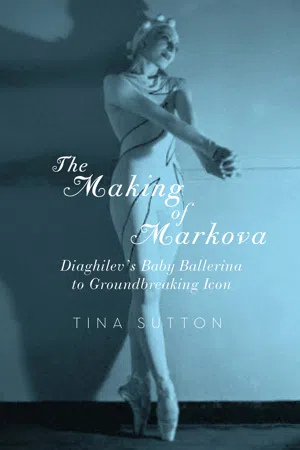
As improbable as it is inspiring, the story of one of the greatest ballerinas of the twentieth century; her fortitude and reinvention; and her journey from the Ballets Russes, Balanchine, and Matisse to international stardom In pre–World War I England, a frail Jewish girl—so shy she barely spoke a word until age six and so sickly she needed to be homeschooled—is diagnosed with flat feet, knock knees, and weak legs. In short order, Lilian Alicia Marks would become a dance prodigy, the cherished baby ballerina of Sergei Diaghilev, and the youngest ever soloist at his famed Ballets Russes. It was there that George Balanchine choreographed his first ballet for her, Henri Matisse designed her costumes, and Igor Stravinsky taught her music—all when the re-christened Alicia Markova was just fourteen. But the timid British dancer would be forced to overcome poverty, jealousy, anti-Semitism, and prejudices against her unconventional looks to become the greatest classical ballerina of her generation—and one of the most celebrated, self reliant, and adventurous. A true ambassador of ballet, Markova co-founded touring companies, traveled to the far corners of the world, and was the first ballerina to appear on television. Given unprecedented access to Dame Markova's intimate journals and correspondence, Tina Sutton paints a full picture of the dancer's astonishing life and times in 1920s Paris and Monte Carlo; 1930s London; and wartime in New York and Hollywood. Ballet lovers and readers everywhere will be fascinated by the story of one of the twentieth century's great artists.
- 400 pages
- English
- ePUB (mobile friendly)
- Available on iOS & Android
eBook - ePub
About this book
Trusted by 375,005 students
Access to over 1.5 million titles for a fair monthly price.
Study more efficiently using our study tools.
Information
Subtopic
Dance1
Another Pavlova
Today Alicia Markova is not only the greatest English dancer, but one of the finest living exponents of the classic ballet. Giselle and Odette (The Swan Lake) are her most remarkable creations.
Ever since childhood Markova has been compared with Pavlova; this is a great distinction, but also a heavy onus, and there are very few dancers, indeed, who would not crumble under it. Markova remains unimpaired and holds her own ground. This is a great achievement.
—“America Meets a New Ballerina in Alicia Markova”
Dance News, 1938, Anatole Chujoy
Dance News, 1938, Anatole Chujoy
Few who saw Alicia Markova dance ever forgot the experience. Her technical bravura was astonishing. Her tiniest movement could break your heart. But it was her buoyancy—appearing to ever so slowly float through the air—that truly confounded and mesmerized audiences. And she did it all so effortlessly.
Sharing the stage with Markova, fellow dancers were stupefied. How was it possible that she never breathed heavily, perspired, or made a sound when she landed? Not even the softest thud. It was a point of pride with her.
At the Ballets Russes, Sergei Diaghilev insisted that the best ballerinas made as little noise as possible. More than anything, his youngest-ever prodigy wanted to please him, so Markova learned to dance silently.
“If Markova springs like a winged fairy, she comes to the ground just as lightly,” wrote British dance critic Cyril Beaumont, “noiselessly in fact, always passing—ball, sole, heel—through the whole of the supporting foot. Of how many ballerine can that be said?”
Maybe she had some help from the size of her feet—only 4½ American (2½ British). They were so tiny that insurance companies refused to insure them. “The risk was too great,” they said. Markova’s foot anomaly also put them off. Her big toes were almost twice as long as the others. So when Markova danced en pointe, she supported her entire body on just one toe.
“Her weight had to be poised with absolute accuracy on the very center of the large toe,” wrote a reporter closely observing the ballerina rehearse. “The slightest deviation could throw her off balance, cause wobbling and put strain on the muscles.” But ask anyone who ever saw Markova dance. She never wobbled.
For choreographers, Markova was like a gift from the gods. She had a phenomenal memory not only for every step she ever danced, but for every balletic move she had ever seen. Moreover, she could do virtually anything that was asked of her. George Balanchine was in awe that at age thirteen, Markova could already execute supremely athletic step sequences formerly danced only by men.
But it was that ability to fly through the air that truly set her apart. Not soar—like Peter Pan or Rudolf Nureyev—just defy gravity for as long as she liked. “I saw her in Les Sylphides making her airborne entrance for the pas de deux,” wrote British dance critic Jane Simpson, “and it was quite clear, even to an already cynical spectator, that only her partner’s restraining hands were stopping her from flying away.”
It was otherworldly—an ethereal quality that made her the quintessential ghostly spirit of Giselle. Audience members would gasp, cry, and pinch one another. “Did we really just see that?” they’d whisper. And her fans came back again and again—even people who cared little for ballet—as if they were watching a magic show and trying to figure out the secrets of each trick.
“The more you see her the more you value her,” wrote New York Herald Tribune dance critic Edwin Denby, someone who did care deeply about ballet. “[I]n every department of classic technique she is flawless. And she has all the peculiarities of physical structure that ballet enthusiasts gloat about—like the overlong arms, the lateral overmobility in the hip joint, the outward set of the arms, and of course the fabulously high arch—all of which add to the poignancy of the gesture because you seem to be seeing what is impossible to do. And she holds your eye on her. Not that she is sexy; she is very proper, but you watch her as intently as if you were perturbed.”
Offstage Markova was just as intriguing—reserved, yet engaged; soft-spoken, but humorous and accessible; plain-featured, yet glamorous. What was going on behind those large dark eyes, one wondered? That air of mystery became one of her greatest assets on stage.
“Who Markova is, nobody knows,” wrote Denby when reviewing her starring role in Antony Tudor’s heartrending Romeo & Juliet. “What you see on the stage is the piece she performs, the character she acts. She shows you, as only the greatest actresses do, a completely fascinating impersonation, completely fascinating because you recognize a heroine of your imagination who finds out all about vanity and love and authority and death. You watch her discover them.” Denby deemed Markova “one of the most poetic dancers of our times.”
Those opinions were shared by many noteworthy critics, with laudatory reviews of Markova’s performances awash in superlatives. She is “the perfect epitome of the classical ballerina,” wrote the all-powerful dance critic of The New York Times, John Martin, and “probably the greatest ballet dancer who ever lived.”
High praise indeed.
Another world-class ballerina, and Markova’s closest lifelong friend, was the exquisite dancer Alexandra Danilova. Here was someone who really did know the offstage Markova as a living, breathing human being with a rollicking sense of humor and boatloads of insecurities. Markova was no supernatural creature of great mystery to Danilova. Nevertheless, she too only saw Markova’s illusory qualities onstage.
I once asked the great Russian-American prima ballerina Alexandra Danilova what the difference would be between a very fine dancer—a soloist—and a real ballerina—it was to be a definition of the word “ballerina.” She thought a moment, her eyes lit up and in her heavy accent she said, “Ah, Ballet is Giselle. Door of cottage open. Pretty young soloist come out. You happy and you say ‘I hope she do well.’ Another performance. Is also Giselle. Door open. Alicia Markova step out. She not danced yet. One step only, but you sigh and say, ’Ah! Ballerina!’ You do not ask, you know. She is star. She shine.”
—Walter Terry, dance critic for
The New York Herald Tribune
The New York Herald Tribune
And she shined right from the start. In the 1930s, American choreographer/dancer Agnes de Mille and British prima ballerina Margot Fonteyn were ballet-school pupils in London. Along with the other students, they were completely riveted while watching Markova rehearse. Barely out of her teens, she was already the city’s reigning star ballerina.
Markova was “both my inspiration and my despair,” recalled Fonteyn, “because I could see equally clearly my vision of the ideal ballerina and the absolute impossibility that I myself could ever, ever resemble this tiny, ethereal being.”
Agnes de Mille never lost her fascination with Markova, writing about her often:
Always about her there was an aroma of sadness, a hint of death in the moment of consummated effort. This was her Jewish heritage, as it was Anna Pavlova’s who made her worldwide reputation with a dance of death, the “Dying Swan.” …
Although English (born Lilian Alicia Marks), she was in face and body astonishingly like the Russian Pavlova—the same black-and-white beauty, the same serene brow, the dark, burning eye, the precise, patient mouth, the swanlike neck.
Ah yes, the inevitable comparison with Pavlova. It would happen again and again throughout Markova’s career. Her likeness to the revered Russian dancer beckoned choreographers, beguiled the press, and gave continuity to the ballet world. When Pavlova died unexpectedly of pleurisy in 1931, hopeful eyes turned to the twenty-year-old Alicia Markova. It was both flattering and burdensome. Anna Pavlova was the most worshipped dancer of her time.
Agnes de Mille was a firsthand witness to Pavlova’s enthralling stage presence and fame, recounting, “… her name was synonymous with the art—Pavlova, the Incomparable, was an internationally known slogan. She was as famous as Caruso and her position as unique. No one today approaches her power over the popular imagination. She half-hypnotized audiences, partaking almost of the nature of divinity.”
But de Mille added, “I have seen two dancers as great or greater since.” Alicia Markova was one of them. Anna Pavlova and her ghost would play an enormous role in the creation of her career, both literally and figuratively.
It was after seeing Pavlova dance and meeting one-on-one with the Russian star that nine-year-old Lilian Alicia Marks decided to dedicate her life to ballet. And when prejudice against Markova’s Jewish faith and Semitic looks almost ended her career in England, it was her uncanny resemblance to Pavlova that inspired choreographer Frederick Ashton to hire her. Finally, for the London press, the constant comparison proved to the world that a British ballet dancer could be as talented as a Russian.
And there was so much the two ballerinas had in common, far more in fact than was commonly known. Both were Jewish—although Pavlova kept that a secret for fear it would end her career, whereas Markova wore her heritage proudly—with dark hair, very pale skin, and exotic, non-classical features.
Both were delicate and frail as opposed to the more robust muscular dancers of the time—such as celebrated prima ballerinas Matilda Kschessinska and Alexandra Danilova—with long torsos and arms, slender legs, and very thin ankles. This added to their vaporous stage presence, with a bird-like quality of seeming to hover mid-air without any noticeable exertion. And each was considered as fine an actress as a dancer, infusing classical roles with a stirringly emotive expressiveness.
Pavlova and Markova were also very small and sickly at birth—the former delivered two months p...
Table of contents
- Cover
- Title Page
- Contents
- Preface
- 1. Another Pavlova
- 2. Diaghileb's Prodigy
- 3. The Ballets Russes
- 4. Starting Over
- 5. Pioneering British Ballet
- 6. Becoming Giselle
- 7. Leaving the Nest
- 8. Only in America
- 9. Spreading Wings
- 10. Taking Flights
- 11. Taking Charge
- 12. The People's Ballerina
- Postscript
- Image Gallery
- Acknowledgments
- Source Notes
- Index
- Copyright
Frequently asked questions
Yes, you can cancel anytime from the Subscription tab in your account settings on the Perlego website. Your subscription will stay active until the end of your current billing period. Learn how to cancel your subscription
No, books cannot be downloaded as external files, such as PDFs, for use outside of Perlego. However, you can download books within the Perlego app for offline reading on mobile or tablet. Learn how to download books offline
Perlego offers two plans: Essential and Complete
- Essential is ideal for learners and professionals who enjoy exploring a wide range of subjects. Access the Essential Library with 800,000+ trusted titles and best-sellers across business, personal growth, and the humanities. Includes unlimited reading time and Standard Read Aloud voice.
- Complete: Perfect for advanced learners and researchers needing full, unrestricted access. Unlock 1.5M+ books across hundreds of subjects, including academic and specialized titles. The Complete Plan also includes advanced features like Premium Read Aloud and Research Assistant.
We are an online textbook subscription service, where you can get access to an entire online library for less than the price of a single book per month. With over 1.5 million books across 990+ topics, we’ve got you covered! Learn about our mission
Look out for the read-aloud symbol on your next book to see if you can listen to it. The read-aloud tool reads text aloud for you, highlighting the text as it is being read. You can pause it, speed it up and slow it down. Learn more about Read Aloud
Yes! You can use the Perlego app on both iOS and Android devices to read anytime, anywhere — even offline. Perfect for commutes or when you’re on the go.
Please note we cannot support devices running on iOS 13 and Android 7 or earlier. Learn more about using the app
Please note we cannot support devices running on iOS 13 and Android 7 or earlier. Learn more about using the app
Yes, you can access The Making of Markova by Tina Sutton in PDF and/or ePUB format, as well as other popular books in Media & Performing Arts & Dance. We have over 1.5 million books available in our catalogue for you to explore.