A charming portrait of one man's dreams and schemes, by "the greatest Italian writer of the twentieth century" (
The Guardian).
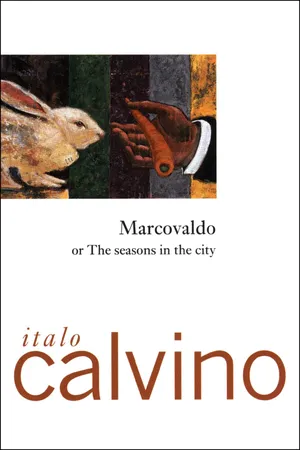
In this enchanting book of linked stories, Italo Calvino charts the disastrous schemes of an Italian peasant, an unskilled worker in a drab northern industrial city in the 1950s and '60s, struggling to reconcile his old country habits with his current urban life.
Marcovaldo has a practiced eye for spotting natural beauty and an unquenchable longing for the unspoiled rural world of his imagination. Much to the continuing puzzlement of his wife, his children, his boss, and his neighbors, he chases his dreams and gives rein to his fantasies, whether it's sleeping in the great outdoors on a park bench, following a stray cat, or trying to catch wasps. Unfortunately, the results are never quite what he anticipates.
Spanning from the 1950s to the 1960s, the twenty stories in
Marcovaldo are alternately comic and melancholy, farce and fantasy. Throughout, Calvino's unassuming masterpiece "conveys the sensuous, tangible qualities of life" (
The New York
Times).
- 128 pages
- English
- ePUB (mobile friendly)
- Available on iOS & Android
eBook - ePub
About this book
Information
AUTUMN
19. The garden of stubborn cats
The city of cats and the city of men exist one inside the other, but they are not the same city. Few cats recall the time when there was no distinction: the streets and squares of men were also streets and squares of cats, and the lawns, courtyards, balconies, and fountains: you lived in a broad and various space. But for several generations now domestic felines have been prisoners of an uninhabitable city: the streets are uninterruptedly overrun by the mortal traffic of cat-crushing automobiles; in every square foot of terrain where once a garden extended or a vacant lot or the ruins of an old demolition, now condominiums loom up, welfare housing, brand-new skyscrapers; every entrance is crammed with parked cars; the courtyards, one by one, have been roofed by reinforced concrete and transformed into garages or movie houses or storerooms or workshops. And where a rolling plateau of low roofs once extended, copings, terraces, water tanks, balconies, skylights, corrugated-iron sheds, now one general superstructure rises wherever structures can rise; the intermediate differences in height, between the low ground of the street and the supernal heaven of the penthouses, disappear; the cat of a recent litter seeks in vain the itinerary of its fathers, the point from which to make the soft leap from balustrade to cornice to drainpipe, or for the quick climb on the roof-tiles.
But in this vertical city, in this compressed city where all voids tend to fill up and every block of cement tends to mingle with other blocks of cement, a kind of counter-city opens, a negative city, that consists of empty slices between wall and wall, of the minimal distances ordained by the building regulations between two constructions, between the rear of one construction and the rear of the next; it is a city of cavities, wells, air conduits, driveways, inner yards, accesses to basements, like a network of dry canals on a planet of stucco and tar, and it is through this network, grazing the walls, that the ancient cat population still scurries.
On occasion, to pass the time, Marcovaldo would follow a cat. It was during the work-break, between noon and three, when all the personnel except Marcovaldo went home to eat, and he — who brought his lunch in his bag — laid his place among the packing-cases in the warehouse, chewed his snack, smoked a half-cigar, and wandered around, alone and idle, waiting for work to resume. In those hours, a cat that peeped in at a window was always welcome company, and a guide for new explorations. He had made friends with a tabby, well-fed, a blue ribbon around its neck, surely living with some well-to-do family. This tabby shared with Marcovaldo the habit of an afternoon stroll right after lunch; and naturally a friendship sprang up.
Following his tabby friend, Marcovaldo had started looking at places as if through the round eyes of a cat and even if these places were the usual environs of his firm he saw them in a different light, as settings for cattish stories, with connections practicable only by light, velvety paws. Though from the outside the neighborhood seemed poor in cats, every day on his rounds Marcovaldo made the acquaintance of some new face, and a miau, a hiss, a stiffening of fur on an arched back was enough for him to sense ties and intrigues and rivalries among them. At those moments he thought he had already penetrated the secrecy of the felines’ society: and then he felt himself scrutinized by pupils that became slits, under the surveillance of the antennae of taut whiskers, and all the cats around him sat impassive as sphinxes, the pink triangle of their noses convergent on the black triangles of their lips, and the only things that moved were the tips of the ears, with a vibrant jerk like radar. They reached the end of a narrow passage, between squalid blank walls; and, looking around, Marcovaldo saw that the cats that had led him this far had vanished, all of them together, no telling in which direction, even his tabby friend, and they had left him alone. Their realm had territories, ceremonies, customs that it was not yet granted to him to discover.
On the other hand, from the cat city there opened unsuspected peep-holes onto the city of men: and one day the same tabby led him to discover the great Biarritz Restaurant.
Anyone wishing to see the Biarritz Restaurant had only to assume the posture of a cat, that is, proceed on all fours. Cat and man, in this fashion, walked around a kind of dome, at whose foot some low, rectangular little windows opened. Following the tabby’s example, Marcovaldo looked down. They were transoms through which the luxurious hall received air and light. To the sound of gypsy violins, partridges and quails swirled by on silver dishes balanced by the white-gloved fingers of waiters in tailcoats. Or, more precisely, above the partridges and quails the dishes whirled, and above the dishes the white gloves, and poised on the waiters’ patent-leather shoes, the gleaming parquet floor, from which hung dwarf potted palms and tablecloths and crystal and buckets like bells with the champagne bottle for their clapper: everything was turned upside-down because Marcovaldo, for fear of being seen, wouldn’t stick his head inside the window and confined himself to looking at the reversed reflection of the room in the tilted pane.
But it was not so much the windows of the dining-room as those of the kitchens that interested the cat: looking through the former you saw, distant and somehow transfigured, what in the kitchens presented itself — quite concrete and within paw’s reach — as a plucked bird or a fresh fish. And it was towards the kitchens, in fact, that the tabby wanted to lead Marcovaldo, either through a gesture of altruistic friendship or else because it counted on the man’s help for one of its raids. Marcovaldo, however, was reluctant to leave his belvedere over the main room: first as he was fascinated by the luxury of the place, and then because something down there had riveted his attention. To such an extent that, overcoming his fear of being seen, he kept peeking in, with his head in the transom.
In the midst of the room, directly under that pane, there was a little glass fish-tank, a kind of aquarium, where some fat trout were swimming. A special customer approached, a man with a shiny bald pate, black suit, black beard. An old waiter in tailcoat followed him, carrying a little net as if he were going to catch butterflies. The gentleman in black looked at the trout with a grave, intent air; then he raised one hand and with a slow, solemn gesture singled out a fish. The waiter dipped the net into the tank, pursued the appointed trout, captured it, headed for the kitchens, holding out in front of him, like a lance, the net in which the fish wriggled. The gentleman in black, solemn as a magistrate who has handed down a capital sentence, went to take his seat and wait for the return of the trout, sautéed “à la meunière”.
If I found a way to drop a line from up here and make one of those trout bite, Marcovaldo thought, I couldn’t be accused of theft; at worst, of fishing in an unauthorized place. And ignoring the miaus that called him towards the kitchens, he went to collect his fishing tackle.
Nobody in the crowded dining-room of the Biarritz saw the long, fine line, armed with hook and bait, as it slowly dropped into the tank. The fish saw the bait, and flung themselves on it. In the fray one trout managed to bite the worm: and immediately it began to rise, rise, emerge from the water, a silvery flash, it darted up high, over the laid tables and the trolleys of hors d’oeuvres, over the blue flames of the crepes Suzette, until it vanished into the heavens of the transom.
Marcovaldo had yanked the rod with the brisk snap of the expert fisherman, so the fish landed behind his back. The trout had barely touched the ground when the cat sprang. What little life the trout still had was lost between the tabby’s teeth. Marcovaldo, who had abandoned his line at that moment to run and grab the fish, saw it snatched from under his nose, hook and all. He was quick to put one foot on the rod, but the snatch had been so strong that the rod was all the man had left, while the tabby ran off with the fish, pulling the line after it. Treacherous kitty! It had vanished.
But this time it wouldn’t escape him: there was that long line trailing after him and showing the way he had taken. Though he had lost sight of the cat, Marcovaldo followed the end of the line: there it was, running along a wall; it climbed a parapet, wound through a doorway, was swallowed up by a basement . . . Marcovaldo, venturing into more and more cattish places, climbed roofs, straddled railings, always managed to catch a glimpse—perhaps only a second before it disappeared — of that moving trace that indicated the thief’s path.
Now the line played out down a sidewalk, in the midst of the traffic, and Marcovaldo, running after it, almost managed to grab it. He flung himself down on his belly: there, he grabbed it! He managed to seize one end of the line before it slipped between the bars of a gate.
Beyond a half-rusted gate and two bits of wall buried under climbing plants, there was a little rank garden, with a small, abandoned-looking building at the far end of it. A carpet of dry leaves covered the path, and dry leaves lay everywhere under the boughs of the two plane-trees, forming actually some little mounds in the yard. A layer of leaves was yellowing in the green water of a pool. Enormous buildings rose all around, skyscrapers with thousands of windows, like so many eyes trained disapprovingly on that little square patch with two trees, a few tiles, and all those yellow leaves, surviving right in the middle of an area of great traffic.
And in this garden, perched on the capitals and balustrades, lying on the dry leaves of the flower-beds, climbing on the trunks of the trees or on the drainpipes, motionless on their four paws, their tails making a question-mark, seated to wash their faces, there were tiger cats, black cats, white cats, calico cats, tabbies, angoras, Persians, house cats and stray cats, perfumed cats and mangy cats. Marcovaldo realized he had finally reached the heart of the cats’ realm, their secret island. And, in his emotion, he almost forgot his fish.
It had remained, that fish, hanging by the line from the branch of a tree, out of reach of the cats’ leaps; it must have dropped from its kidnapper’s mouth at some clumsy movement, perhaps as it was defended from the others, or perhaps displayed as an extraordinary prize. The line had got tangled, and Marcovaldo, tug as he would, couldn’t manage to yank it loose. A furious battle had meanwhile been joined among the cats, to reach that unreachable fish, or rather, to win the right to try and reach it. Each wanted to prevent the others from leaping: they hurled themselves on one another, they tangled in mid-air, they rolled around clutching each other, and finally a general war broke out in a whirl of dry, crackling leaves.
After many futile yanks, Marcovaldo now felt the line was free, but he took care not to pull it: the trout would have fallen right in the midst of that infuriated scrimmage of felines.
It was at this moment that, from the top of the walls of the gardens, a strange rain began to fall: fish-bones, heads, tails, even bits of lung and lights. Immediately the cats’ attention was distracted from the suspended trout and they flung themselves on the new delicacies. To Marcovaldo, this seemed the right moment to pull the line and regain his fish. But, before he had time to act, from a blind of the little villa, two yellow, skinny hands darted out: one was brandishing scissors; the other, a frying-pan. The hand with the scissors was raised above the trout, the hand with the frying-pan was thrust under it. The scissors cut the line, the trout fell into the pan; hands, scissors and pan withdrew, the blind closed: all in the space of a second. Marcovaldo was totally bewildered.
“Are you also a cat-lover?” A voice at his back made him turn round. He was surrounded by little old women, some of them ancient, wearing old-fashioned hats on their heads; others, younger, but with the look of spinsters; and all were carrying in their hands or their bags packages of leftover meat or fish, and some even had little pans of milk. “Will you help me throw this package over the fence, for those poor creatures?”
All the ladies, cat-lovers, gathered at this hour around the garden of dry leaves to take food to their proteges.
“Can you tell me why they are all here, these cats?” Marcovaldo inquired.
“Where else could they go? This garden is all they have left! Cats come here from other neighborhoods, too, from miles and miles around . . .”
“And birds, as well,” another lady added. “They’re forced to live by the hundreds and hundreds on these few trees . . .”
“And the frogs, they’re all in that pool, and at night they never stop croaking . . . You can hear them even on the eighth floor of the buildings around here.”
“Who does this villa belong to anyway?” Marcovaldo asked. Now, outside the gate, there weren’t just the cat-loving ladies but also other people: the man from the gas pump opposite, the apprentices from a mechanic’s shop, the postman, the grocer, some passers-by. And none of them, men and women, had to be asked twice: all wanted to have their say, as always when a mysterious and controversial subject comes up.
“It belongs to a Marchesa. She lives there, but you never see her . . .”
“She’s been offered millions and millions, by developers, for this little patch of land, but she won’t sell . . .”
“What would she do with millions, an old woman all alone in the world? She wants to hold on to her house, even if it’s falling to pieces, rather than be forced to move . . .”
“It’s the only undeveloped bit of land in the downtown area . . . Its value goes up every year . . . They’ve made her offers—”
“Offers! That’s not all. Threats, intimidation, persecution . . . You don’t know the half of it! Those contractors!”
“But she holds out. She’s held out for years . . .”
“She’s a saint. Without her, where would those poor animals go?”
“A lot she cares about the animals, the old miser! Have you ever seen her give them anything to eat?”
“How can she feed the cats when she doesn’t have food for herself? She’s the last descendant of a ruined family!”
“She hates cats. I’ve seen her chasing them and hitting them with an umbrella!”
“Because they were tearing up her flowerbeds!”
“What flower-beds? I’ve never seen anything in this garden but a great crop of weeds!”
Marcovaldo realized that with regard to the old Marchesa opinions were sharply divided: some saw her as an angelic being, others as an egoist and a miser.
“It’s the same with the birds; she never gives them a crumb!”
“She gives them hospitality. Isn’t that plenty?”
“Like she gives the mosquitoes, you mean. They all come from here, from that pool. In the summertime the mosquitoes eat us alive, and it’s all the fault of that Marchesa!”
“And the mice? This villa is a mine of mice. Under the dead leaves they have their burrows, and at night they come out . . .”
“As far as the mice go, the cats take care of them . . .”
“Oh, you and your cats! If we had to rely on them . . .”
“Why? Have you got something to say against cats?”
Here the discussion degenerated into a general quarrel.
“The authorities should do something: confiscate the villa!” one man cried.
“What gives them the right?” another protested.
“In a modern neighborhood like ours, a mouse-nest like this . . . it should be forbidden . . .”
“Why, I picked my apartment precisely because it overlooked this little bit of green . . .”
“Green, hell! Think of the fine skyscraper they could build here!”
Marcovaldo would have liked to add something of his own, but he couldn’t get a word in. Finally, all in one breath, he exclaimed: “The Marchesa stole a trout from me!”
The unexpected news supplied fresh ammunition to the old woman’s enemies, but her defenders exploited it as proof of the indigence to which the unfortunate noblewoman was reduced. Both sides agreed that Marcovaldo should go and knock at her door to demand an explanation.
It wasn’t clear whether the gate was locked or unlocked; in any case, it opened, after a push, with a mournful creak. Marcovaldo picked his way among the leaves and cats, climbed the steps to the porch, knocked hard at the entrance.
At a window (the very one where the frying-pan had appeared), the blind was raised slightly and in one corner a round, pale blue eye was seen, and a clump of hair dyed an undefinable color, and a dry skinny hand. A voice was heard, asking: “Who is it? Who’s at the door?”, the words accompanied by a cloud smelling of fried oil.
“It’s me, Marchesa. The trout man,” Marcovaldo explained. “I don’t mean to trouble you. I only wanted to tell you, in case you didn’t know, that the trout was stolen from me, by that cat, and I’m the one who caught it. In fact the line . . .”
“Those cats! It’s always those cats . . .” the Marchesa said, from behind the shutter, with a shrill, somewhat nasal voice. “AD my troubles come from the cats! Nobody knows what I go through! Prisoner night and day of those horrid beasts! And with all the refuse people throw over the walls, to spite me!”
“But my trout . . .”
“Your trout! What am I supposed to know about your trout!” The Marchesa’s voice became almost a scream, as if she wanted to drown out the sizzle of the oil in the pan, which ca...
Table of contents
- Title Page
- Contents
- Copyright
- Author’s Note:
- SPRING
- SUMMER
- AUTUMN
- WINTER
- SPRING
- SUMMER
- AUTUMN
- WINTER
- SPRING
- SUMMER
- AUTUMN
- WINTER
- SPRING
- SUMMER
- AUTUMN
- WINTER
- SPRING
- SUMMER
- AUTUMN
- WINTER
- About the Author
Trusted by 375,005 students
Access to over 1.5 million titles for a fair monthly price.
Study more efficiently using our study tools.
Frequently asked questions
Yes, you can cancel anytime from the Subscription tab in your account settings on the Perlego website. Your subscription will stay active until the end of your current billing period. Learn how to cancel your subscription
No, books cannot be downloaded as external files, such as PDFs, for use outside of Perlego. However, you can download books within the Perlego app for offline reading on mobile or tablet. Learn how to download books offline
Perlego offers two plans: Essential and Complete
- Essential is ideal for learners and professionals who enjoy exploring a wide range of subjects. Access the Essential Library with 800,000+ trusted titles and best-sellers across business, personal growth, and the humanities. Includes unlimited reading time and Standard Read Aloud voice.
- Complete: Perfect for advanced learners and researchers needing full, unrestricted access. Unlock 1.5M+ books across hundreds of subjects, including academic and specialized titles. The Complete Plan also includes advanced features like Premium Read Aloud and Research Assistant.
We are an online textbook subscription service, where you can get access to an entire online library for less than the price of a single book per month. With over 1.5 million books across 990+ topics, we’ve got you covered! Learn about our mission
Look out for the read-aloud symbol on your next book to see if you can listen to it. The read-aloud tool reads text aloud for you, highlighting the text as it is being read. You can pause it, speed it up and slow it down. Learn more about Read Aloud
Yes! You can use the Perlego app on both iOS and Android devices to read anytime, anywhere — even offline. Perfect for commutes or when you’re on the go.
Please note we cannot support devices running on iOS 13 and Android 7 or earlier. Learn more about using the app
Please note we cannot support devices running on iOS 13 and Android 7 or earlier. Learn more about using the app
Yes, you can access Marcovaldo by Italo Calvino in PDF and/or ePUB format, as well as other popular books in Literature & Literature General. We have over 1.5 million books available in our catalogue for you to explore.