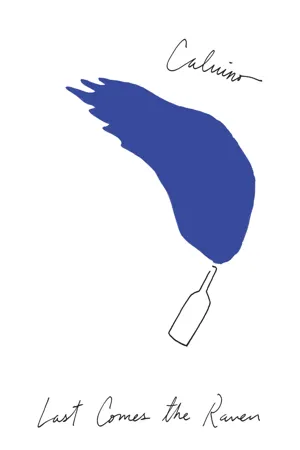
The first complete English-language edition of one of Calvino’s important early short story collections
Blending reality and illusion with elegance and precision, the stories in this collection—one of Calvino’s earliest—take place in a World War II–era and postwar Italy tinged with the visionary and fablelike qualities that would come to define this master storyteller’s later style. A trio of gluttonous burglars invade a pastry shop; two children trespass upon a forbidden garden; a wealthy family invites a rustic goatherd to lunch, only to mock him. In the title story, a compact masterpiece of shifting perspectives, a panicked soldier tries to keep his wits—and his life—when he faces off against a young partisan with a loaded rifle and miraculous aim. Throughout, Calvino delights in discovering hidden truths beneath the surface of everyday life.
Stories from Last Comes the Raven have been published in translation, but the collection as a whole has never appeared in English. This volume, including several stories newly translated by Ann Goldstein, is an important addition to Calvino’s legacy.
- 320 pages
- English
- ePUB (mobile friendly)
- Available on iOS & Android
eBook - ePub
About this book
Information
Adam, One Afternoon
The new gardener’s boy had long hair kept in place by a piece of cloth tied around his head with a little bow. He was walking along the path with his watering can filled to the brim and his other arm stretched out to balance the load. Slowly, carefully, he watered the nasturtiums as if pouring out coffee and milk, until the earth at the foot of each plant dissolved into a soft black patch; when it was large and moist enough he lifted the watering can and passed on to the next plant. Maria-nunziata was watching him from the kitchen window and thinking what a nice calm job gardening must be. He was a young man, she noticed, though he still wore shorts and that long hair made him look like a girl. She stopped washing the dishes and tapped on the window.
“Hey, boy,” she called.
The gardener’s boy raised his head, saw Maria-nunziata, and smiled. She laughed back at him, partly because she had never seen a boy with such long hair and a bow like that on his head. The gardener’s boy beckoned to her with one hand, and Maria-nunziata went on laughing at the funny gesture he’d made, and began gesturing back to explain that she had the dishes to wash. But the boy beckoned again, and pointed at the pots of dahlias with his other hand. Why was he pointing at those dahlias? Maria-nunziata opened the window and stuck her head out.
“What’s up?” she asked, and began laughing again.
“D’you want to see something nice?”
“What’s that?”
“Something nice. Come and see. Quickly.”
“Tell me what.”
“I’ll give it to you. I’ll give you something very nice.”
“But I’ve got the dishes to wash, and the signora’ll come along and not find me.”
“Do you want it or don’t you? Come on, now.”
“Wait a second,” said Maria-nunziata, and shut the window.
When she came out through the kitchen door the gardener’s boy was still there, watering the nasturtiums.
“Hello,” said Maria-nunziata.
Maria-nunziata seemed taller than she was because of her high-heeled shoes, which were awful to work in, but she loved wearing them. Her little face looked like a child’s amid its mass of black curls, and her legs were thin and childlike, too, though her body, under the folds of her apron, was already round and ripe. She was always laughing, either at what others or she herself said.
“Hello,” said the gardener’s boy. The skin on his face, neck, and chest was dark brown, perhaps because he was always half naked, as now.
“What’s your name?” asked Maria-nunziata.
“Libereso,” said the gardener’s boy.
Maria-nunziata laughed and repeated, “Libereso . . . Libereso . . . What a funny name, Libereso.”
“It’s a name in Esperanto,” he said. “In Esperanto it means ‘liberty.’ ”
“Esperanto,” said Maria-nunziata. “Are you Esperanto?”
“Esperanto’s a language,” explained Libereso. “My father speaks Esperanto.”
“I’m Calabrian,” exclaimed Maria-nunziata.
“What’s your name?”
“Maria-nunziata,” she said, and laughed.
“Why are you always laughing?”
“Why are you called Esperanto?”
“Not Esperanto, Libereso.”
“Why?”
“Why are you called Maria-nunziata?”
“It is the Madonna’s name. I’m named after the Madonna, and my brother after Saint Joseph.”
“Senjosef?”
Maria-nunziata burst out laughing. “Senjosef! Saint Joseph, not Senjosef, Libereso!”
“My brother,” said Libereso, “is named Germinal and my sister Omnia.”
“That nice thing you mentioned,” said Maria-nunziata. “Show it to me.”
“Come on, then,” said Libereso. He put down the watering can and took her by the hand.
Maria-nunziata hesitated. “Tell me what it is first.”
“You’ll see,” he said, “but you must promise me to take care of it.”
“Will you give it to me?”
“Yes, I’ll give it to you.” He had led her to a corner of the garden wall. There the dahlias standing in pots were as tall as the two of them.
“It’s there.”
“What is?”
“Wait.”
Maria-nunziata peeped over his shoulder. Libereso bent down to move a pot, lifted another by the wall, and pointed to the ground.
“There,” he said.
“What is it?” asked Maria-nunziata. She could not see anything; the corner was in shadow, full of wet leaves and garden mold.
“Look, it’s moving,” said the boy. Then she saw something that looked like a moving stone or leaf, something wet, with eyes and feet: a toad.
“Mamma mia!”
Maria-nunziata went skipping away among the dahlias in her high-heeled shoes. Libereso squatted down by the toad and laughed, showing the white teeth in the middle of his brown face.
“Are you frightened? It’s only a toad! Why are you frightened?”
“A toad!” gasped Maria-nunziata.
“Of course it’s a toad. Come here,” said Libereso.
She pointed at it with a trembling finger. “Kill it.”
He put out his hands, as if to protect it. “I don’t want to. It’s so nice.”
“A nice toad?”
“All toads are nice. They eat the worms.”
“Oh!” said Maria-nunziata, but she did not come any nearer. She was chewing the edge of her apron and trying to watch out of the corners of her eyes.
“Look how pretty it is,” said Libereso, and put a hand on it.
Maria-nunziata approached, no longer laughing, and looked on, openmouthed. “No! No! Don’t touch it!”
With one finger Libereso was stroking the toad’s gray-green back, which was covered with slimy warts.
“Are you mad? Don’t you know they burn when you touch them, and make your hand swell up?”
The boy showed her his big brown hands, the palms covered with a layer of yellow calluses.
“Oh, it won’t hurt me,” he said. “And it’s so pretty.”
Now he’d taken the toad by the scruff of the neck like a cat and put it in the palm of his hand. Maria-nunziata, still chewing the edge of her apron, came nearer and crouched down beside him.
“Mamma mia!” she exclaimed.
They were both crouching down behind the dahlias, and Maria-nunziata’s rosy knees were grazing the brown, scratched ones of Libereso. Libereso cupped his other hand over the back of the toad and caught it every now and again as it tried to slip out.
“You stroke it, Maria-nunziata,” he said.
The girl hid her hands in her apron. “No,” she said firmly.
“What?” he said. “You don’t want it?”
Maria-nunziata lowered her eyes, glanced at the toad, and lowered them again quickly. “No,” she said.
“But it’s yours. I’m giving it to you.”
Maria-nunziata’s eyes clouded over. It was sad to refuse a present—no one ever gave her presents—but the toad really did revolt her.
“You can take it home if you like. It’ll keep you company.”
“No,” she said.
Libereso put the toad back on the ground, and it quickly hopped away and squatted under the leaves.
“Good-bye, Libereso.”
“Wait a minute.”
“But I must go and finish washing the dishes. The signora doesn’t like me to come out in the garden.”
“Wait. I want to give you something. Something really nice. Come with me.”
She began following him along the gravel paths. What a strange boy this Libereso was, with that long hair, and picking up toads in his hands.
“How old are you, Libereso?”
“Fifteen. And you?”
“Fourteen.”
“Now, or on your next birthday?”
“On my next birthday. Feast of the Annunciation.”
“Has that passed yet?”
“What, don’t you know when the Feast of the Annunciation is?” She began laughing.
“No.”
“The Feast of the Annunciation, when there’s the procession. Don’t you go to the procession?”
“Me? No.”
“Back home there are lovely processions. It’s not like here, back home. There are big fields full of bergamots, nothing but bergamots, and everyone picks bergamots from morning till night. I’ve got fourteen brothers and sisters and they all pick bergamots; five died when they were babies, and then my mother got tetanus, and we were in a train for a week to go to Uncle Carmelo’s, and eight of us all slept in a garage there. Tell me, why do you have such long hair?”
They had stopped.
“Because it grows like that. You’ve got long hair, too.”
“I’m a girl. If you wear long hair, you’re like a girl.”
“I’m not like a girl. You don’t tell a boy from a girl by the hair.”
“Not by the hair?”
“No, not by the hair.”
“Why not by the hair?”
“Would you like me to give you something nice?”
“Oh, yes.”
Libereso began moving among the arum lilies, budding white trumpets silhouetted against the sky. Libereso looked into each, groped around with two fingers, and then hid something in his fist. Maria-nunziata had not gone into the flower bed, and was watching him with silent laughter. What was he up to now? When Libereso had looked into all the lilies, he came up to her, holding one hand over the other.
“Open your hands,” he said.
Maria-nunziata cupped her hands but was afraid to put them under his. “What have you got in there?”
“Something very nice. You’ll see.”
“Show me first.”
Libereso opened his hands and let her look inside. His palm was full of multicolored rose chafers, red and black and even purple ones, but the green were the prettiest. They were buzzing and slithering over one another and waving little black legs in the air. Maria-nunziata hid her hands under her apron.
“Here,” said Libereso. “Don’t you like them?”
“Yes,” said Maria-nunziata uncertainly, still keeping her hands under her apron.
“When you hold them tight they tickle. Would you like to feel?”
Maria-nunziata held out her hands timidly, and Libereso poured a cascade of rose chafers of every color into them.
“Don’t be frightened; they won’t bite you.”
“Mamma mia!” It hadn’t occurred to her that they might bite her. She opened her hands and the rose chafers spread their wings and the beautiful colors vanished and there was nothing to be seen but a swarm of black insects flying about and settling.
“What a pity. I try to give you a present and you don’t want it.”
“I must go wash the dishes. The signora will be cross if she can’t find me.”
“Don’t you want a present?”
“What are you going to give me now?”
“Come and see.”
He took her hand again and led her through the flower beds.
“I must get back to the kitchen soon, Libereso. There’s a chicken to pluck, too.”
“Pooh!”
“Why pooh?”
“We don’t eat the flesh of dead birds or...
Table of contents
- Title Page
- Contents
- Copyright
- Editor’s Note
- Adam, One Afternoon
- A Ship Loaded with Crabs
- The Enchanted Garden
- Dawn in the Bare Branches
- From Father to Son
- Man in the Wasteland
- The Master’s Eye
- Lazy Sons
- A Goatherd at Luncheon
- The Bagnasco Brothers
- The House of the Beehives
- The Same Thing as Blood
- The Wait for Death in a Hotel
- Anguish in the Barracks
- Fear on the Footpath
- Hunger at Bévera
- Going to Headquarters
- Last Comes the Raven
- One of the Three Is Still Alive
- Animal Woods
- Minefield
- Seen in the Cafeteria
- Theft in a Pastry Shop
- Dollars and Old Whores
- The Adventure of a Soldier
- Sleeping like Dogs
- Desire in November
- A Judge Is Hanged
- The Cat and the Policeman
- Who Put the Mine in the Sea?
- About the Author
- Connect with HMH
- Footnotes
Trusted by 375,005 students
Access to over 1.5 million titles for a fair monthly price.
Study more efficiently using our study tools.
Frequently asked questions
Yes, you can cancel anytime from the Subscription tab in your account settings on the Perlego website. Your subscription will stay active until the end of your current billing period. Learn how to cancel your subscription
No, books cannot be downloaded as external files, such as PDFs, for use outside of Perlego. However, you can download books within the Perlego app for offline reading on mobile or tablet. Learn how to download books offline
Perlego offers two plans: Essential and Complete
- Essential is ideal for learners and professionals who enjoy exploring a wide range of subjects. Access the Essential Library with 800,000+ trusted titles and best-sellers across business, personal growth, and the humanities. Includes unlimited reading time and Standard Read Aloud voice.
- Complete: Perfect for advanced learners and researchers needing full, unrestricted access. Unlock 1.5M+ books across hundreds of subjects, including academic and specialized titles. The Complete Plan also includes advanced features like Premium Read Aloud and Research Assistant.
We are an online textbook subscription service, where you can get access to an entire online library for less than the price of a single book per month. With over 1.5 million books across 990+ topics, we’ve got you covered! Learn about our mission
Look out for the read-aloud symbol on your next book to see if you can listen to it. The read-aloud tool reads text aloud for you, highlighting the text as it is being read. You can pause it, speed it up and slow it down. Learn more about Read Aloud
Yes! You can use the Perlego app on both iOS and Android devices to read anytime, anywhere — even offline. Perfect for commutes or when you’re on the go.
Please note we cannot support devices running on iOS 13 and Android 7 or earlier. Learn more about using the app
Please note we cannot support devices running on iOS 13 and Android 7 or earlier. Learn more about using the app
Yes, you can access Last Comes The Raven by Italo Calvino in PDF and/or ePUB format, as well as other popular books in Literature & Classics. We have over 1.5 million books available in our catalogue for you to explore.