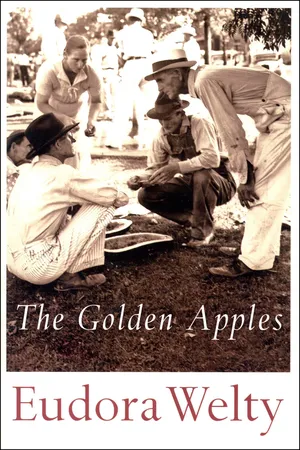
This collection of short stories of the Mississippi Delta by the Pulitzer Prize–winning author is "a work of art" (
The New York Times Book Review).
Here in Morgana, Mississippi, the young dream of other places; the old can tell you every name on every stone in the cemetery on the town's edge; and cuckolded husbands and love-starved piano teachers share the same paths. It's also where one neighbor has disappeared on the horizon, slipping away into local legend.
Black and white, lonely and the gregarious, sexually adventurous and repressed, vengeful and resigned, restless and settled, the vividly realized characters that make up this collection of interrelated stories, with elements drawn from ancient myth and transplanted to the American South, prove that this National Book Award–winning writer, as Katherine Anne Porter once wrote, had "an ear sharp, shrewd, and true as a tuning fork."
"I doubt that a better book about 'the South'—one that more completely gets the feel of the particular texture of Southern life, and its special tone and pattern—has ever been written." —
The New Yorker
- 288 pages
- English
- ePUB (mobile friendly)
- Available on iOS & Android
eBook - ePub
The Golden Apples
About this book
Information
2.
June Recital
Loch was in a tempest with his mother. She would keep him in bed and make him take Cocoa-Quinine all summer, if she had her way. He yelled and let her wait holding the brimming spoon, his eyes taking in the whole ironclad pattern, the checkerboard of her apron—until he gave out of breath, and took the swallow. His mother laid her hand on his pompadour cap, wobbled his scalp instead of kissing him, and went off to her nap.
“Louella!” he called faintly, hoping she would come upstairs and he could devil her into running to Loomis’s and buying him an ice cream cone out of her pocket, but he heard her righteously bang a pot to him in the kitchen. At last he sighed, stretched his toes—so clean he despised the very sight of his feet—and brought himself up on his elbow to the window.
Next door was the vacant house.
His family would all be glad if it burned down; he wrapped it with the summer’s love. Beyond the hackberry leaves of their own tree and the cedar row and the spready yard over there, it stretched its weathered side. He let his eyes rest or go flickering along it, as over something very well known indeed. Its left-alone contour, its careless stretching away into that deep backyard he knew by heart. The house’s side was like a person’s, if a person or giant would lie sleeping there, always sleeping.
A red and bottle-shaped chimney held up all. The roof spread falling to the front, the porch came around the side leaning on the curve, where it hung with bannisters gone, like a cliff in a serial at the Bijou. Instead of cowboys in danger, Miss Jefferson Moody’s chickens wandered over there from across the way, flapped over the edge, and found the shade cooler, the dust fluffier to sit in, and the worms thicker under that blackening floor.
In the side of the house were six windows, two upstairs and four down, and back of the chimney a small stair window shaped like a keyhole—one made never to open; they had one like it. There were green shades rolled up to various levels, but not curtains. A table showed in the dining room, but no chairs. The parlor window was in the shadow of the porch and of thin, vibrant bamboo leaves, clear and dark as a pool he knew in the river. There was a piano in the parlor. In addition there were little fancy chairs, like Sunday School chairs or children’s drug store chairs, turned this way and that, and the first strong person trying to sit down would break them one after the other. Instead of a door into the hall there was a curtain; it was made of beads. With no air the curtain hung still as a wall and yet you could see through it, if anybody should pass the door.
In that window across from his window, in the back upper room, a bed faced his. The foot was gone, and a mattress had partly slid down but was holding on. A shadow from a tree, a branch and its leaves, slowly traveled over the hills and hollows of the mattress.
In the front room there, the window was dazzling in afternoon; it was raised. Except for one tall post with a hat on it, that bed was out of sight. It was true, there was one person in the house—Loch would recall him sooner or later—but it was only Mr. Holifield. He was the night watchman down at the gin, he always slept all day. A framed picture could be seen hanging on the wall, just askew enough so that it looked straightened every now and then. Sometimes the glass in the picture reflected the light outdoors and the flight of birds between branches of trees, and while it reflected, Mr. Holifield was having a dream.
Loch could look across through cedars that missed one, in the line, and in a sweeping glance see it all—as if he possessed it—from its front porch to its shedlike back and its black-shadowed summerhouse—which was an entirely different love, odorous of black leaves that crumbled into soot; and its shade of four fig trees where he would steal the figs if July ever came. And above all the shade, which was dark as a boat, the blue sky flared—shooting out like a battle, and hot as fire. The hay riders his sister went with at night (went with against their father’s will, slipped out by their mother’s connivance) would ride off singing, “Oh, It Ain’t Gonna Rain No More.” Even under his shut eyelids, that light and shade stayed divided from each other, but reversed.
Some whole days at a time, often in his dreams day and night, he would seem to be living next door, wild as a cowboy, absolutely by himself, without his mother or father coming in to feel his skin, or run a finger up under his cap—without one parent to turn on the fan and the other to turn it off, or them both together to pin a newspaper around the light at night to shade him out of their talk. And there was where Cassie could never bring him books to read, miserable girls’ books and fairy tales.
It was the leaky gutter over there that woke Loch up, back in the spring when it rained. Splashy as a waterfall in a forest, it shook him with that agony of being made to wake up from a sound sleep to be taken away somewhere, made to go. It made his heart beat fast.
They could do what they wanted to to him but they could not take his pompadour cap off him or take his house away. He reached down under the bed and pulled up the telescope.
It was his father’s telescope and he was allowed to look through it unmolested as long as he ran a temperature. It was what they gave him instead of his nigger-shooter and cap pistol. Smelling of brass and the drawer of the library table where it came from, it was an object hitherto brought out in the family group for eclipses of the moon; and the day the airplane flew over with a lady in it, and they all waited for it all day, wry and aching up at the sky, the telescope had been gripped in his father’s hand like a big stick, some kind of protective weapon for what was to come.
Loch fixed the long brass tubes and shot the telescope out the window, propping the screen outward and letting more mosquitoes in, the way he was forbidden. He examined the size of the distant figs: like marbles yesterday, wine-balls today. Getting those would not be the same as stealing. On the other side of fury at confinement a sweet self-indulgence could visit him in his bed. He moved the glass lovingly toward the house and touched its roof, with the little birds on it cocking their heads.
With the telescope to his eye he even smelled the house strongly. Morgana was extra deep in smell this afternoon; the magnolias were open all over the tree at the last corner. They glittered like lights in the dense tree that loomed in the shape of a cave opening at the brought-up-close edge of the Carmichael roof. He looked at the thrush’s nest, Woodrow Spights’ old ball on the roof, the drift of faded election handbills on the porch—the vacant house again, the half of a china plate deep in the weeds; the chickens always went to that plate, and it was dry.
Loch trained the telescope to the back and caught the sailor and the girl in the moment they jumped the ditch. They always came the back way, swinging hands and running low under the leaves. The girl was the piano player at the picture show. Today she was carrying a paper sack from Mr. Wiley Bowles’ grocery.
Loch squinted; he was waiting for the day when the sailor took the figs. And see what the girl would hurry him into. Her name was Virgie Rainey. She had been in Cassie’s room all the way through school, so that made her sixteen; she would ruin any nice idea. She looked like a tomboy but it was not the truth. She had let the sailor pick her up and carry her one day, with her fingers lifting to brush the leaves. It was she that had showed the sailor the house to begin with, she that started him coming. They were rusty old fig trees but the figs were the little sweet blue. When they cracked open their pink and golden flesh would show, their inside flowers, and golden bubbles of juice would hang, to touch your tongue to first. Loch gave the sailor time, for it was he, Loch, who was in command of leniency here; he was giving him day after day.
He swayed on his knees and saw the sailor and Virgie Rainey in a clear blue-and-white small world run sparkling to the back door of the empty house.
And next would come the old man going by in the blue wagon, up as far as the Starks’ and bade to the Carmichaels’ corner.
“Milk, milk,
Buttermilk.
Fresh dewberries and—
Buttermilk.”
That was Mr. Fate Rainey and his song. He would take a long time to pass. Loch could study through the telescope the new flower in his horse’s hat each day. He would go past the Starks’ and circle the cemetery and niggertown, and come back again. His cry, with a song’s tune, would come near, then far, and near again. Was it an echo—was an echo that? Or was it, for the last time, the call of somebody seeking about in a deep cave, “Here—here! Oh, here am I!”
There was a sound that might have been a blue jay scolding, and that was the back door; they were just now going in off the back porch. When he saw the door prized open—the stretched screen billowing from being too freely leaned against—and let the people in, Loch felt the old indignation rise up. But at the same time he felt joy. For while the invaders did not see him, he saw them, both with the naked eye and through the telescope; and each day that he kept them to himself, they were his.
Louella appeared below on their steps and with a splash threw out the dirty dish water in the direction of the empty house. But she would never speak, and he would never speak. He had not shared anybody in his life even with Louella.
After the door fell to at the sailor’s heel, and the upstairs window had been forced up and propped, then silence closed over the house next door. It closed over just as silence did in their house at this time of day; but like the noisy waterfall it kept him awake—fighting sleep.
In the beginning, before he saw anyone, he would just as soon have lain there and thought of wild men holding his house in thrall, or of a giant crouched double behind the window that corresponded to his own. The big fig tree was many times a magic tree with golden fruit that shone in and among its branches like a cloud of lightning bugs—a tree twinkling all over, burning, on and off, off and on. The sweet golden juice to come—in his dream he put his tongue out, and then his mother would be putting that spoon in his mouth.
More than once he dreamed it was inside that house that the cave had moved, and the buttermilk man went in and out the rooms driving his horse with its red rose and berating its side with a whip that unfurled of itself; in the dream he was not singing. Or the horse itself, a white and beautiful one, was on its way over, approaching to ask some favor of him, a request called softly and intelligibly upward—which he was not decided yet whether to grant or deny. This call through the window had not yet happened—not quite. But someone had come.
He turned away. “Cassie!” he cried.
Cassie came to his room. She said, “Didn’t I tell you what you could do? Trim up those Octagon Soap coupons and count them good if you want that jack-knife.” Then she went off again and slammed her door. He seemed to see her belatedly. She had been dressed up for whatever she was doing in her room like somebody in the circus, with colored spots on her, and hardly looked like his sister.
“You looked silly when you came in!” he called.
But over at the empty house was a stillness not of going off and leaving him but of coming nearer. Something was coming very close to him, there was something he had better keep track of. He had the feeling that something was being counted. Then he too must count. He could be wary enough that way, counting by ones, counting by fives, by tens. Sometimes he threw his arm across his eyes and counted without moving his lips, imagining that when he got to a certain amount he might give a yell, like “Coming, ready or not!” and go down by the hackberry limb. He never had yelled, and his arm was a heavy weight across his face. Often that was the way he fell asleep. He woke up drenched with the afternoon fever breaking. Then his mother pulled him and pushed him as she put cool pillow cases on the pillows and pushed him back straight. She was doing it now.
“Now your powder.”
His mother, dressed up for a party, tilted the little pinked paper toward his stuck-out, protesting tongue, and guided the glass of water into his groping hand. Every time he got a powder swallowed, she said calmly, “Dr. Loomis only gives you these to satisfy me you’re getting medication.” His father, when he came home from the office, would say, “Well, if you’ve got malaria, son . . .” (kissing him) “. . . you’ve got malaria, that’s all there is to it. Ha! Ha! Ha!”
“I’ve made you some junket, too,” she said with a straight face.
He made a noise calculated to sicken her, and she smiled at him.
“When I come back from Miss Nell Carlisle’s I’ll bring you all the news of Morgana.”
He could not help but smile at her—lips shut. She was almost his ally. She swung her little reticule at him and went off to the Rook party. By leaning far out he could see a lackadaisical, fluttery kind of parade, the ladies of Morgana under their parasols, all trying to keep cool while they walked down to Miss Nell’s. His mother was absorbed into their floating, transparent colors. Miss Perdita Mayo was talking, and they were clicking their summery heels and drowning out—drowning out something. . . .
A little tune was playing on the air, and it was coming from the piano in the vacant house.
The tune came again, like a touch from a small hand that he had unwittingly pushed away. Loch lay back and let it persist. All at once tears rolled out of his eyes. He opened his mouth in astonishment. Then the little tune seemed the only thing in the whole day, the whole summer, the whole season of his fevers and chills, that was accountable: it was personal. But he could not tell why it was so.
It came like a signal, or a greeting—the kind of thing a horn would play out in the woods. He halfway closed his eyes. It came and trailed off and was lost in the neighborhood air. He heard it and then wondered how it went.
It took him back to when his sister was so sweet, to a long time ago. To when they loved each other in a different world, a boundless, trustful country all its own, where no mother or father came, either through sweetness or impatience—different altogether from his solitary world now, where he looked out all eyes like Argus, on guard everywhere.
A spoon went against a dish, three times. In her own room Cassie was carrying on some girls’ business that, at least, smelled terrible to him, as bad as when she painted a hair-receiver with rosebuds and caught it on fire drying it. He heard Louella talking to herself in the lower hall. “Louella!” he called, flat on his back, and she called up for him to favor her with some rest or she would give up the ghost right then. When he drew up to the window again, the first thing he saw was someone new, coming along the walk out front.
Here came an old lady. No, she was an old woman, round and unsteady-looking—unsteady the way he felt himself when he got out of bed—not on her way to a party. She must have walked in from out in the country. He saw her stop in front of the vacant house, turn herself, and go up the front walk.
Something besides countriness gave her her look. Maybe it came from her having nothing in her hands, no reticule or fan. She looked as if she could even be the one who lived in the house and had just stepped outside for a moment to see if it was going to rain and now, matter-of-factly, a little toilsomely with so much to do, was going back in.
But when she began to hasten, Loch got the idea she might be the sailor’s mother come after her son. The sailor didn’t belong in Morgana anyhow. Whoever she was, she climbed the steps and crossed the wobbly porch and put her hand to the front door, which she opened just as easily as Virgie Rainey had opened the back door. She went inside, and he saw her through the beady curtain, which made her outline quiver for a moment.
Suppose doors with locks and keys were ever locked—then nothing like this would have the chance to happen. The nearness of missing things, and the possibility of preventing them, made Loch narrow his eyes.
Three party ladies who were late and puffing, all hurrying together in a duck-like line, now passed. They just missed sight of the old woman—Miss Jefferson Moody, Miss Mamie Carmichael, and Miss Billy Texas Spights. They would have stopped everything. Then in the middle of the empty air behind everybody, butterflies suddenly crossed and circled each other, their wings digging and flashing like duelers’ swords in the vacuum.
Though Loch was gratified with the outrage mounting—three people now were in the vacant house—and could consider whether the old woman might have come to rout out the other two and give them her tirade, he was puzzled when the chandelier lighted up in the parlor. He ran the telescope out the window again and put his frowning eye to it. He discovered the old woman moving from point to point all around the parlor, in and out of the little chairs, sidling along the piano. He could not see her feet; she behaved a little like a wind-up toy on wheels, rolling into the corners and edges of objects and being diverted and sent on, but never out of the parlor.
He moved his eye upstairs, up an inch on the telescope. There on a ma...
Table of contents
- Title Page
- Contents
- Copyright
- Dedication
- Introduction
- Main Families In Morgana, Mississippi
- Shower of Gold
- June Recital
- Sir Rabbit
- Moon Lake
- The Whole World Knows
- Music From Spain
- The Wanderers
- Read More from Eudora Welty
- About the Author
- Connect with HMH
Trusted by 375,005 students
Access to over 1.5 million titles for a fair monthly price.
Study more efficiently using our study tools.
Frequently asked questions
Yes, you can cancel anytime from the Subscription tab in your account settings on the Perlego website. Your subscription will stay active until the end of your current billing period. Learn how to cancel your subscription
No, books cannot be downloaded as external files, such as PDFs, for use outside of Perlego. However, you can download books within the Perlego app for offline reading on mobile or tablet. Learn how to download books offline
Perlego offers two plans: Essential and Complete
- Essential is ideal for learners and professionals who enjoy exploring a wide range of subjects. Access the Essential Library with 800,000+ trusted titles and best-sellers across business, personal growth, and the humanities. Includes unlimited reading time and Standard Read Aloud voice.
- Complete: Perfect for advanced learners and researchers needing full, unrestricted access. Unlock 1.5M+ books across hundreds of subjects, including academic and specialized titles. The Complete Plan also includes advanced features like Premium Read Aloud and Research Assistant.
We are an online textbook subscription service, where you can get access to an entire online library for less than the price of a single book per month. With over 1.5 million books across 990+ topics, we’ve got you covered! Learn about our mission
Look out for the read-aloud symbol on your next book to see if you can listen to it. The read-aloud tool reads text aloud for you, highlighting the text as it is being read. You can pause it, speed it up and slow it down. Learn more about Read Aloud
Yes! You can use the Perlego app on both iOS and Android devices to read anytime, anywhere — even offline. Perfect for commutes or when you’re on the go.
Please note we cannot support devices running on iOS 13 and Android 7 or earlier. Learn more about using the app
Please note we cannot support devices running on iOS 13 and Android 7 or earlier. Learn more about using the app
Yes, you can access The Golden Apples by Eudora Welty in PDF and/or ePUB format, as well as other popular books in Literature & Literature General. We have over 1.5 million books available in our catalogue for you to explore.