A famed neuroscientist explores the emotions that make life worth living in "clear, accessible, and at times eloquent prose" (
San Francisco Chronicle).
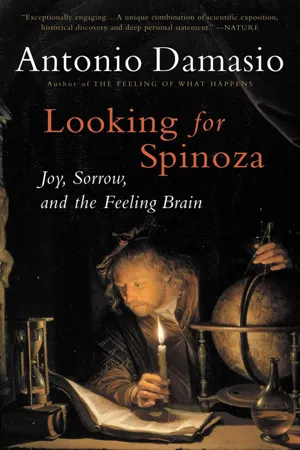
In the seventeenth century, the philosopher Spinoza examined the role emotion played in human survival and culture. Yet, the neurobiological roots of joy and sorrow remained a mystery. Today, we spend countless resources doctoring our feelings with alcohol, prescription drugs, health clubs, therapy, vacation retreats, and other sorts of consumption; yet the inner workings of our minds—what feelings are, how they work, and what they mean—are still largely an unexplored frontier.
Here, bestselling author and distinguished scientist Antonio Demasio concludes the groundbreaking trilogy he began with
Descartes' Error by drawing on his innovative research and experience with neurological patients to examine the cerebral processes of human emotion
. With scientific expertise and "a flair for writing," he navigates the neurology of feelings (
The New York Review of Books).
"Damasio has the rare talent of rendering science intelligible while also being gifted in philosophy, literature and wit." —Margaret Jacob,
Los Angeles Times
"Exceptionally engaging and profoundly gratifying . . . Achieves a unique combination of scientific exposition, historical discovery and deep personal statement regarding the human condition." —
Nature
"Damasio . . . succeeds in making the latest brain research accessible to the general reader, while his passionate Spinozist reflections make that data relevant to everyday life." —
Publishers Weekly
- 368 pages
- English
- ePUB (mobile friendly)
- Available on iOS & Android
eBook - ePub
About this book
Information
Subtopic
Psychiatry & Mental HealthIndex
PsychologyIndex
A | B | C | D | E | F | G | H | I | J | K | L | M | N | O | P | Q | R | S | T | U | V | W | X | Y | Z
A
acting, emotions and, 69, 71–73
adaptive adjustments, 49
addiction, 7, 152
admiration, 45–46
Adolphs, Ralph, 60, 61–62, 116–17, 303 (n13), 306 (n25), 307 (n30), 317 (n11), 339
adrenalin rush, 114–15
Advancement of Learning (Bacon), 224
affects, 8, 11–12, 72
Agid, Yves, 67–69, 307 (n33)
Aizenberg, Joanna, 326 (n15)
akinesia, 66
Albiac, Gabriel, 258, 329 (n13), 329 (n21)
alcohol, 119, 122, 123, 124
aloneness, 287
altruism, 157, 160–63
Amaral, David, 306 (n24)
amor intellectualis Dei, 276, 280
amphetamines, 123
amputation, 193
Amsterdam, 16–17, 228, 230–50, 252
amygdala, 58–60, 90, 103
Anagnostopoulus, Mariana, 338
analgesia, 113–15, 119
Anatomy Lesson of Dr. Tulp (Rembrandt), 16, 217–20, 262
Anderson, Steven, 77–79, 152, 307 (n29), 317 (n13), 317 (n14)
Andreasen, Nancy C., 314 (n33)
anger, 40, 41, 44–45, 50, 139, 163, 275
angiotensin, 104
anguish, 137–40
animal studies
altruism and, 160–61
compassion and, 167
emotions and, 40–42, 47–48
sexual desire and, 95
visual processing and, 201–2
anterior cingulate cortex, 76, 99, 100, 103, 109
antibodies, 58–59
antigens, 58–59
Antwerp, 230–31
Aplysia Californica, 42
appetites, 34, 49–50, 85, 93–96, 125, 168–69, 174
appraisal, 56
apprehension, 146
approaching response, 30–31
area postrema, 125
Aristotle, 15, 150, 171, 267, 278, 320–21 (n23)
Armstrong, David, 322–23 (n2)
arousal response, 30–31
asceticism, 278
as-if-body-loop, 115–21, 148–50...
Table of contents
- Title Page
- Contents
- Copyright
- Dedication
- Enter Feelings
- Of Appetites and Emotions
- Feelings
- Ever Since Feelings
- Body, Brain, and Mind
- A Visit to Spinoza
- Who’s There?
- Appendix I
- Appendix II
- Notes
- Glossary
- Acknowledgments
- Index
- About the Author
- Connect with HMH
- Footnotes
Trusted by 375,005 students
Access to over 1.5 million titles for a fair monthly price.
Study more efficiently using our study tools.
Frequently asked questions
Yes, you can cancel anytime from the Subscription tab in your account settings on the Perlego website. Your subscription will stay active until the end of your current billing period. Learn how to cancel your subscription
No, books cannot be downloaded as external files, such as PDFs, for use outside of Perlego. However, you can download books within the Perlego app for offline reading on mobile or tablet. Learn how to download books offline
We are an online textbook subscription service, where you can get access to an entire online library for less than the price of a single book per month. With over 1.5 million books across 990+ topics, we’ve got you covered! Learn about our mission
Look out for the read-aloud symbol on your next book to see if you can listen to it. The read-aloud tool reads text aloud for you, highlighting the text as it is being read. You can pause it, speed it up and slow it down. Learn more about Read Aloud
Yes! You can use the Perlego app on both iOS and Android devices to read anytime, anywhere — even offline. Perfect for commutes or when you’re on the go.
Please note we cannot support devices running on iOS 13 and Android 7 or earlier. Learn more about using the app
Please note we cannot support devices running on iOS 13 and Android 7 or earlier. Learn more about using the app
Yes, you can access Looking for Spinoza by Antonio Damasio in PDF and/or ePUB format, as well as other popular books in Psychology & Psychiatry & Mental Health. We have over 1.5 million books available in our catalogue for you to explore.