The
New York Times–bestselling author provides an "entertaining" look at how artists enlighten us about the workings of the brain (
New York magazine).
In this book, the author of
How We Decide and
Imagine: How Creativity Works "writes skillfully and coherently about both art and science"—and about the connections between the two (
Entertainment Weekly).
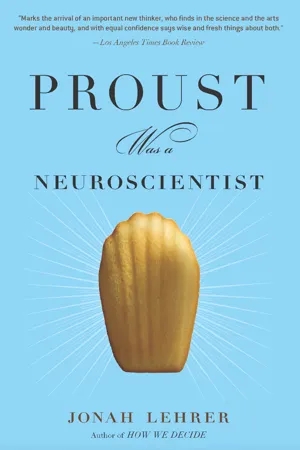
In this technology-driven age, it's tempting to believe that science can solve every mystery. After all, it's cured countless diseases and sent humans into space. But as Jonah Lehrer explains, science is not the only path to knowledge. In fact, when it comes to understanding the brain, art got there first.
Taking a group of artists—a painter, a poet, a chef, a composer, and a handful of novelists—Lehrer shows how each one discovered an essential truth about the mind that science is only now rediscovering. We learn, for example, how Proust first revealed the fallibility of memory; how George Eliot discovered the brain's malleability; how the French chef Escoffier discovered umami (the fifth taste); how Cézanne worked out the subtleties of vision; and how Gertrude Stein exposed the deep structure of language—a full half-century before the work of Noam Chomsky and other linguists.
More broadly, Lehrer shows that there's a cost to reducing everything to atoms and acronyms and genes. Measurement is not the same as understanding, and art knows this better than science does. An ingenious blend of biography, criticism, and first-rate science writing,
Proust Was a Neuroscientist urges science and art to listen more closely to each other, for willing minds can combine the best of both to brilliant effect.
"His book marks the arrival of an important new thinker . . . Wise and fresh." —
Los Angeles Times
- 256 pages
- English
- ePUB (mobile friendly)
- Available on iOS & Android
eBook - ePub
Proust Was a Neuroscientist
About this book
Information
Subtopic
Literary BiographiesIndex
Biological SciencesTable of contents
- Title Page
- Table of Contents
- Copyright
- Dedication
- Epigraphs
- Prelude
- Chapter 1: Walt Whitman
- Chapter 2: George Eliot
- Chapter 3: Auguste Escoffier
- Chapter 4: Marcel Proust
- Chapter 5: Paul Cézanne
- Chapter 6: Igor Stravinsky
- Chapter 7: Gertrude Stein
- Chapter 8: Virginia Woolf
- Coda
- Acknowledgments
- Notes
- Bibliography
- Index
- About the Author
- Footnotes
Trusted by 375,005 students
Access to over 1.5 million titles for a fair monthly price.
Study more efficiently using our study tools.
Frequently asked questions
Yes, you can cancel anytime from the Subscription tab in your account settings on the Perlego website. Your subscription will stay active until the end of your current billing period. Learn how to cancel your subscription
No, books cannot be downloaded as external files, such as PDFs, for use outside of Perlego. However, you can download books within the Perlego app for offline reading on mobile or tablet. Learn how to download books offline
Perlego offers two plans: Essential and Complete
- Essential is ideal for learners and professionals who enjoy exploring a wide range of subjects. Access the Essential Library with 800,000+ trusted titles and best-sellers across business, personal growth, and the humanities. Includes unlimited reading time and Standard Read Aloud voice.
- Complete: Perfect for advanced learners and researchers needing full, unrestricted access. Unlock 1.5M+ books across hundreds of subjects, including academic and specialized titles. The Complete Plan also includes advanced features like Premium Read Aloud and Research Assistant.
We are an online textbook subscription service, where you can get access to an entire online library for less than the price of a single book per month. With over 1.5 million books across 990+ topics, we’ve got you covered! Learn about our mission
Look out for the read-aloud symbol on your next book to see if you can listen to it. The read-aloud tool reads text aloud for you, highlighting the text as it is being read. You can pause it, speed it up and slow it down. Learn more about Read Aloud
Yes! You can use the Perlego app on both iOS and Android devices to read anytime, anywhere — even offline. Perfect for commutes or when you’re on the go.
Please note we cannot support devices running on iOS 13 and Android 7 or earlier. Learn more about using the app
Please note we cannot support devices running on iOS 13 and Android 7 or earlier. Learn more about using the app
Yes, you can access Proust Was a Neuroscientist by Jonah Lehrer in PDF and/or ePUB format, as well as other popular books in Biological Sciences & Literary Biographies. We have over 1.5 million books available in our catalogue for you to explore.