eBook - ePub
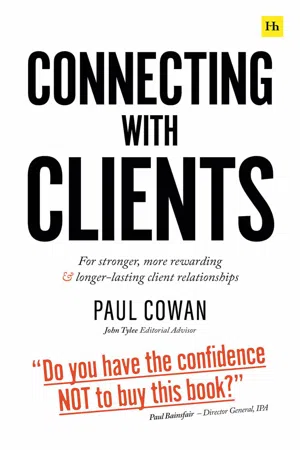
Connecting with Clients
For stronger, more rewarding and longer-lasting client relationships
- English
- ePUB (mobile friendly)
- Available on iOS & Android
eBook - ePub
Connecting with Clients
For stronger, more rewarding and longer-lasting client relationships
About this book
CLIENT RELATIONSHIPS
Finding some clients difficult to understand?
Confused when they say one thing but mean another?
Need better, more useful feedback?
Sometimes feel on the back-foot?
Have trouble managing client expectations?
Wonder why they seem impossible to please?
Concerned about being blind-sided by unexpected client loss?
THIS BOOK IS YOUR LIFELINE
Connecting with Clients contains new ideas derived from the world's leading relationship experts
Insights from over 500,000 pieces of client feedback worldwide
With tips and guidance from an adman, organisational change agent, couples' counsellor and co-founder of The Client Relationship Consultancy
Dip into short chapters and discover a valuable insight on every page
REJUVENATE YOUR CLIENT RELATIONSHIPS
With the help of this book, you will be able to:
Evaluate your client relationships and diagnose issues
Recognise your part in a problem
Obtain useful and clear feedback
Understand, relate to and communicate with your clients
Manage yourself and your team members
Get the best from your clients so that they get the best from you
CONNECTING WITH CLIENTS WILL SAVE YOU TIME, EFFORT AND MONEY AND MAKE LIFE MORE ENJOYABLE.
Information
Subtopic
Business GeneralIndex
BusinessCRITICAL VOICE IN YOUR HEAD? Four Liberating Questions.1
The chief executive was over-stressed.2
He looked tired, was slightly tubbier around the waist than usual and the tension in his face highlighted the bags under his eyes. His voice sounded strained and held a slight edge of frustration.
His client, in stark contrast, looked thinner, younger and more alive than ever.
The CEO had become distanced from colleagues – he seemed too burdened to connect with them. Important decisions took him longer to make, his management team drained him; they needed strong and firm direction. He listened to everybody as carefully as ever, but meetings exhausted him.
Most of all he listened to his own voice, which criticised him for not being on top of everything, for failing to manage the key issues, for delaying decisions, for allowing his team to fall apart.
The CEO listened dutifully to his internal critical voice, which told him to do better, work harder, be a better dad and husband.
He listened to his internal voice being critical of people around him and felt frustrated by them. Even those to whom he would normally turn towards for support made him feel slightly irritable.
And he criticised his own anger, blaming himself for not working hard enough or being good enough.
So he worked harder, didn’t give himself enough time off to relax and entered a vicious cycle.
Listening to his own critical voice was his only error.
It’s likely that more than 10% of people have a tendency to be more self-critical than others.3 If you are wondering whether this is you, it may be difficult to recognise your pattern because it’s the water you swim in every day. After all, only flying fish get to take a look at their everyday environment from time to time.
But, just say you recognise a pattern of work before pleasure; you notice yourself feeling peeved or a tad frustrated when others don’t live up to your expectations; you experience a physical tension under pressure; and you have a voice in your head telling you what’s right or wrong, how to improve and beating you up if you make a mistake. If you do all, or some, of these things, then it is likely you will be more easily trapped by a vicious, self-perpetuating cycle.
The CEO’s stress did not reflect reality. Rather, it reflected the suffering inside his mind.
There’s a simple process for freeing ourselves of the thoughts that make us suffer.1
Write down your stressful thoughts and then ask yourself the following four questions:
Question 1: Is this critical thought true?
This question could change your life. Be still and ask yourself if the thought you wrote down is true.
Question 2: Can you absolutely know it’s true?
This is an opportunity to open your mind and go deeper – into possibly unknown areas – to find the answers that live beneath what we think we know.
Question 3: How do you react – what happens – when you believe that thought?
Notice internal cause and effect. You may find that when you believe the thought there is a disturbance that can range from mild discomfort to frustration or fear.
What do you feel?
And, when you believe that thought, how do you treat the person (or the situation) you’ve written about? How do you treat yourself?
Make a list and be specific.
Question 4: Who would you be without the thought?...
Table of contents
- CONTENTS
- CONNECTING WITH CLIENTS
- AS YOU USE THIS BOOK, REMEMBER THE PRINCIPLE OF MARGINAL GAINS
- ABOUT THE AUTHOR
- ALREADY LISTENING. But Not Hearing.
- ANNUAL REVIEWS. What’s Not to Like?
- AVIATE, NAVIGATE, COMMUNICATE. Managing More In Less Time.
- BAD NEWS STICKS.
- BEST BOSS. WORST BOSS. The Importance of Emotional Intelligence.
- BRILLIANT BASICS.
- BULLSHIT. The Fastest Way to Undermine Your Relationships.
- BURN CALORIES, BUILD RELATIONSHIPS, CREATE NEW OPPORTUNITIES AND ENJOY A COFFEE. The Benefits of Walking the Corridors.
- CALL YOUR CLIENTS EVERY DAY AND KEEP THE OTHER AGENCIES AWAY.
- CHANGE BLINDNESS. How To Drift Into Trouble.
- CLEAN LANGUAGE. How To Understand What Your Client Means. And How To Help Them Understand What They Really Mean.
- COMMUNICATION IN THE VIRTUAL WORLD. The Impact on Us and Our Client Relationships.
- CRITICAL VOICE IN YOUR HEAD? Four Liberating Questions.1
- DAVID OGILVY’S ADVICE FOR CLIENT RELATIONSHIPS.1
- EFFECTIVE LISTENING.
- EMAIL. The Everyday Opportunity to Miscommunicate With Your Colleagues and Clients.
- “EVERYTHING IS OK.” Is Your Client Telling the Whole Truth? Diagnostic Inquiry.
- EXCELLENCE OR WHAT THE HELL ARE YOU DOING HERE?
- EXIT INTERVIEW YOUR CLIENTS. It’s Never Too Late to Get Feedback.
- EXTRAVERT OR INTROVERT? Getting the Best From Yourself and Others.
- FEEDBACK OR FEEDFORWARD. Why Look Back When You Can Look Forward?
- GLOBAL ACCOUNT GAIN, LOCAL OFFICE PAIN. Forced Relationships.
- “GOOD WORK IS NOT ENOUGH.”1 Care In Relationships.
- HIDDEN COMPLAINTS WILL BITE YOUR ARSE IF YOU MISS THEM.
- HOW TO ALIENATE YOUR CLIENTS. Top Tips From Real Life.1
- INTUITION. Aka Trust Your Gut.
- JUST PICK UP THE F*****G PHONE.
- MANAGING EXPECTATIONS.
- MEETINGS. Meetings. Meetings.
- MICRO-EVENTS. How They Form a Narrative.
- MINDSET. Fixed or Growth?
- MISTAKES AND LEARNING GO TOGETHER.
- NEVER GIVE UP. There is Always Another Option.
- ONE MEETING. Two Contrasting Realities.
- OPENING THE JOHARI WINDOW.
- OPTIMISM BIAS. How to Feel Good and Make Poor Decisions.
- OWNERSHIP. Aka a Sense of Agency.
- PARENT, ADULT OR CHILD? Ego States – The Hidden Dynamic Affecting Your Relationships.
- PARTNERSHIP WITH YOUR CLIENTS?
- PEOPLE. Too Important to Leave to the HR Team.
- PERCEPTIONS ARE REALITY.
- PROBLEM A AND PROBLEM B. Why Agencies Get Hired for the Work and Fired for the Relationship. And the Real Reason that Emma and Jason are in Couples Counselling.
- PSYCHOLOGICAL GAMES.
- RED ZONE OR BLUE ZONE?1
- REDUNDANCY EFFECT. What Happens When You Overload Your Client’s Mind in a Pitch or Presentation.
- SELF-DEVELOPMENT AND PERSONAL GROWTH. Once You Know Something About Yourself, You Can’t Unknow It. That Leads to Growth.
- SEPARATED BY A COMMON LANGUAGE. Why You and Your Client May Use the Same Words But Mean Different Things.
- STOP MOANING. Start Motivating.
- TARGET FIXATION. How to Avoid It Hurting You, Killing You or Simply Wasting Your Time, Energy and Money.
- TEAM CHANGE. The Masters and Disasters.
- THE AGENCY DOESN’T LISTEN. Real Clients. In Their Own Words.1
- THE FINGER OF BLAME. Easily Done in a Pressurised Agency World.
- THE HOLOGRAM. Understanding a Client Organisation.
- THE SOUND RELATIONSHIP HOUSE.
- THE TELEPHONE LIST. Overcoming Avoidance, the Easy Way.
- THE UNWRITTEN CONTRACT WITH YOUR NEW CLIENT. It’s Psychological.1
- THE VIRUS INFECTING YOUR CLIENT TEAM. Contagious, Airborne and Damaging to Health. And Spread by Even the Most Junior Client.
- THE WORKING ALLIANCE. Aka the 60-Second Relationship Check.
- TRAINING YOUR CLIENTS. And Possibly Your Partner.
- TRUST. “You know it when you feel it.”1
- TZUR NSTINK, SHITAK KHOSINK. Let’s Sit Crooked But Talk Straight.
- UNDERSTANDING YOUR CLIENT’S ORGANISATION. Use a Metaphor.
- WASH UPS. Get the Dirt Out Before It Sticks.
- WHAT YOU LOOK FOR YOU WILL FIND. A Buddhist Tale.
- WHEN THE S*** HITS THE FAN. The Importance of Staying Calm When Things Are Hot.
- WHO ARE YOU? An Opportunity to Stop Wasting Your Energy.
- WHY CLIENT-AGENCY RELATIONSHIPS ARE ALWAYS UNSTABLE. Hello Agency Theory.
- WHY RELATIONSHIPS HAVE BECOME INCREASINGLY TRANSACTIONAL.
- YOUR CLIENT IS NOT CRAZY. He is Just Different From You.
- YOUR CLIENT SPEAKS. You Remember It Differently.
- YOUR PSYCHOLOGICAL CONTRACT.1
- ZZZZZZZZ. Staying Alert With the Ever-So-Dull Client.
- AND FINALLY. This Book Could Not Have Happened Without…
- NOTES AND REFERENCES
- WHAT NEXT?
- PUBLISHING DETAILS
Trusted by 375,005 students
Access to over 1.5 million titles for a fair monthly price.
Study more efficiently using our study tools.
Frequently asked questions
Yes, you can cancel anytime from the Subscription tab in your account settings on the Perlego website. Your subscription will stay active until the end of your current billing period. Learn how to cancel your subscription
No, books cannot be downloaded as external files, such as PDFs, for use outside of Perlego. However, you can download books within the Perlego app for offline reading on mobile or tablet. Learn how to download books offline
Perlego offers two plans: Essential and Complete
- Essential is ideal for learners and professionals who enjoy exploring a wide range of subjects. Access the Essential Library with 800,000+ trusted titles and best-sellers across business, personal growth, and the humanities. Includes unlimited reading time and Standard Read Aloud voice.
- Complete: Perfect for advanced learners and researchers needing full, unrestricted access. Unlock 1.5M+ books across hundreds of subjects, including academic and specialized titles. The Complete Plan also includes advanced features like Premium Read Aloud and Research Assistant.
We are an online textbook subscription service, where you can get access to an entire online library for less than the price of a single book per month. With over 1.5 million books across 990+ topics, we’ve got you covered! Learn about our mission
Look out for the read-aloud symbol on your next book to see if you can listen to it. The read-aloud tool reads text aloud for you, highlighting the text as it is being read. You can pause it, speed it up and slow it down. Learn more about Read Aloud
Yes! You can use the Perlego app on both iOS and Android devices to read anytime, anywhere — even offline. Perfect for commutes or when you’re on the go.
Please note we cannot support devices running on iOS 13 and Android 7 or earlier. Learn more about using the app
Please note we cannot support devices running on iOS 13 and Android 7 or earlier. Learn more about using the app
Yes, you can access Connecting with Clients by Paul Cowan in PDF and/or ePUB format, as well as other popular books in Business & Business General. We have over 1.5 million books available in our catalogue for you to explore.