"Opie delves into the history books to find true soul in the food of the South, including its place in the politics of black America."—NPR.org
Frederick Douglass Opie deconstructs and compares the foodways of people of African descent throughout the Americas, interprets the health legacies of black culinary traditions, and explains the concept of soul itself, revealing soul food to be an amalgamation of West and Central African social and cultural influences as well as the adaptations blacks made to the conditions of slavery and freedom in the Americas.
Sampling from travel accounts, periodicals, government reports on food and diet, and interviews with more than thirty people born before 1945, Opie reconstructs an interrelated history of Moorish influence on the Iberian Peninsula, the African slave trade, slavery in the Americas, the emergence of Jim Crow, the Great Migration, the Great Depression, and the Civil Rights and Black Power movements. His grassroots approach reveals the global origins of soul food, the forces that shaped its development, and the distinctive cultural collaborations that occurred among Africans, Asians, Europeans, and Americans throughout history. Opie shows how food can be an indicator of social position, a site of community building and cultural identity, and a juncture at which different cultural traditions can develop and impact the collective health of a community.
"Opie goes back to the sources and traces soul food's development over the centuries. He shows how Southern slavery, segregation, and the Great Migration to the North's urban areas all left their distinctive marks on today's African American cuisine."—Booklist
"An insightful portrait of the social and religious relationship between people of African descent and their cuisine."—FoodReference.com
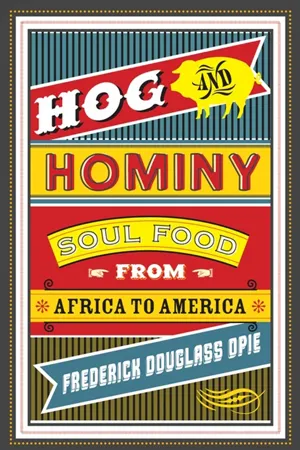
- 258 pages
- English
- ePUB (mobile friendly)
- Available on iOS & Android
eBook - ePub
About this book
Information
Topic
ArtSubtopic
Agricultural Public PolicyTable of contents
- Cover
- Half title
- Arts & Traditions of the Table
- Title
- Copyright
- Dedication
- Contents
- List of Illustrations
- Introduction
- 1: The Atlantic Slave Trade and the Columbian Exchange
- 2: Adding to my Bread and Greens: Enslaved Cookery in British Colonial America
- 3: Hog and Hominy: Southern Foodways in the Nineteenth Century
- 4: The Great Migration: From the Black Belt to the Freedom Belt
- 5: The Beans and Greens of Necessity: African Americans and the Great Depression
- 6: Eating Jim Crow: Restaurants, Barbecue Stands, and Bars and Grills During Segregation
- 7: The Chitlin Circuit: The Origins and Meanings of Soul and Soul Food
- 8: The Declining Influence of Soul Food: The Growth of Caribbean Cuisine in Urban Areas
- 9: Food Rebels: African American Critics and Opponents of Soul Food
- Epilogue
- Notes
- Bibliography
- Index
Trusted by 375,005 students
Access to over 1.5 million titles for a fair monthly price.
Study more efficiently using our study tools.
Frequently asked questions
Yes, you can cancel anytime from the Subscription tab in your account settings on the Perlego website. Your subscription will stay active until the end of your current billing period. Learn how to cancel your subscription
No, books cannot be downloaded as external files, such as PDFs, for use outside of Perlego. However, you can download books within the Perlego app for offline reading on mobile or tablet. Learn how to download books offline
Perlego offers two plans: Essential and Complete
- Essential is ideal for learners and professionals who enjoy exploring a wide range of subjects. Access the Essential Library with 800,000+ trusted titles and best-sellers across business, personal growth, and the humanities. Includes unlimited reading time and Standard Read Aloud voice.
- Complete: Perfect for advanced learners and researchers needing full, unrestricted access. Unlock 1.5M+ books across hundreds of subjects, including academic and specialized titles. The Complete Plan also includes advanced features like Premium Read Aloud and Research Assistant.
We are an online textbook subscription service, where you can get access to an entire online library for less than the price of a single book per month. With over 1.5 million books across 990+ topics, we’ve got you covered! Learn about our mission
Look out for the read-aloud symbol on your next book to see if you can listen to it. The read-aloud tool reads text aloud for you, highlighting the text as it is being read. You can pause it, speed it up and slow it down. Learn more about Read Aloud
Yes! You can use the Perlego app on both iOS and Android devices to read anytime, anywhere — even offline. Perfect for commutes or when you’re on the go.
Please note we cannot support devices running on iOS 13 and Android 7 or earlier. Learn more about using the app
Please note we cannot support devices running on iOS 13 and Android 7 or earlier. Learn more about using the app
Yes, you can access Hog and Hominy by Frederick Douglass Opie in PDF and/or ePUB format, as well as other popular books in Art & Agricultural Public Policy. We have over 1.5 million books available in our catalogue for you to explore.