A historian examines how everyday people reacted to the president's assassination in this "highly original, lucidly written book" (James M. McPherson, author of
Battle Cry of Freedom).
The news of Abraham Lincoln's assassination on April 15, 1865, just days after Confederate surrender, astounded a war-weary nation. Massive crowds turned out for services and ceremonies. Countless expressions of grief and dismay were printed in newspapers and preached in sermons. Public responses to the assassination have been well chronicled, but this book is the first to delve into the personal and intimate responses of everyday people—northerners and southerners, soldiers and civilians, black people and white, men and women, rich and poor.
Exploring diaries, letters, and other personal writings penned during the spring and summer of 1865, historian Martha Hodes captures the full range of reactions to the president's death—far more diverse than public expressions would suggest. She tells a story of shock, glee, sorrow, anger, blame, and fear. "'Tis the saddest day in our history," wrote a mournful man. It was "an electric shock to my soul," wrote a woman who had escaped from slavery. "Glorious News!" a Lincoln enemy exulted, while for the black soldiers of the Fifty-Fourth Massachusetts, it was all "too overwhelming, too lamentable, too distressing" to absorb.
Longlisted for the National Book Award,
Mourning Lincoln brings to life a key moment of national uncertainty and confusion, when competing visions of America's future proved irreconcilable and hopes for racial justice in the aftermath of the Civil War slipped from the nation's grasp. Hodes masterfully explores the tragedy of Lincoln's assassination in human terms—terms that continue to stagger and rivet us today.
Frequently asked questions
Yes, you can cancel anytime from the Subscription tab in your account settings on the Perlego website. Your subscription will stay active until the end of your current billing period. Learn how to cancel your subscription.
At the moment all of our mobile-responsive ePub books are available to download via the app. Most of our PDFs are also available to download and we're working on making the final remaining ones downloadable now. Learn more here.
Perlego offers two plans: Essential and Complete
Essential is ideal for learners and professionals who enjoy exploring a wide range of subjects. Access the Essential Library with 800,000+ trusted titles and best-sellers across business, personal growth, and the humanities. Includes unlimited reading time and Standard Read Aloud voice.
Complete: Perfect for advanced learners and researchers needing full, unrestricted access. Unlock 1.4M+ books across hundreds of subjects, including academic and specialized titles. The Complete Plan also includes advanced features like Premium Read Aloud and Research Assistant.
Both plans are available with monthly, semester, or annual billing cycles.
We are an online textbook subscription service, where you can get access to an entire online library for less than the price of a single book per month. With over 1 million books across 1000+ topics, we’ve got you covered! Learn more here.
Look out for the read-aloud symbol on your next book to see if you can listen to it. The read-aloud tool reads text aloud for you, highlighting the text as it is being read. You can pause it, speed it up and slow it down. Learn more here.
Yes! You can use the Perlego app on both iOS or Android devices to read anytime, anywhere — even offline. Perfect for commutes or when you’re on the go. Please note we cannot support devices running on iOS 13 and Android 7 or earlier. Learn more about using the app.
Yes, you can access Mourning Lincoln by Martha Hodes in PDF and/or ePUB format, as well as other popular books in History & American Civil War History. We have over one million books available in our catalogue for you to explore.
SARAH BROWNE WAS EXUBERANT. Exclamation points marched across the pages of her diary, four in a row. In the first hours of Monday, April 3, 1865, news had come into the Salem telegraph office reporting General Grant’s probable victory at Petersburg. Soon after Sarah heard the ringing bells at four o’clock that afternoon, she learned that the Union army had entered Richmond. Telegrams reported the city burning and Grant pursuing Lee, and the next day’s papers told of a crowd gathering in Washington to listen to Secretary of War Edwin Stanton announce the fall of the Confederate capital. That intelligence merited another four exclamation points. From the newspaper columns, Sarah selected particular facts. “Rebels flying toward Lynchburg. Our losses less than 7,000,” she wrote. “Sheridan has headed off Lee!!” By Friday, April 7, the headline of the Boston Evening Transcript declared the news glorious: six rebel generals captured, Mobile likely to fall, Lee’s troops cut off from Lynchburg, and President Lincoln in Richmond, walking among the Union soldiers and now-free black population. “All over the North are wild with joy,” Sarah wrote. “Joy—Joy every where!” To continue with her usual household tasks seemed nearly impossible.1
At four o’clock in the morning on Monday, April 10, the Browne house-hold was roused by bells and gunfire, followed by voices calling out that Lee and his entire army had surrendered. Sarah and the children hurried out of bed to illuminate the outdoor gaslights and unfurl a flag from an upstairs window. In the predawn darkness, neighbors blew horns and tossed firecrackers. In the daylight, walking through Salem, Sarah exchanged happy greetings with everyone who had come outdoors to celebrate, and the news garnered eight exclamation points in her diary. At a special service that week, the minister at church spoke boldly of black suffrage, and Sarah felt grateful to God. It was only when she read through the speech President Lincoln had delivered from the White House on April 11, laying out his ideas for reconstructing the nation, that her mood shifted. “I am much disappointed at finding it unmistakably conservative,” she sighed. “Why can’t he cut down the whole tree, instead of lopping off the branches?”2
Down south, at the same moment, Albert Browne was marveling over the fall of Richmond. “How fast I have lived these past two years,” he exulted. “What a grand period in history is the present moment.” The South, Albert believed, could now emerge from feudalism into the “glorious splendor of the nineteenth century.” And to think of the elevation of Negroes! “A man is a man, be he black, white, or grey,” he wrote to his family up north.3
After Lee’s surrender, came the re-raising of the Union flag over Fort Sumter in South Carolina, where Confederates had won the first battle of the war. Albert was there now, four years later, among those listening reverently to the abolitionist New York minister Henry Ward Beecher, and it was a day he would never forget, a day he hoped his children and grandchildren would never forget, a day “most grand, imposing and soul inspiring.” The battered walls of the fort. The defiant, high-flying flag. The triumph. The glory. Albert described everything in a letter home, even the way the chairs were arranged for the speakers. That was the easy part—it was his emotions that he couldn’t convey, for everything was “unspeakable” (he underlined that word). Late into the night, lying awake, Albert heard the public prayers of hundreds of former slaves gathered in the streets of Charleston, praising God for freedom. How unabashedly symbolic was the return to Sumter to raise the Union flag once again over the fort, bringing full circle the revolutionary changes wrought by four years of terrible war! “The sights I have seen,” Albert Browne told his wife and children, “are written with a piece of steel on my memory.”4
AS APRIL ARRIVED IN JACKSONVILLE, Rodney Dorman was in despair over the city’s unsanitary conditions: the torn-up sidewalks layered thickly with sand and soil, the heaps of foul trash and fish carcasses fermenting under the southern sun. Worse, though, were the enemy occupiers. If they didn’t pack up soon, and take their “nonsensical, outrageous-to-humanity dogmas & knavery” with them, Dorman wrote in his journal, he would have to find a way to leave. Most horrific of all, the gunboats from Fernandina and Charleston brought in the northern newspapers proclaiming Confederate defeat. The Union men in his midst cheered and hugged, fired a two-hundred-gun salute, lit rockets, set barrels of tar afire, and got drunk, all of which sent Dorman into a rage, the flames from their tar barrels perhaps conjuring visions of his own torched home. The black soldiers irked him the most, even though he was sure their white comrades and the northern missionaries had put them up to their insolent behavior, since the white Yankees were, he fumed into his diary, “blacker than the negroes.” Why should he believe the news, anyway? After all, there had been a dozen false reports that Richmond had fallen. Still unconvinced, even in the face of the carousing Yankees, Dorman wrote the words “if the North succeeds in this war.” Soon enough, he was confronted with a jubilant meeting of African Americans at the Methodist church led by, he could only scowl, “some negro, abolitionist incendiary chaplain.” If only, he pled, “a thunder bolt would grind the whole of them to powder.”5
Dorman then turned his thoughts to Abraham Lincoln, whose name he always wrote as Lincon, intentionally misspelling the second syllable to emphasize the scoundrel’s wily nature. The collapse of the Confederacy was, he reasoned, akin to the Roman defeat of Carthage or the English defeat of the Irish: a tyrant had gotten his military victory, but now he had a badly fractured country on his hands, one he would never be able to control. Turning pensive for only a moment, Dorman paused his tirade. “Summer is coming on now, & I don’t know what I am going to do,” he wrote. “It will be intolerable to spend it here, & I don’t know where else I can go.” Jacksonville had become hell incarnate, and he no longer had a home.6
Dorman read all about the Union flag raising at Sumter in those late-arriving New York newspapers too—”some kind of a tom-foolery celebration” by a bunch of “fools & knaves,” he called it. How Dorman hated Henry Beecher, leading the festivities in South Carolina, gabbling to his geese, more wicked than the devil himself. That Beecher wasn’t a radical like William Lloyd Garrison made no difference. It was all the same, the Yankee preacher’s shameful charisma and activism having spread antislavery ideology like wildfire. For Rodney Dorman, not even “a hundred hangings” would be enough for Henry Ward Beecher.7
RICHMOND HAD FALLEN! ON SUNDAY, April 2, 1865, the white congregation at Saint Paul’s Church watched as the sexton entered to deliver a message, then watched President Jefferson Davis slip out of his pew. The worshippers soon learned that the telegram, from Robert E. Lee, had alerted Davis that the city would shortly come under Union control. Davis left the Confederate capital that night, soon to be followed by the rest of his government. With impending occupation, white residents could stay or go, and the streets were chaotic, crowded with loaded-down horses, carriages, and wagons. Rebel troops would burn parts of the city on their way out.
When Union troops marched in the next morning, they sang “Babylon Is Fallen.” Union soldiers, black and white, met crowds of black men and women who shook their hands, blessed them, and thanked God for answering their prayers. “You’ve come at last,” they said. “We’ve been looking for you.” Their people had fought for freedom, and now they were free. The elderly praised God that they had lived to see the day. Right from the start, the runaway slave and abolitionist Frederick Douglass had proclaimed the Civil War “a war for and against slavery,” and from the start, black men had pressed the federal government to let them fight. But even now, for some, the downfall of Richmond could barely avenge generations of enslavement. “They sold my father, they murdered my mother,” one freedman said. Another looked around at the wounded Confederates, wanting to do violence to every one of them.8
Meanwhile, when the news reached a black school in Norfolk, the boys and girls gave three cheers, then sang “Colored Volunteer” and “Battle Cry of Freedom,” enunciating the words Not a man shall be a slave and Union forever. When they came to “John Brown’s Body,” with the words We’ll hang Jeff Davis from the sour apple tree, a little girl named Rose wanted to know if the Confederate president had been sent to the gallows. A little boy announced he was “glad Uncle Sam beat the Secesh,” and with the help of the missionary teachers from up north, the children made wreathes and banners for the upcoming parade. They talked of finding parents or siblings who had been sold away or forced by their masters to leave the city during the war. Rose felt indignant when she learned that Jefferson Davis was still alive, but Union victory now seemed certain, and that meant freedom forever.9
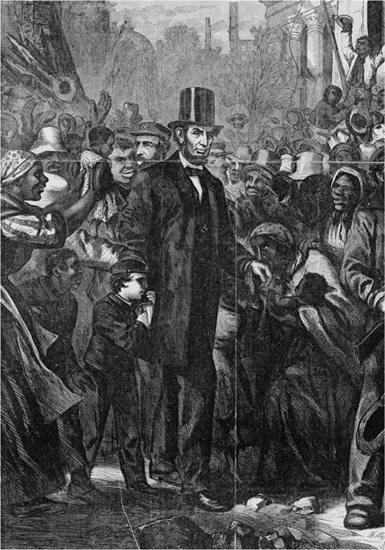
The next day, Tuesday, April 4, President Lincoln arrived in Richmond, holding the hand of his twelve-year-old son, Tad, as he walked among the people. All along the route to the former executive mansion—where Lincoln would sit at the desk of the fleeing Jefferson Davis—thousands of overjoyed African Americans encircled and followed, spreading word of Lincoln’s presence. Some of the city’s middling and poorer whites joined in, but it was the black residents who shouted praises to God, calling the president “father” or “master Abraham.” The black Philadelphia journalist Thomas Morris Chester was already referring to his people as citizens in his dispatches. At a jubilee celebration, black families filled every church pew and aisle. Outside, people climbed up to the windows, the crowd so immense that many stood too far away to hear a single word.10
“We thought Lincoln was risking too much to go into Richmond,” wrote Annie Dudley, a white woman who worked at the Bureau of Indian Affairs in Washington, “very much afraid he would get killed by some of those defeated arch rebels.”11
The news of Richmond’s fall came to Union troops by telegram, with mounted officers galloping along the lines, or by northern newspapers delivered by passing locomotives or docking steamers. The men threw their hats in the air and cheered. “By jove I never thought men had such lungs,” exclaimed a Michigan soldier. They threw their shoes in the air too, fired muskets and cannons, lit firecrackers, jumped up and down, and danced to the music of regimental bands. Soldiers who got word at nine in the morning reveled till past midnight, gulping whiskey and malt liquor. “Glory to God!” an Ohio man wrote in the pages of the address book he used as a wartime diary. In Tennessee, a bunch of soldiers repeatedly fired a cannon in front of a Confederate residence until every pane of glass was smashed, then joked that the burning building could now pass for an illuminated Unionist home. When word arrived at the Union hospitals, the sick and wounded could all of a sudden “bear their pain better.”12
President Lincoln walks through the streets of Richmond, Virginia, just after the Confederate capital fell to the Union. In this 1866 drawing, Lincoln holds the hand of his twelve-year-old son, Tad, while African Americans celebrate their freedom and pay tribute to their “best friend.” Picture Collection, The Branch Libraries, The New York Public Library, Astor, Lenox and Tilden Foundations.
Wild. Crazy. Agog. That’s how people described the mood when the news reached the northern home front. In Wilmington, New York, Cincinnati, Chicago, Sacramento, and everywhere in between, it was huzzas, songs, speeches, pealing church chimes and clanging fire bells, tooting steam whistles and roaring guns and cannons. Crowds collected around the newspaper and telegraph offices. Classroom doors burst open as teachers dismissed school. Washington was in an intoxicated uproar all day April 3 and for three days afterward, the White House “resplendent with candles,” the Capitol dome decorated with “tiers of lights.” The War Department and Post Office were lit up too, and in front of the Patent Office, gas jets spelled the word Union in enormous letters.13
“Richmond has fallen,” Emilie Davis wrote in her Philadelphia diary. The young woman’s words were spare but the occasion grand, for her brothers had fought with black units in the war, she had attended an emancipation celebration in 1863, and she had listened to Frederick Douglass deliver a lecture only a few months earlier. Young folks in the city, both black and white, took in the illuminations on Chestnut, Walnut, and Arch Streets, and to sixteen-year-old Margaret Howell, the night felt like “New Year’s Eve, Christmas Eve, and Fourth of July all combined.” In Boston, boys piled into a wagon, waving flags and handkerchiefs, shaking rattles and banging drums, stopping in front of each house to shout the news and catch an answering cheer in return. At the state legislature, the men adjourned and broke into “Old John Brown.” When the news reached the California mining town of Weaverville, the workers quit and took their families dancing at the local theater late into the night. Across the Atlantic, the U.S. consul and future novelist William Dean Howells had been entertaining American guests at his home in Venice when word came (it was late April by then), prompting exultation and “great handshaking.”14
Like Emilie Davis, and like Sarah and Albert Browne, those who counted themselves foes of slavery were immeasurably overjoyed. At eighty-seven years old, John Prentiss of New Hampshire had prayed he would live to see the day. The rebels had fought for slavery as their “Corner Stone,” the elderly white man wrote in his diary, referring to the 1861 “cornerstone speech” of Alexander Stephens, in which the Confederate vice president had proclaimed the “great truth that the negro is not equal to the white man,” that enslavement was his natural condition. Now, Prentiss rejoiced, the slaveholders were “doomed forever.” Abolitionists knew this was the work of God.15
TO THE VICTORS, THE ENTIRE nation appeared to be celebrating, but that impression was accurate only if they ignored the evidence of Confederate distress. For Secretary of the Navy Gideon Welles it seemed the “entire population” was celebrating in the streets of Washington, even as he noted in his diary that all secessionists living in the capital “must have retired.” Notably, the Confederates themselves refrained from describing scenes of universal celebration; Henry Berkeley, an imprisoned private from Lee’s army, named the revelers only as “all yankeedom.” True, some of Richmond’s white residents joined in the festivities, but most stayed inside. Union soldiers could read their “sour faces,” reflecting both anguish and apprehension. Thomas Morris Chester could see them standing silently at their front steps or peering from their windows. He knew it was an occasion they had scarcely ever imagined, and for the vanquished it was frightening indeed. Henri Garidel, in town from Louisiana, watched as black people greeted his conquerors amid billowing Union flags. Listening to their hurrahs, his heart felt “heavy as a mountain.” Lincoln’s carriage, it seemed to Garidel, was “followed by the entire Negro population of Richmond,” and now his own heart was breaking. Nor was every white person up north thrilled—one New Yorker surmised that the “contemptable Copperheads” were keeping quiet out of fear, some even deceitfully waving flags, despite their hatred of Lincoln, black people, and the whole Civil War.16
For Lee’s men, the last months in the Army of Northern Virginia had been an ordeal of despair and exhaustion accompanied by steady desertion. A member of the Richmond Howitzers, watching the bursting mortar shells through the night, thought “the world would fall to pieces.” Civilians invoked the language of doom too. “Every body is dying with the blues,” Amanda Edmunds wrote from her family’s thousand-acre Virginia plantation. Diehard rebels tried mightily to keep up their spirits, but Yankee glee made it worse, or maybe it was their pious gratitude. Seventeen-year-old Emma LeConte had been living in Columbia, South Carolina, in February, when the combined actions of Union soldiers, slaves, evacuating Confederates, and escaped prisoners set the city afire, sparing the college campus where her father taught. The family also owned a large plantation, and now LeConte had to suffer heretofore unknown hardships, reading by c...