“The seminal book on global poverty and hunger . . . How rapacious speculators and complicit bureaucrats are starving a billion people” (Wenonah Hauter, executive director of Food & Water Watch and author of Foodopoly).
Few people know that world hunger was very nearly eradicated in our lifetimes. In the past five years, however, widespread starvation has suddenly reappeared, and chronic hunger is a major issue on every continent.
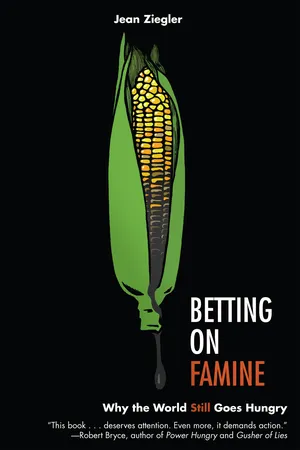
In an extensive investigation of this disturbing shift, Jean Ziegler—one of the world’s leading food experts—lays out in clear and accessible terms the complex global causes of the new hunger crisis. Ziegler’s wide-ranging and fascinating examination focuses on how the new sustainable revolution in energy production has diverted millions of acres of corn, soy, wheat, and other grain crops from food to fuel. The results, he shows, have been sudden and startling, with declining food reserves sending prices to record highs and a new global commodities market in ethanol and other biofuels gobbling up arable lands in nearly every continent on earth.
Like Raj Patel’s pioneering Stuffed and Starved, Betting on Famine will enlighten the millions of Americans concerned about the politics of food at home—and about the forces that prevent us from feeding the world’s children.
“In this devastating book, [Ziegler] describes the horrors of food insecurity, the callousness of ‘crusaders of neoliberalism’ who control food and land access, and the individuals and grassroots organizations fighting for subsistence farmers and the right to food.” —Publishers Weekly (starred review)
“Passionate, well-researched, objective, and illuminating . . . When we close this book, indignant, we know that those who die of hunger are victims of money and power.” —L’Express
- 241 pages
- English
- ePUB (mobile friendly)
- Available on iOS & Android
eBook - ePub
About this book
Information
PART I
MASSACRE
1
THE GEOGRAPHY OF HUNGER
The human right to food, which follows from article 11 of the International Covenant on Economic, Social and Cultural Rights, has since 2002 been defined by the office of the UN’s Special Rapporteur on the Right to Food as follows:
The right to have regular, permanent and unrestricted access, either directly or by means of financial purchases, to quantitatively and qualitatively adequate and sufficient food corresponding to the cultural traditions of the people to which the consumer belongs, and which ensure a physical and mental, individual and collective, fulfilling and dignified life free of fear.
Among all human rights, the right to food is certainly the one most constantly violated on our planet. Allowing people to starve borders on organized crime. As we read in Ecclesiastes: “A meagre diet is the very life of the poor, to deprive them of it is to commit murder. To take away a fellow-man’s livelihood is to kill him, to deprive an employee of his wages is to shed blood.”
According to estimates made by the FAO, the number of people on the planet who are seriously and permanently undernourished reached 925 million in 2010, as against 1.023 billion in 2009. Nearly a billion human beings out of the 7 billion on the planet thus suffer from permanent hunger.
The phenomenon of hunger may be approached in very simple terms. Solid foods, whether of animal or vegetable (and sometimes mineral) origin, are consumed by living beings to satisfy their needs for energy and nutrition. Liquid foods, or beverages (including water from underground sources, which may contain dissolved minerals), are consumed for the same purpose (liquid foods may be essentially considered solid food when they are in the form of soups, sauces, and so on). Together, solid and liquid sources of nourishment constitute what we call an organism’s diet.
The human diet provides the vital energy that human beings need to live. The fundamental unit of food energy is the calorie, which enables us to measure the amount of nourishment that the body needs to grow, maintain, and rebuild itself. An inadequate caloric intake leads first to hunger, then to death. Human caloric needs vary according to age: about 700 calories per day for an infant, 1,000 for a child between one and two years old, and 1,600 for a five-year-old; adults’ needs range from 2,000 to 2,700 calories per day depending on the climate where they live and the kind of work they do. The World Health Organization (WHO) sets 2,200 calories per day as the minimum necessary for an adult. Below this limit, an adult cannot maintain his or her body in a healthy state.
Severe, permanent undernutrition also causes acute suffering, tormenting the body. It induces lethargy and gradually weakens both mental and physical capacities. It leads to social marginalization, the loss of economic autonomy, and, of course, permanent unemployment on account of the sufferer’s inability to engage in regular work. With rare exceptions, a human being may live normally for three minutes without breathing, three days without drinking, and three weeks without eating. No more. Then we begin to decline. Severe hunger leads inevitably to death.
To die of hunger is painful. The dying process is long and causes unbearable suffering. Hunger destroys the body slowly, and it destroys the mind and spirit also. Anxiety, despair, a panicked feeling of being alone and abandoned accompany the body’s physical decline.
Death from hunger passes through five stages. The body exhausts first its reserves of sugar, then of fat. Lethargy sets in, then rapid weight loss. Next the immune system collapses. Diarrhea accelerates the dying process. Oral parasites and respiratory tract infections cause dreadful suffering. Next the body begins to devour its own muscle mass. For undernourished children, death comes much more quickly than for adults. At the end, children can no longer stand upright. Like so many little animals, they huddle in the dust. Their arms hang lifelessly. Their faces look like those of the very old. Finally, they die.
In humans, neuronal development in the brain occurs primarily in the first five years of life. If, during this period, a child does not receive quantitatively and qualitatively adequate and sufficient food, his brain will remain stunted for life. By contrast, for example, an adult whose car breaks down while crossing the Sahara and who is deprived of food for some time before being saved, even at death’s door, can return without difficulty to a normal life. A program of “re-nutrition” administered under medical supervision will enable a starving adult to regain all his or her mental and physical capacities.
The case of a child under five years of age deprived of sufficient food of adequate quality is entirely different. Even if such a child subsequently enjoy a series of miraculously favorable events in her life—her father finds work, she is adopted by a well-off family, and so on—her destiny is sealed. She has been crucified at birth; she will remain cognitively impaired for life. No therapeutic feeding program can provide her the satisfying, normal life she deserves.
In a great many cases, undernutrition causes illnesses called the “diseases of hunger”: noma, kwashiorkor, and others. In addition, hunger dangerously weakens the immunological defenses of its victims. In his large-scale investigation of AIDS, Peter Piot, executive director of the Joint UN Programme on HIV/AIDS (UNAIDS), has shown that millions of people who die of the disease could be saved, or could at least resist this scourge more effectively, if they had access to regular and sufficient nourishment. As Piot writes:
For the poor across the globe, food is always the first necessity. Even more so in the face of HIV/AIDS. Good nutrition is the first line of defence in warding off the detrimental effects of the disease. And while it cannot match the effectiveness of life-extending drug therapies, nutritious food can help people infected with HIV stay healthier, longer. This allows teachers to continue to teach, farmers to continue to farm and parents to continue to care for their children. Without proper nutrition, however, the disease progresses faster and with more force.
In Switzerland, the average life expectancy at birth for men and women combined is slightly more than eighty-three years. In France, it is eighty-two. It is thirty-two years in Swaziland, a small country in southern Africa ravaged by AIDS and hunger.
The curse of hunger is passed from mother to child biologically. Every year, millions of undernourished women give birth to millions of children who are condemned from birth, deprived from their first day on earth. During her pregnancy, the malnourished mother transmits the curse of hunger to her child. Fetal undernutrition causes permanent physical and cognitive impairment: brain damage and neuromuscular motor deficiency. A starving mother cannot breast-feed her baby, nor does she have the means to buy infant formula. In the countries of the South, half a million women die in childbirth every year, most because of prolonged lack of food during pregnancy. Hunger is thus by far the leading cause of death and needless suffering on our planet.
How does the FAO attempt to collect data on world hunger? The organization’s analysts, statisticians, and mathematicians are universally recognized for their expertise. The mathematical model that they developed first in 1971 and have been refining ever since is extremely complex. On a planet where 7 billion human beings live divided among some 193 states, it is obviously impossible to collect data on individuals. The FAO’s statisticians therefore use an indirect method of sampling, which I describe in a deliberately simplified fashion here.
First, for each country the FAO gathers data on food production and on the country’s imports and exports of foodstuffs, assessing for each of these figures the total number of calories represented. (Such an analysis reveals, for example, that even though India accounts for almost half of the people in the world who suffer from serious, permanent undernutrition, the country in certain years exports tens of millions of metric tons of wheat. Between June 2002 and November 2003, for example, India’s wheat exports reached 17 million tons.) By this method, the FAO calculates the total number of calories available in each country.
Second, statisticians analyze for each country the population’s demographic and sociological structure. As we have seen, caloric needs vary according to age. Sex constitutes another key variable: women burn fewer calories than men, for a whole range of sociological reasons. The work a person does and his socioeconomic status constitute still another important variable: a steelworker laboring at a blast furnace obviously requires more calories than a retiree who spends his days sitting on a park bench. Such factors vary furthermore according to the region and climatic zone under consideration; prevailing air temperatures and weather conditions influence caloric needs.
At this second stage of their analysis, FAO statisticians are in a position to correlate each country’s caloric and demographic data, to determine its total caloric deficit, and therefore to calculate the theoretical number of people afflicted with serious, permanent undernutrition. However, the results of such calculations say nothing about the distribution of calories within a given population. The statisticians therefore refine their models by targeted surveys based on sampling techniques. The goal is to identify particularly vulnerable groups.
Bernard Maire and Francis Delpeuch have criticized the FAO’s model. First, they question its parameters. The FAO’s statisticians in Rome, they say, are able to determine nutritional deficits so far as calories are concerned, that is, at the level of macronutrients (protein, carbohydrates, fats) that provide calories, and therefore food energy. But they are utterly unable to account for a population’s deficiencies in micronutrients, the lack of vitamins, minerals, and trace elements. Yet the absence in the food supply of enough iodine, iron, and vitamins A and C, among other elements indispensable to health, each year leaves millions of people blind, deformed, or disabled, and kills millions more. Thus the FAO manages with its statistical methods to calculate the number of victims of undernutrition, but not those who suffer from malnutrition.
Maire and Delpeuch further question the reliability of the FAO’s method, which depends entirely upon the quality of the statistics provided to it by individual states. Many countries in the southern hemisphere, for example, have no system for gathering statistical information at all, not even in embryonic form. Yet it is precisely in the Southern countries that hunger claims the greatest number of victims.
Despite all the criticisms leveled at the mathematical model used by the FAO’s statisticians—criticisms whose pertinence I recognize—I for my part consider that the model does enable us to grasp long-term variations in the number of undernourished people and deaths from hunger on our planet. In any case, even if the FAO’s figures are underestimates, its method does satisfy this dictum of Jean-Paul Sartre: “To know the enemy is to fight the enemy.”
The current goal of the UN is, by 2015, to reduce by half the number of people suffering from hunger. In formally adopting this target in 2000 as the first of the UN’s eight Millennium Development Goals (MDGs), the Assembly General in New York took 1990 as its point of reference. It is thus the total number of people who were starving in 1990 that the UN is attempting to reduce by half.
This goal, of course, will not be reached, for the pyramid of martyrs to hunger, far from shrinking, only grows. As the FAO itself admits:
Latest available statistics indicate that some progress has been made towards achieving MDG 1, with the prevalence of hunger declining from 20 percent undernourished in 1990–92 to 16 percent in 2010. However, with the world’s population still increasing (albeit more slowly than in recent decades), a declining proportion of people who are hungry can mask an increase in the number. In fact, developing countries as a group have seen an overall setback in terms of the number of hungry people (from 827 million in 1990–92 to 906 million in 2010).
In order to more accurately determine the geography of hunger, the distribution of this form of mass destruction around the planet, we must first have recourse to a fundamental distinction that is referred to by the UN and its specialized agencies: “structural hunger” on the one hand, and “conjunctural hunger” on the other.
Structural hunger inheres in the insufficiently developed structures of agricultural production in the South. It is permanent and unspectacular, and it is reproduced biologically as, every year, millions of undernourished mothers bring millions of hungry babies into the world. Structural hunger represents the physical and mental destruction of human beings, the shattering of their dignity, endless suffering.
Conjunctural hunger, on the other hand, is highly visible. It erupts periodically on our television screens. It occurs suddenly, when natural disasters—swarms of locusts, drought, floods—devastate a region, or when war tears apart the fabric of a society, ruins its economy, drives hundreds of thousands of its victims into camps for internally displaced persons within a country or into refugee camps beyond its borders. In all these situations, farmers can neither sow seed nor harvest their crops anymore. Markets are destroyed, roads blocked, bridges collapsed. The institutions of government no longer function. For millions of victims of hunger penned into camps, the WFP is their only ...
Table of contents
- Cover
- Title Page
- Copyright
- Contents
- Dedication
- Acknowledgments
- List of Abbreviations
- Preface
- Part I: Massacre
- Part II: The Awakening of Conscience
- Part III: Enemies of the Right to Food
- Part IV: The Collapse of the WFP and the FAO’s Impotence
- Part V: The Vultures of “Green Gold”
- Part VI: The Speculators
- Epilogue
- Notes
Trusted by 375,005 students
Access to over 1.5 million titles for a fair monthly price.
Study more efficiently using our study tools.
Frequently asked questions
Yes, you can cancel anytime from the Subscription tab in your account settings on the Perlego website. Your subscription will stay active until the end of your current billing period. Learn how to cancel your subscription
No, books cannot be downloaded as external files, such as PDFs, for use outside of Perlego. However, you can download books within the Perlego app for offline reading on mobile or tablet. Learn how to download books offline
Perlego offers two plans: Essential and Complete
- Essential is ideal for learners and professionals who enjoy exploring a wide range of subjects. Access the Essential Library with 800,000+ trusted titles and best-sellers across business, personal growth, and the humanities. Includes unlimited reading time and Standard Read Aloud voice.
- Complete: Perfect for advanced learners and researchers needing full, unrestricted access. Unlock 1.5M+ books across hundreds of subjects, including academic and specialized titles. The Complete Plan also includes advanced features like Premium Read Aloud and Research Assistant.
We are an online textbook subscription service, where you can get access to an entire online library for less than the price of a single book per month. With over 1.5 million books across 990+ topics, we’ve got you covered! Learn about our mission
Look out for the read-aloud symbol on your next book to see if you can listen to it. The read-aloud tool reads text aloud for you, highlighting the text as it is being read. You can pause it, speed it up and slow it down. Learn more about Read Aloud
Yes! You can use the Perlego app on both iOS and Android devices to read anytime, anywhere — even offline. Perfect for commutes or when you’re on the go.
Please note we cannot support devices running on iOS 13 and Android 7 or earlier. Learn more about using the app
Please note we cannot support devices running on iOS 13 and Android 7 or earlier. Learn more about using the app
Yes, you can access Betting on Famine by Jean Ziegler in PDF and/or ePUB format, as well as other popular books in Politics & International Relations & Agricultural Public Policy. We have over 1.5 million books available in our catalogue for you to explore.