"An original, fascinating, and beautifully written reckoning . . . of that great human passion: to write."—Kay Redfield Jamison, national bestselling author of
An Unquiet Mind
Why is it that some writers struggle for months to come up with the perfect sentence or phrase while others, hunched over a keyboard deep into the night, seem unable to stop writing? In
The Midnight Disease, neurologist Alice W. Flaherty explores the mysteries of literary creativity: the drive to write, what sparks it, and what extinguishes it. She draws on intriguing examples from medical case studies and from the lives of writers, from Franz Kafka to Anne Lamott, from Sylvia Plath to Stephen King. Flaherty, who herself has grappled with episodes of compulsive writing and block, also offers a compelling personal account of her own experiences with these conditions.
"[Flaherty] is the real thing . . . and her writing magically transforms her own tragedies into something strange and whimsical almost, almost funny."—
The Washington Post
"This is interesting, heated stuff."—
San Francisco Chronicle
"Brilliant . . . [a] precious jewel of a book . . . that sparkles with some fresh insight or intriguing fact on practically every page."—
Seattle Post-Intelligencer
"Flaherty mixes memoir, meditation, compendium and scholarly reportage in an odd but absorbing look at the neurological basis of writing and its pathologies . . . Writers will delight in the way information and lore are interspersed."—
Publishers Weekly
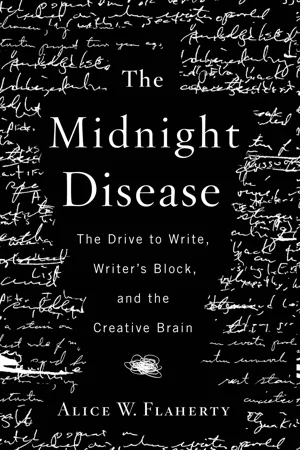
eBook - ePub
The Midnight Disease
The Drive to Write, Writer's Block, and the Creative Brain
- 308 pages
- English
- ePUB (mobile friendly)
- Available on iOS & Android
eBook - ePub
About this book
Information
Subtopic
Creative WritingIndex
PsychologyIndex
Some men pretend to understand a Book
by scouting thro’ the Index:
as if a Traveller should go about to describe a Palace
when he had seen nothing but the Privy.
—Jonathan Swift, Mechanical Operation of the Spirit (1784)
If you don’t find it in the Index, look very carefully through the entire catalog.
—Sears, Roebuck, Consumer’s Guide (1897)
A | B | C | D | E | F | G | H | I | J | K | L | M | N | O | P | Q | R | S | T | U | V | W | X | Y | Z
A
Action-emotion uncoupling, 190–92
ADHD (attention deficit hyperactivity disorder), 111, 112, 117, 178
Adolescents’ sleep cycle, 128–29
Adrenaline (epinephrine), 7, 188, 190
Adventures of Huckleberry Finn, The (Twain), 88–89
Agency, sense of, 238
Aggression, 133, 188
Agraphia, 83–84, 158, 160, 170–71, 180
Akiskal, Hagop, 33
Alcohol and drug use, 15, 36, 67–68, 136, 168, 187, 188, 210, 213, 245, 249, 263
Alexia with agraphia, 171, 180
Alexia without agraphia, 170–71
Alexithymia, 71, 231–33, 245
Alice in Wonderland (Carroll), 27
Alienation from inner voice, 238–40, 242–48
Allen, Woody, 124, 162
Alphabets, 163, 164
Alprazolam (Xanax), 136
Alzheimer’s dementia, 72. See also Dementia
Amabile, Teresa, 25
Ambrose, Bishop, 166
Amis, Martin, 46
Amnesia, 61, 185
Amok, 38
Amphetamines, 128, 188
Amygdala, 22, 121, 186, 220, 258
Andersen, Hans Christian, 47, 178, 197
Andropause, 132
Anemia, 64–65
Angela (deaf woman with hallucinations), 249–50
Angular gyrus, 171, 180, 181, 182
Animals
bereavement in, 210
communication by, 149–50, 198–99, 222
dominance hierarchy o...
Table of contents
- Title Page
- Contents
- Copyright
- Dedication
- Acknowledgments
- Introduction
- Hypergraphia: The Incurable Disease of Writing
- Literary Creativity and Drive
- Writer’s Block as State of Mind
- Writer’s Block as Brain State
- How We Write: The Cortex
- Why We Write: The Limbic System
- Metaphor, the Inner Voice, and the Muse
- References
- Illustration Credits
- Index
- About the Author
- Connect with HMH
Trusted by 375,005 students
Access to over 1.5 million titles for a fair monthly price.
Study more efficiently using our study tools.
Frequently asked questions
Yes, you can cancel anytime from the Subscription tab in your account settings on the Perlego website. Your subscription will stay active until the end of your current billing period. Learn how to cancel your subscription
No, books cannot be downloaded as external files, such as PDFs, for use outside of Perlego. However, you can download books within the Perlego app for offline reading on mobile or tablet. Learn how to download books offline
We are an online textbook subscription service, where you can get access to an entire online library for less than the price of a single book per month. With over 1.5 million books across 990+ topics, we’ve got you covered! Learn about our mission
Look out for the read-aloud symbol on your next book to see if you can listen to it. The read-aloud tool reads text aloud for you, highlighting the text as it is being read. You can pause it, speed it up and slow it down. Learn more about Read Aloud
Yes! You can use the Perlego app on both iOS and Android devices to read anytime, anywhere — even offline. Perfect for commutes or when you’re on the go.
Please note we cannot support devices running on iOS 13 and Android 7 or earlier. Learn more about using the app
Please note we cannot support devices running on iOS 13 and Android 7 or earlier. Learn more about using the app
Yes, you can access The Midnight Disease by Alice W. Flaherty in PDF and/or ePUB format, as well as other popular books in Psychology & Creative Writing. We have over 1.5 million books available in our catalogue for you to explore.