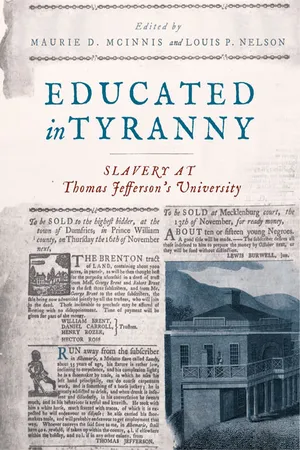
From the University of Virginia's very inception, slavery was deeply woven into its fabric. Enslaved people first helped to construct and then later lived in the Academical Village; they raised and prepared food, washed clothes, cleaned privies, and chopped wood. They maintained the buildings, cleaned classrooms, and served as personal servants to faculty and students. At any given time, there were typically more than one hundred enslaved people residing alongside the students, faculty, and their families. The central paradox at the heart of UVA is also that of the nation: What does it mean to have a public university established to preserve democratic rights that is likewise founded and maintained on the stolen labor of others?
In Educated in Tyranny, Maurie McInnis, Louis Nelson, and a group of contributing authors tell the largely unknown story of slavery at the University of Virginia. While UVA has long been celebrated as fulfilling Jefferson's desire to educate citizens to lead and govern, McInnis and Nelson document the burgeoning political rift over slavery as Jefferson tried to protect southern men from anti-slavery ideas in northern institutions. In uncovering this history, Educated in Tyranny changes how we see the university during its first fifty years and understand its history hereafter.
Zachariah was exhausted. He was strong, but the task was daunting. His owner, Luther M. George, recently leased him to the university, which had been under construction for two years. Soon after Zachariah arrived on site Mr. Henderson, the overseer for construction, directed him to dig the cellar and foundation for a hotel that stood behind and downhill from the first of the pavilions. Having lived and labored in Albemarle County most of his life, Zachariah had seen the firing of the massive kiln that produced the bricks for the first of the “Academical Pavilions” (now Pavilion VII). As he dug he watched other black men working daily to level the land of the larger worksite. The previous summer they removed huge volumes of earth (records would report nearly 1,000 cubic yards) forming what Mr. Henderson called “terraces.” Zachariah watched as these men deployed shovels and barrows to slowly transform the gentle hillocks into the staged building sites for three more pavilions (now Pavilions I, III, and V). Soon thereafter those same men dug foundations and cellars for the next two pavilions (Pavilions II and IV); he learned there were to be ten, five on each side of the terraces. Since only one building now stood completed, Zachariah and his fellow laborers slept on pallets on the floor in the upstairs chambers while the cook struggled to produce meals in the nearly unlit cellar kitchen. Zachariah’s daily work excavating the hotel cellar moved quickly until he hit bedrock. For weeks he shoveled the loose earth, all the while knowing that the substantial bedrock also had to be extracted. Once Zachariah began chipping away on the stone, his pace dramatically slowed and Henderson became frustrated. Soon, the earth-moving team from the pavilions was reassigned to work with Zachariah, and with the assistance of these others, the excavation was eventually completed.1
The deep cellar of Hotel A and its attendant sunken yard (fig. 1.1) are the work of Zachariah’s hands. Yet, while he was digging, Jefferson and the Board of Visitors were debating the appropriate sizes for the hotels. The sunken workyard Zachariah toiled so hard to excavate in 1821 was probably the result of the decision to shrink the building plan for the hotel after the cellar had already been excavated. And, if that were not frustrating enough, the majority of Zachariah’s earned money, more than twenty-five dollars, would go to his owner.
Fig. 1.1. Aerial view of Hotel A from the JUEL digital model of the Academical Village. The view shows the deeply excavated cellar.
Enslaved laborers—both skilled and unskilled—played a critical role in the construction of the University of Virginia, yet there are few accounts from the period that tell this story. We do not have a surviving journal from James Henderson, who was hired by the university proctor, Arthur Spicer Brockenbrough, to oversee the work of men like Zachariah. Were such a letterbook to survive we might have Henderson describing the daily tasks and habits of Zachariah and other enslaved African Americans. So one of our only options is to read between the lines of account books and to carefully piece together the working lives of enslaved laborers on the construction site through records never intended to be used that way. Zachariah’s work, outlined above, comes to us with a bit more detail as a result of the frustrating nature of his task, the shifting of other laborers to the same task, and the resultant payments necessitated by the unforeseen bedrock. This chapter will provide a few glimpses into the lives of a few enslaved laborers and then will make some generalizations about their daily life during the initial construction of the university from 1817 to 1827.
Construction in antebellum America was still dominated by the traditional cultures of craft that had persisted for centuries. In fairly remote contexts, craftsmen undertook a wide range of the tasks necessary to realize a building. But in urban settings, or on major construction sites like the University of Virginia, individuals were either day laborers, often unskilled and taking any work that came their way, or they were skilled artisans, usually having learned that skill through an apprenticeship.2 Skilled artisans usually fell into categories by building material: sawyers ripped lumber while rough carpenters could frame houses; joiners produced fine, usually interior finished work; brickmakers understood the fine craft of working clay and firing kilns while masons worked bricks up into walls with bonding patterns finished with fine mortar jointing. By the 1820s, smaller building components like glass, some hardware, and paint were commonly manufactured in bulk and transported to the site. But there they would be assembled and installed by specialist artisans: glaziers, painters, and so forth. In the antebellum South, these artisans could be free whites, free blacks, or enslaved, and the majority of construction sites had all three laboring side by side, some earning money for their efforts, others not. Timber-frame construction techniques demonstrate one way that traditional building methodology worked across socioeconomic and cultural differences. In the early nineteenth century, timber framing depended on the fundamental method of securing framing members with a system of mortise-and-tenon joinery. By using roman numerals to identify how various members of a frame were intended to be assembled, any laborer—black or white, enslaved or free—could do this work. The records of the proctor’s account books, with their complex array of payments to a wide range of individuals, certainly makes clear that this was the case at the University of Virginia.
The proctor’s account books provide important insights into the everyday lives of the numerous enslaved African Americans who labored to build the University of Virginia, but the entries require explication. For example, on December 24, 1821, Proctor Brockenbrough made a draft to pay “Jack for the waggonage of a Hhd [hogshead] of plaster from Milton & Lundy for kiln drying planks.” The total was two dollars.3 This entry is interesting in a number of ways. The first is the reminder that enslaved laborers—skilled and unskilled—were regularly leased to the proctor, as the agent of the university, to undertake work in the construction. For many large construction projects, it was common for enslaved people to be hired from local slaveowners. Sometimes, laborers were hired for an entire year, or they might be hired for a particular project. In these leasing arrangements the earned money was usually paid to the laborer’s owner, but occasionally, as in this case, enslaved workers were additionally compensated for accomplishing above-average arduous tasks like digging the Hotel A cellar through bedrock (in this case the compensation was whiskey) or successfully completing unsupervised work like kiln-drying planks. The second is that the entry records that Jack drove the wagon of hogsheads (large wooden barrels roughly four feet long and thirty inches in diameter) to the university construction site from Milton Farm, about eight miles away. Milton Farm was an important port on the Rivanna River and home to a lime kiln. This is a reminder that the construction of the university was a massive undertaking requiring the acquisition of huge volumes of building materials, many of which, contrary to common mythologies, were not produced on site but were produced in workyards all over the region or even across the state. Lastly, the draft was made on Christmas Eve, so perhaps the timing of this payment was related to the upcoming holiday, commonly the only week-long work break during the year, or it could just be simply year-end accounting.
In the following year, the proctor’s accounts record a four-dollar payment for “coffin for Rhoda,” a poignant reminder of the lives behind the entries in the ledger book.4 And much like the portage from Milton, this entry reminds us that the university construction site was also a social landscape. One wonders if Rhoda might be among the first African Americans interred in the unmarked graves that comprise the university’s African American Burial Ground. As one of the few records to capture the names and work of enslaved African Americans, this chapter depends heavily on Proctor Brockenbrough’s construction-era account books. But in using this record, we have struggled to recapture these individuals as people, not numbers.
One of the men who appears most consistently in the construction record is Carpenter Sam, a well-respected artisan on the construction site who was owned by Proctor Brockenbrough. Sam first appears in the records when he is identified as the carpenter charged to begin the tinwork to cover the roof of the newly completed Pavilion VII in 1818, a task he later undertook for the roofs of Pavilion V and Hotels A, D, and F. By 1822, he was very active all around the site contributing to the carpentry work on Hotels A and C and Pavilions V and VII. Either because he was an enormously well qualified artisan or because he was owned by Proctor Brockenbrough, Sam is among the most well paid of the laborers working on site, usually drawing a salary for Brockenbrough of between twelve and nineteen dollars per month. We have no way of knowing, of course, if Sam received any of that money.
By 1824, as work on the pavilions and hotels was coming to a close, Sam built smokehouses around the site to meet the inevitable need for food preservation and storage once the pavilions and hotels were occupied. In this task, Sam supervised three other carpenters, Davey, William, and “young Sam,” also owned by Brockenbough, and who may well be the carpenter’s son. Later that year, Carpenter Sam was identified as “old” Sam to differentiate him from the younger carpenter of the same name. In 1825, with the smokehouses complete, a team of three carpenters—Old Sam, Young Sam, and Davey—was set to the task of building stables, once again with Old Sam in charge. Sam’s services were retained until the opening of the university as the final tasks of construction dwindled to a close in 1827. Through the full decade of construction, Carpenter Sam was a prominent persona on the university’s construction site, taking the lead on constructing many of the ancillary buildings necessitated by daily life at the university.5
None of those ancillary buildings built by Old Sam and his teams have survived. One artifact that has survived is a saw handle recently found in the attic of Pavilion X (fig. 1.2). The handle bears the stamp “A. S. Brockenbrough.” As Proctor Brockenbrough was a white man of significant authority, it seems unlikely that this was his pers...
Table of contents
Cover
Title Page
Copyright Page
Dedication
CONTENTS
Acknowledgments
Introduction
1. Slavery and Construction
2. Landscape of Slavery
3. Everyday Life in the Yard
4. Violence
5. Hotels
6. Proslavery Thought
7. Anatomical Theater
8. Free People of Color
9. The African American Burial Ground
Notes on Contributors
Illustration Credits
Index
Trusted by 375,005 students
Access to over 1.5 million titles for a fair monthly price.
Study more efficiently using our study tools.
Frequently asked questions
Yes, you can cancel anytime from the Subscription tab in your account settings on the Perlego website. Your subscription will stay active until the end of your current billing period. Learn how to cancel your subscription
No, books cannot be downloaded as external files, such as PDFs, for use outside of Perlego. However, you can download books within the Perlego app for offline reading on mobile or tablet. Learn how to download books offline
Perlego offers two plans: Essential and Complete
Essential is ideal for learners and professionals who enjoy exploring a wide range of subjects. Access the Essential Library with 800,000+ trusted titles and best-sellers across business, personal growth, and the humanities. Includes unlimited reading time and Standard Read Aloud voice.
Complete: Perfect for advanced learners and researchers needing full, unrestricted access. Unlock 1.5M+ books across hundreds of subjects, including academic and specialized titles. The Complete Plan also includes advanced features like Premium Read Aloud and Research Assistant.
Both plans are available with monthly, semester, or annual billing cycles.
We are an online textbook subscription service, where you can get access to an entire online library for less than the price of a single book per month. With over 1.5 million books across 990+ topics, we’ve got you covered! Learn about our mission
Look out for the read-aloud symbol on your next book to see if you can listen to it. The read-aloud tool reads text aloud for you, highlighting the text as it is being read. You can pause it, speed it up and slow it down. Learn more about Read Aloud
Yes! You can use the Perlego app on both iOS and Android devices to read anytime, anywhere — even offline. Perfect for commutes or when you’re on the go. Please note we cannot support devices running on iOS 13 and Android 7 or earlier. Learn more about using the app
Yes, you can access Educated in Tyranny by Maurie D. McInnis, Kirt von Daacke, Louis P. Nelson, Benjamin Ford, Maurie D. McInnis,Kirt von Daacke,Louis P. Nelson,Benjamin Ford in PDF and/or ePUB format, as well as other popular books in History & North American History. We have over 1.5 million books available in our catalogue for you to explore.