![]()
CHAPTER 1
The Origins of the Naval Offensive
Britain declared war on Germany on 4 August 1914 in response to the German assault on the Western democracies of France and Belgium. The military assistance Britain offered to its continental allies was, in the first instance, small. During the first weeks of the war the Royal Navy escorted just four divisions of infantry to France. This British Expeditionary Force, or BEF was puny compared to the hundreds of divisions deployed by each of the main European antagonists.
Lord Kitchener, the Secretary of State for War, had no doubt that this small force would have to be increased to continental proportions. He thought the war would be a protracted struggle and set about raising a large volunteer army which might reach a million men by 1917.
Others in Britain sought a way of avoiding the cost of a long war. They reasoned that while the four divisions of the army might be puny, Britain had a far more effective instrument already to hand. The Royal Navy had ruled supreme since Trafalgar. In the early years of the twentieth century its position had been tested by the rapid growth of the German fleet. But at the outbreak of war the Royal Navy was still dominant. The British possessed 24 of the latest type of battleships (Dreadnought was their popular name) while the Germans had just 13. Moreover, 13 more dreadnoughts were under construction in naval dockyards around Britain. In contrast, the Germans were building just two. In addition, the British had some 40 older battleships, much less powerful than dreadnoughts but still formidable enough, while the Germans had a mere handful of these older vessels.
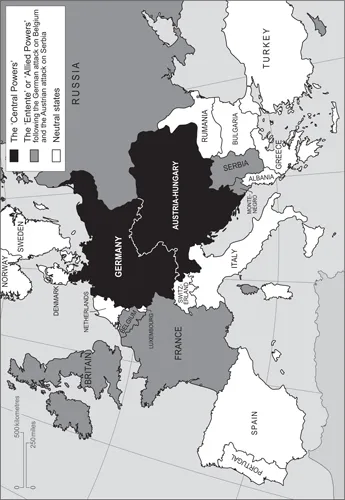
1 Europe, August 1914
The political master of the great British armada was Winston Churchill, First Lord of the Admiralty. Churchill had been given this post in October 1911 to ensure that a reluctant navy would comply with the army's plans for it to escort an expeditionary force to France in the event of war, rather than pursue its preferred goal of capturing an island off the German coast. By September 1914 the escort had been accomplished without the loss of a single soldier. Naval units were then engaged in sweeping up small squadrons of German ships in distant seas, ensuring that vital supplies of food and war materiel of all kinds carried in unarmed merchant ships arrived safely in Britain, and in maintaining offensive patrols in the North Sea to keep watch on the German fleet.
None of this proved very congenial to Churchill. Since the outbreak of the war his restless mind had been devising a series of what he considered to be more offensive operations for his ships. Although his schemes were many and various they had one factor in common: they sought not just to defeat the German fleet but to use British naval power to exploit such a victory and shorten the duration of the war on land.
During the first four months of the war Churchill devised three schemes by which the navy could materially affect the entire course of the war.
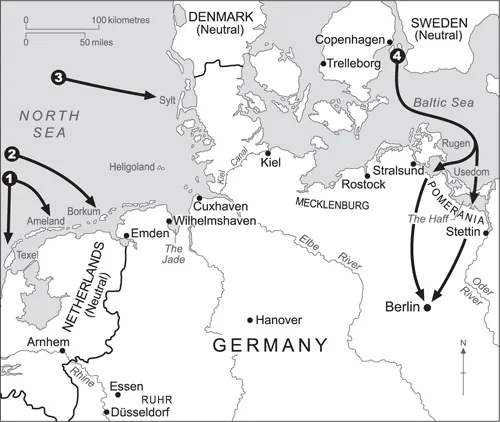
The first of these schemes, ironically, was the seizure of an island close to the German north coast, the islands most often mentioned being Sylt or Borkum. The plan proceeded as follows. Heavy units from the fleet would obliterate the enemy island defences and their garrisons. The fleet would then escort sufficient troops to hold the island against attack. After that the island would be converted into a base from which torpedo craft and submarines could operate. The Germans would find the activities of these craft such a threat to their main fleet and its nearby bases that they would attempt to recapture the island, using the greater part of their dreadnoughts. This would provoke the hitherto elusive decisive naval battle, which the British would win.
Subsequent operations would follow to capitalize on the victory. With the German fleet removed as a threat, British heavy units could enter the Baltic, establish control of that sea and be in a position to land contingents of Russian troops on the German north coast—just 90 miles from Berlin. The Germans would be forced to react by removing troops from the Western Front, thus laying that vital area open to penetration by British and French troops.
2 Naval plans against Germany, 1914–15
The problem for Churchill's plan was that none of his admirals now thought it feasible and most thought it dangerous. Lord Fisher, the irascible and erratic septuagenarian whom Churchill in November had brought back from retirement as First Sea Lord, seemed at times to favour the scheme. Indeed, in November 1914 he wrote a long paper pressing the scheme in very Churchillian terms. But his support may have arisen from the fact that the navy had not so far accomplished anything dramatic (on 21 December he wrote to Churchill, ‘Do something!!!!! We are waiting to be kicked!!!’). Or his support might have been more apparent than real, a delaying tactic that masked underlying misgivings. A naval staff officer (Captain Herbert Richmond) reported a colleague's view that Fisher ‘didn't intend to have the Borkum business done’. The colleague said ‘they can go on getting out their plans as much as they like, but Jacky [Fisher] is simply not going to do them in the end’.
The reason that the admirals were reluctant to do the ‘Borkum business’ is not difficult to discern. The island to be attacked lay in mine-infested waters and was further protected by submarine and torpedo-boat flotillas. The British bombarding squadrons would be exposed to attack from all the heavy units of the German fleet. Troops would have to be landed under heavy machine-gun and artillery fire. Even if the island was captured, supplying the garrison by merchant ships passing through minefields and running the gauntlet of submarines would be a precarious affair.
As for the Baltic aspect of the scheme, it was even more hazardous. Even if the island phase saw the destruction of the entire German fleet, British dreadnoughts operating in the confined waters of the Baltic would encounter extensive minefields and the permanent squadrons of submarines and torpedo boats that were stationed there. Moreover, landing Russian troops on the north German coast presupposed that the Russians had troops available; that these troops were skilled in combined operations; that logistic support in the form of artillery and stores was available in sufficient quantity; that any language problems could be overcome; and that the Russians were willing to risk such a highly trained, well-supplied force well away from their own main theatre. A compounding issue was that the Germans, in possession of an excellent rail network, could have moved reserves northward at a faster rate than the attacking army could have been reinforced from the sea. Not surprisingly, the admirals were unwilling to risk Britain's main fleet in an operation that contained so many hazards and so little chance of success.
Churchill's second scheme involved moving the BEF to the Belgian coast. The proximity of the navy would then allow it to support the army with naval gunfire, addressing to some extent the shortage of heavy land-based artillery in the early months of the war. The British troops could then advance along the coast towards the enemy-occupied port of Zeebrugge, close to the western border of Holland. Such a manoeuvre might even influence the attitude of the neutral Dutch towards the war. After discussions with Sir John French, the commander-in-chief of the BEF, Churchill became very enthusiastic about the coastal advance. By early December he was describing it to French as ‘a good & brilliant operation [which would aid] the general success of the war’. Eventually, however, General Joseph Joffre, the commander-in-chief of the French army, turned against the scheme. He was reluctant for the BEF to move to the coastal flank because he thought it might prove a tempting position from which the British could embark for home. Later, opinion in Britain also turned against the plan. It was thought that in the confined waters of the Channel the heavy ships of the fleet would be at great risk from mines and torpedoes, and that in any case the BEF would not have sufficient guns and ammunition for an advance sufficiently dramatic to justify the risk.
As for bringing Holland into the war, there was some initial enthusiasm. Fisher took up the idea with alacrity. He considered that it ‘will sweep the field’. But his call for 750,000 men for the purpose and his wild exhortations to land them at ‘Antwerp, Amsterdam and all the other spots … along the Dutch coast—LAND EVERYWHERE AT ONCE!’ perhaps indicated that his support for this operation was conditional on it never being carried out. Moreover, there was the matter of Dutch national interest. Significant units of the German army stood within striking distance of Holland. These formidable hordes could invade much faster than any British force landed from the sea, even if it landed ‘everywhere at once’. As with the Baltic scheme, the Germans could also reinforce their men at a faster rate than could a seaborne landing. No doubt bringing in Holland was a good idea but this scheme was not going to do it.
The third Churchillian scheme involved Turkey and harked back to the beginning of the war. Two German ships, a battlecruiser (the Goeben) and a lighter vessel had eluded two larger British squadrons in the Mediterranean and sailed through the Dardanelles to Constantinople in August 1914. At the time this action was thought to have resulted in the German-Turkish alliance, which was announced soon after the ships' arrival. It is now known that the ships were directed to Constantinople in support of an alliance already concluded. But Churchill and the navy had attracted some odium over the incident and the First Lord of the Admiralty was not disposed to look kindly upon the Turkish government.
Churchill therefore set up with the concurrence of the Secretary of State for War (Kitchener) a joint planning group to work out a scheme for the seizure of the Gallipoli Peninsula by means of an army supplied by Greece to admit ‘a British Fleet to the Sea of Marmara’. What the fleet was to do once it arrived in the Marmara was not specified. Major-General Charles Callwell, the Director of Military Operations, encapsulated the deliberations of this group in a memorandum on 3 September. He considered it ‘an extremely difficult operation of war’ but thought that an army of 60,000 Greeks might do the job.
The problem with this plan was soon obvious. There was no Greek force available. The offer had been made by Prime Minister Eleatherios Venizelos against the wishes of his own pro-German king, Constantine I, and without taking note of the state of the Greek army. In 1914 it was being re-equipped. It was short of all types of materiel and was in no state to rectify this position rapidly because Greece had no armaments industry. Nor were the Allies in a position to make up the Greek deficiencies. The Greek army was therefore in no position to take the field against any foe.
The option of operations against Turkey spluttered on for some time. In early November the Turks had bombarded Russian ports in the Black Sea, precipitating a war between the two countries. A few days later Britain and France declared war on Turkey. Churchill had already anticipated these events. Two days before the British declaration of war he had ordered a squadron stationed near the Dardanelles to bombard the forts at the entrance. So were fired the first shots in the long war between Britain and Turkey.
After that flurry Turkey dropped off the British agenda. Then on 25 November, in the context of a discussion about the defence of Egypt, Churchill noted that ‘the ideal method of defending Egypt was by an attack on the Gallipoli Peninsula. This, if successful, would give us control of the Dardanelles, and we could dictate terms at Constantinople.’ He also noted, however, that this was a ‘very difficult operation requiring a large force’, and the discussion soon meandered into the question of whether wells in the Palestinian desert could be destroyed behind a Turkish force advancing on the Suez Canal.
Churchill did not cease to think aggressively about Turkey. Asquith reported in early December that Churchill's ‘volatile mind’ was ‘set on Turkey & Bulgaria, & he wants to organise a heroic adventure against Gallipoli and the Dardanelles’. Nevertheless, despite Churchillian enthusiasm to punish the Turks no plans were made, and Britain's major commitment to the war remained the few (but increasing) number of divisions on what was beginning to be called the Western Front.
It was a series of alarming developments on that front that gave...