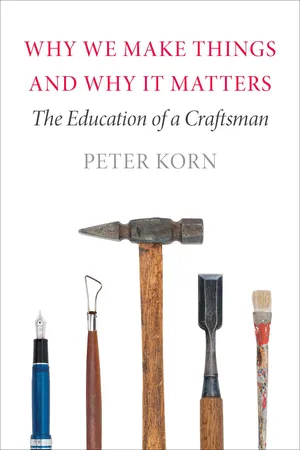
A furniture maker and author offers a mix of personal memoir and personal philosophy in a book perfect for craftspersons, artisans, and artists.
Woodworking, handicrafts—the rewards of creative practice, bringing something new and meaningful into the world through one's own vision, make us fully alive. Peter Korn explains his search for meaning as an Ivy League-educated child of the middle class who finds employment as a novice carpenter on Nantucket, transitions to self-employment as a designer/maker of fine furniture, takes a turn at teaching at Colorado's Anderson Ranch Arts Center, and finally founds a school in Maine: the Center for Furniture Craftsmanship, an internationally respected, non-profit institution.
This is not a "how-to" book in any sense. Korn wants to get at the why of craft and the satisfactions of creative work to understand their essential nature. How does the making of objects shape our identities? How does creative work enrich our communities and society? What does the process of making things reveal to us about ourselves? Korn poignantly provides answers in this book that is for the artist, artisan, crafter, do-it-yourselfer inside us all.
"In his beautiful book, Peter Korn invites us to understand craftsmanship as an activity that connects us to others, and affirms what is best in ourselves." —Matthew Crawford,
New York Times–bestselling author of
Shop Class as Soulcraft
"What is the point of craft in a completely mass-produced world?... This fascinating account offers insights into the significance of the handmade object for the maker as well as for society as a whole." —Martin Puryear, artist, recipient of the Guggenheim and MacArthur Foundation Fellowships
- 176 pages
- English
- ePUB (mobile friendly)
- Available on iOS & Android
eBook - ePub
About this book
Information
Subtopic
Artist BiographiesIndex
Social Scienceschapter 1
A Shared Hunger
There was a time when I assumed that becoming a master craftsman would be a process of enlightenment. My hands were still ignorant then, and I was searching for an occupation in which I could forge an adult self. Eager for competence, I thought that having one’s craft together would mean having one’s life together. Today, having become reasonably competent as a furniture maker, I know better. Spiritual enlightenment is not on the table. Still, the notions that drew me into the workshop forty years ago were not without consequence. The footing on which I started my journey has shaped my choices, concerns, and experiences throughout, and my transcendent expectations for a life in craft were rewarded in more palpable ways.
These days I teach more than I build. My students are adults from a wide variety of backgrounds, many with lives that could be considered highly successful by any normative standard. Yet, consistently, I find that they have been drawn to woodworking by a hunger similar to that which first impelled me. They do not invest time, money, and effort traveling to Maine to cut dovetails with hand tools because they need little hardwood benches, which are the introductory-class projects. What lures them is the hope of finding a deeper meaning by learning to make things well with their own hands. Many go on to set up workshops of their own, and more than a few develop a passion for woodworking they describe as transformational.
Beyond the red clapboard walls of our school I encounter many more people who express the same sort of longing. The banquet of work, leisure, and consumption that society prescribes has left some essential part of them undernourished. They are hungry for avenues of engagement that provide more wholesome sustenance.
The craft of furniture making is not a cure-all for this condition, but it functions as a source of meaning, authenticity, fulfillment – call it what you will, for the moment – for many people of my acquaintance. The same is true of other self-expressive, creative disciplines. They may not lead to the profound transfiguration to which I once vaguely aspired, yet their satisfactions are well matched to the earthly nature of our spiritual appetites. Furniture making, like all contemporary crafts, is a road less traveled. Yet it has much to reveal about the risks and rewards of sustained creative effort – about what art is and why it matters – in the context of our shared search for a better way to live.
Here I should mention three well-regarded authors who have already offered extracts of craft as antidotes to the spiritual deficiencies of modern life. Most iconic for my generation is Robert Pirsig, whose 1970s best seller, Zen and the Art of Motorcycle Maintenance, was presented as a meditation on the subject of quality. Pirsig lays out his central theme in describing how two young mechanics had carelessly repaired his bike:
The mechanics in their attitude toward the machine were really taking no different attitude from the manual’s toward the machine, or from the attitude I had when I brought it in there. We were all spectators. And it occurred to me there is no manual that deals with the real business of motorcycle maintenance, the most important aspect of all. Caring about what you are doing is considered either unimportant or taken for granted. On this trip I think we should notice it, explore it a little, to see if in that strange separation of what man is from what man does we may find some clues as to what the hell has gone wrong in this twentieth century.1
Pirsig’s view, as he develops it, is that a good life may be found through craftsmanlike engagement with the actions, objects, and relationships of ordinary experience, through caring about what you do. If you choose to ride a motorcycle, then being able to repair a fouled spark plug becomes a moral imperative.
Thirty-five years later, sociologist Richard Sennett surveyed the same landscape from another station point in The Craftsman, where he asks what the process of making things reveals to us about ourselves. In particular, Sennett critiques current social and economic conditions for depriving workers of the satisfactions inherent to “doing a job well for its own sake,” which is the essence he distills from craft. His solution is to cultivate an “aspiration for quality” in our workplaces and schools.2 Like Pirsig, Sennett employs the ideal of quality, in the sense of caring about what one does, to address broad philosophical questions: What is the nature of work? What is the nature of a good life?
These same questions animate Shop Class as Soulcraft, in which author Matthew Crawford argues that our educational system and our occupational structures are deformed by a prejudice against manual labor. He punctures the myth of white-collar superiority by pointing out that today’s corporate workplace has been rationalized as relentlessly as the industrial factory of a century earlier. Creative thought and decision making are centralized into the hands of small cohorts of experts, so that only rote work gets distributed among the worker bees. As a result, the average white-collar employee feels, accurately, like a replaceable cog in a soulless machine; work has been stripped of its potential to provide meaning and fulfillment. In counterpoint, Crawford asserts that significantly greater job satisfaction may be found in manual trades that engage a worker’s cognitive, problem-solving abilities, such as his own vocation of motorcycle repair.
Although each identifies a different culprit, all three authors believe that some primary defect in contemporary culture severs the satisfactions of individual agency from the things that we actually do. (Broadly speaking, Pirsig faults the Aristotelian underpinnings of Western thought, Sennett faults the culture of corporate capitalism, and Crawford faults the pernicious effects of the Cartesian mind/body divide on education and the workplace.) Their indictments sound like nostalgia for a time when people found greater fulfillment in work because an aspiration to quality was ingrained. But, as any furniture maker who has looked at antiques with a skilled eye knows, quality has always been tailored to the cost constraints of time and materials. Really, what Pirsig, Sennett, and Crawford are asking is not where quality has gone, but how we can cultivate the aspiration for quality in today’s world.
Several decades ago, as we were walking down a crowded Manhattan sidewalk, an acquaintance named George Trow told me that you have only to step a degree or two outside of normalcy to gain an illuminating perspective on it. Certainly that described George, who wrote for The New Yorker and flew as close to the sun of genius as anyone I’ve known. At that moment he was musing on his own predicament in life, but in the years since I have come to realize that the vantage point from my workbench is similarly askew. Furniture making, practiced as a craft in the twenty-first century, is a decidedly marginal occupation – economically, socially, technologically, and culturally. Yet it also happens to be premised on the selfsame ideal that Pirsig, Sennett, and Crawford each end up prescribing. For all of them, the key to a good life is the engaged pursuit of quality. As a craftsman I have the opportunity to turn that key every day, whether or not I actually do. The yardstick of quality is always in plain sight at the workbench.
While craft may be a byway of contemporary culture, its divergence offers a revealing prospect onto the main thoroughfare. The view from my workbench is complementary to those of Pirsig, Sennett, and Crawford. Our core difference is the role that we assign to creativity. Where they pay it little attention, my experience has been that the effort to bring something new and meaningful into the world – whether in the arts, the kitchen, or the marketplace – is exactly what generates the sense of meaning and fulfillment for which so many of us yearn so deeply. The dedication to quality that they prescribe is essential to productive creative engagement, but it is only a component, not the effort itself.
Craft is just one arena for creativity, but it is the one I know intimately. My intuition from the day I first picked up a hammer was that making things with a commitment to quality would lead to a good life. What I propose here is to retrace my steps with reference to larger frameworks – historical, sociological, psychological, and biological – to discover how and why that intuition turned out to be valid. What is it about creative work, and craft, in particular, that makes them so rewarding? What are the natures of those rewards? What, as Sennett asks, does the process of making things reveal to us about ourselves? As a furniture maker attempting to draw upon his own experience to illuminate such universal questions, I confess in advance to an ingrained pragmatism. The answers that make sense to me tend to be firmly rooted in the loam and muck of the world as I have found it, and that is where I’ll begin.
chapter 2
Hammering Out a Vocation
I was born in 1951 and lived out my childhood in Rydal, an affluent suburb of Philadelphia. My father was a gregarious, capable lawyer who commuted into the city by train. My mother went back to college to complete her undergraduate studies when my sister and I were still quite young, and followed through to a Ph.D. in history. In a proper autobiography there would be a significant ethnic backstory to fill in – the cultural disparity between my father’s Eastern European Jewish roots and my mother’s German Jewish background, the thrust of Reform Judaism toward assimilation, the sense of being outsiders in an America where anti-Semitism was still evident, and the lingering pall of the Holocaust.
But that was the world of my childhood as I understand it from the perspective of half a century. The way it seemed to me then was that the “Nazis” and “Japs” had been soundly defeated, the Holocaust was ancient history like everything else that took place before I was born, the world was fast outgrowing anti-Semitism, and science was conquering diseases so fast that all of them would be vanquished before my generation was old enough to be vulnerable. I grew up swaddled in the belief that tragedy was over, that wars, persecution, and disease belonged to the past, and that, while bad things might happen to people in books and in other places (such as those starving children in India for whom we ate everything on our plates), they did not happen in the world I inhabited.
There was a day when, as a small boy, I found a day-bed mattress at the top of the stairs. With great effort I maneuvered it off the landing until it started to descend the green carpeted steps on its own. I hadn’t thought any further ahead than that moment, and delight flashed to fear as the mattress rapidly gained momentum and, abruptly, punched a hole in the wall opposite the bottom landing. Then – amazing! – broken chunks of granular white plaster, jagged splinters of rough wood lathe, and, most impressive of all, a dry, empty cavity behind the wall, a secret world. It had never occurred to me that there might be anything behind the painted surface. This was my mental state growing up: life was all surface. The discovery of depth, when it came during my college years, did not have the drama of a mattress smashing through a wall. Rather, a capacity for reflection seemed to emerge as gradually and fitfully as a child learns to walk.
One of the first tiny steps occurred the summer before my senior year at Germantown Friends School, when I participated in an American Friends Service Committee work camp in Owatonna, Minnesota. Our group of student volunteers lived in a bat-infested barn housing a Salvation Army store in one corner of the ground floor. It was 1968 and three of us were fledgling hippies who hung out together. There was Larry, with whom I would laugh until we collapsed to the floor, and Fred, who was moody, ironic, and intense as a Janis Ian song. What I found particularly incomprehensible about Fred was that he was in analysis. I wasn’t unfamiliar with Freud, but I simply couldn’t imagine what Fred found to be so miserable about. And, while I remained mystified, the simple fact of Fred, and his disdain for my own reflexive cheerfulness, was a chink in the smooth surface of life. Now I knew there was a cavity behind the wall, even if I didn’t have a clue what might be inside.
Three summers later, my nineteen-year-old self lay sprawled on a bed, reading a book on social activism. Not that I had become a committed social activist – I was a college student working as a gardener on Nantucket. An antiwar, longhaired, pot-smoking, pro–civil rights student who had marched on Washington and been tear-gassed at Fort Dix for peace and justice, but a self-absorbed student nonetheless. That summer, the full extent of my daily activism consisted of choosing the colored elastic with which I would tie back my ponytail. Black symbolized Bakunin and anarchy, red was for Trotsky and socialism, blue matched my eyes.
The name of the book I was reading is lost to memory, but the gist of its message was that working to improve people’s material circumstances isn’t enough. Even if you manage to relieve their hunger and physical discomfort, you will not have touched their spiritual needs, which are what really matter. Better to be hungry and cold, but spiritually nourished, than to feast by a blazing hearth with spiritual emptiness gnawing away from inside.
Although I strongly suspected that no starving person would agree with the author’s contention, I detected a certain truth in his words. Having attended a Quaker secondary school, I had seen many generous people – teachers, social workers, philanthropists, psychologists, Peace Corps volunteers, political activists – trying to help others through life’s difficulties. Unfortunately, to my young eyes, the helpers didn’t appear to be particularly happy or fulfilled themselves. There had to be more to life. The phrase “Physician, heal thyself!” came to mind, and it occurred to me that I should find out how to live my own life well before I presumed to help others. If I had to date my journey into craft, this was the moment it began.
A year later, having spent the summer in Mexico learning Spanish, I moved to Nantucket Island in search of “real life.” My intent was to earn the remainder of my college credits through independent study. I didn’t know what real life was. I just knew that in school I seemed to be experiencing life secondhand.
Nantucket was not then the wealthy enclave it is now; the ghosts of the nineteenth century were still in possession – and I mean this fairly literally. The Nantucket I knew as a child, starting with family vacations in the 1950s, was an isolated backwater of deteriorating old houses furnished with the hundred-year-old salvage of the island’s whaling heyday. At the time I moved there, in 1972, there were only three thousand year-round residents, almost all of whom were island-born except for fifty or sixty hippie immigrants like myself. A mild collision of cultures ensued that one could stereotype as hippie-meets-redneck, but it was not particularly antagonistic. For a twenty-year-old it was a magical time and place.
I arrived on ...
Table of contents
- Title Page
- Copyright
- Contents
- Introduction
- Chapter 1: A Shared Hunger
- Chapter 2: Hammering Out a Vocation
- Chapter 3: The Seductive Ideology of Craft
- Chapter 4: Live from New York
- Chapter 5: Heart, Head, and Hand
- Chapter 6: Thinking With Things
- Chapter 7: Exercising My Voice
- Chapter 8: The Inward Migration of Truth
- Chapter 9: Second Epiphany
- Chapter 10: Mapping a Craftsman’s Mind
- Chapter 11: A Miracle at the Heart of the Ordinary
- Chapter 12: Creating a School
- Chapter 13: The Creative Cycle
- Chapter 14: A Good Life
- Endnotes
- Selected Reading List
- Index
- Photos
Trusted by 375,005 students
Access to over 1.5 million titles for a fair monthly price.
Study more efficiently using our study tools.
Frequently asked questions
Yes, you can cancel anytime from the Subscription tab in your account settings on the Perlego website. Your subscription will stay active until the end of your current billing period. Learn how to cancel your subscription
No, books cannot be downloaded as external files, such as PDFs, for use outside of Perlego. However, you can download books within the Perlego app for offline reading on mobile or tablet. Learn how to download books offline
We are an online textbook subscription service, where you can get access to an entire online library for less than the price of a single book per month. With over 1.5 million books across 990+ topics, we’ve got you covered! Learn about our mission
Look out for the read-aloud symbol on your next book to see if you can listen to it. The read-aloud tool reads text aloud for you, highlighting the text as it is being read. You can pause it, speed it up and slow it down. Learn more about Read Aloud
Yes! You can use the Perlego app on both iOS and Android devices to read anytime, anywhere — even offline. Perfect for commutes or when you’re on the go.
Please note we cannot support devices running on iOS 13 and Android 7 or earlier. Learn more about using the app
Please note we cannot support devices running on iOS 13 and Android 7 or earlier. Learn more about using the app
Yes, you can access Why We Make Things and Why It Matters by Peter Korn in PDF and/or ePUB format, as well as other popular books in Social Sciences & Artist Biographies. We have over 1.5 million books available in our catalogue for you to explore.