eBook - ePub
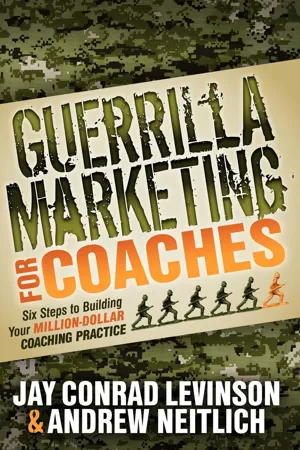
Guerrilla Marketing for Coaches
Six Steps to Building Your Million-Dollar Coaching Practice
- 262 pages
- English
- ePUB (mobile friendly)
- Available on iOS & Android
eBook - ePub
Guerrilla Marketing for Coaches
Six Steps to Building Your Million-Dollar Coaching Practice
About this book
START BUILDING YOUR MILLION-DOLLAR COACHING BUSINESS TODAY! The coaching profession has experienced phenomenal growth over the past decade, and has become an accepted way for people and organizations to improve performance. In response to this demand, professionals from around the world are getting into coaching. Unfortunately, despite the growth of the coaching field, many coaches struggle to attract clients and charge what they are worth. It doesn't have to be this way! "Guerrilla Marketing for Coaches" provides a practical, step-by-step guide for coaches who want to fill their practice with desirable clients, and build a firm that generates wealth. Follow the six steps in this book--along with the many success stories from top coaches in the field--and you are on your way to having a million-dollar firm. You discover: The top ways to attract clients and fill your practice--without spending much, if any, money; The proven conversations to close deals and get hired; How to build a firm that generates wealth for you, and make money even if you are not working directly with clients. Join Guerrilla Marketing founder Jay Conrad Levinson and acclaimed coach trainer Andrew Neitlich as they guide you to true success in this booming profession.
Information
Step II
USE LOW-COST, HIGH-IMPACT TACTICS TO GET CLIENTS
You don’t have to spend a fortune on marketing your services to be a very successful coach. However, you must put into place proven approaches to filling your practice with clients. These tactics start with referrals and go on to include: achieving expert status through information and education, online marketing tactics, alliances that bring a stream of clients, leadership in relevant associations and organizations, and a variety of creative strategies to reach top decision makers. The good news is that you can choose the tactics that work best for you, your talents, and your style; there are no one-size-fits-all approaches that you must follow. Also, once you get started, each new tactic reinforces the others, and you enjoy an upward spiral of visibility that attracts more and more clients your way.
Chapter Seven
SET UP YOUR TESTING LABORATORY
There are many ways to attract coaching clients, and the most effective ways don’t cost much, if any, money. However, you still need to figure out which marketing tactics work best for you, and then continue to improve them over time.
A useful metaphor for this process is the testing laboratory. Whether you are starting out as a coach, or already have a successful practice, you should conduct constant tests about what works and what doesn’t to attract clients. Keep what works and build on it. When something doesn’t work, choose whether to discard that tactic or make an adjustment to your execution and test again. Over time, you will know, exactly, the specific marketing tactics that work best for you. You’ll also come to learn how often you need to do them in order to hit your goals. Also, by getting into the habit of testing new ideas on a regular basis, your practice continues to grow and dominate the competition.
I wish I could tell you which marketing tactics will work best for you, but—other than giving you a menu of low-cost, high-impact tactics to try for yourself—it’s just not possible. Having worked with thousands of coaches over the past decade, I can say for sure that every coach develops their own marketing systems, based on what works best for their style, talents, and preferences. Your testing laboratory tells you what works best for you.
In my own case, here are just a few things I have learned about my own results in attracting clients:
• About 75 percent of the prospects I get from referral sources become clients. Meanwhile, among prospects who hear about me through online marketing activities, the conversion rate is much lower. Perhaps 25 percent of these prospects become clients. For this reason, I have become much better at quickly qualifying prospects who learn about me online, so that I don’t waste my time with people who are just looking for free coaching.
• Clients who come via referrals typically sign up for a six-month or full-year engagement. Clients who come via the Internet are much less willing to sign up for an engagement that long. Usually they want to start with a three-month trial.
• The ten best referral sources in my network send me about 80 percent of the total number of referrals that I get. Of course, I am careful to nurture those relationships, while also working hard to build relationships with more referral sources.
• When I give a three-hour seminar to 25 people, whether for a fee or for free, at the end of the seminar three to six people will want to talk to me about a coaching engagement, and two to four of them will become clients. For this reason, seminars have become one of my top business development tactics to get coaching clients.
• When I used to give a one-hour speech at an association meeting where 30 people heard me talk, I got anywhere from zero to one client—even while my speech got rave reviews. This was despite the fact that giving speeches is a great way for other coaches to attract clients. I have tried changing up my speeches to get better results, but have not had success. For this reason, when I’m invited to speak, I instead offer to do a free 3-hour seminar. That way, I know that I’m more likely to get clients.
• When I give a one-hour webinar to 25 people who are on my newsletter list, one or two of them will become clients. However, my list only grows fast enough to support one webinar every month. I need to find ways to grow my list more quickly if I want to offer more webinars.
• Ten percent of my newsletter subscribers eventually buy something from me, whether it is an information product or coaching engagement. Many of these people have also attended webinars, read my blog or book, or seen me speak. In other words, my business development activities reinforce each other.
You get the idea. There is no limit to the types of things you can test, in addition to the marketing tactics that attract the most clients:
• Different versions of your elevator speech.
• Questions to ask prospects that get them most interested in your services.
• Conversations that get a prospect to finally decide to hire you or not.
• The types of articles that get the most attention from your target market.
• Blog entries that get the most hits.
• Social media platforms that work best to attract new referral sources and clients.
• The offers on your website that get you the most subscribers and, ultimately, clients.
• Association memberships that are worth the dues that they charge, and those that aren’t.
• The best way to get in the door with clients. For instance, test whether you have the most success starting with a low-cost assessment, a three-month contract, or a yearlong contract that includes a free assessment.
• The highest price you can charge so that you win 85 percent of the engagements you can pursue. You don’t want to win 100 percent of the engagements you pursue, or you are charging too low. The most successful coaches win 75 to 85 percent of the engagements they go after.
Once you have enough experience and data, you can predict your revenues with a fair amount of certainty because you know how many and which types of business development activities you need to do to attract enough clients to hit your goals. Ultimately you want to get to the point where you have your business development down to a system.
For instance, the table below projects revenues that I can expect from three of my business development activities: my top referrals sources, three-hour seminars, and online webinars. For each activity, I can project a range of expected results based on my past experience. I know I can hit the low end of the projections just by doing each activity on schedule, while executing them consistently. Meanwhile, I can test new ideas to more consistently hit the upper range of these projections.
| Illustrative Revenue Projections from Business Development Activities | |||
| Top Ten Referral Sources | 3-Hour Seminars | Online Webinars | |
| Estimated # of Prospects Each Time | N/A | 3–6 | 2–4 |
| Frequency of Tactic | Ongoing | 5 times per year | 12 times per year |
| Total Estimated Prospects from This Tactic Per Year | 15–20 | 15–30 | 24–48 |
| Conversion Rate | 75% | 66% | 25% |
| Estimated # of Clients | 13–17 | 10–20 | 6–12 |
| Revenue Per Client Per Year | $30,000 | $25,000 | $15,000 |
| Total Revenue from This Tactic | $330,000 – $450,000 | $250,000 – $500,000 | $90,000 – $180,000 |
Start recording your results. Test different ways to do even better, and record what worked and didn’t. Take baby steps until you get your confidence. Don’t bet everything on a particular marketing tactic until you have done some small tests. Keep building on what works, and discarding or tweaking what doesn’t.
There is one crucial mindset needed to have a successful testing laboratory and enjoy the benefits of a systematic business development program: You have to be willing to fail. We have all heard that Thomas Edison developed 1,000 light bulb prototypes before he discovered one that actually worked. Hopefully your experience in attracting coaching clients won’t be as punishing, but you do have to expect and embrace failure.
Many newer coaches give up too soon because they can’t take the stream of failures required for their coaching business to get going. Be prepared to hear the word “no” a lot. Get used to testing different ways to attract clients, and then not getting the results you wanted. I can’t tell you how many rejections I have heard from prospects I wanted to work with, and how many marketing tactics I have tried that did nothing for me. When these things happen to you, pick yourself up, get as much advice as you can about how you can do better next time, and make an adjustment. Keep testing. Be willing to fail. It might take a long time to get that first client, and then that first referral, and then a full practice.
As long as you know you have a valuable solution for clients, and as long as you have the passion to be a coach, you will eventually test and fail your way to success.
Chapter Eight
THE MOST POWERFUL TACTIC IN YOUR ARSENAL—CONVERSATION TO GET REFERRALS
Even the novice coach knows how important referrals are to building a thriving practice. Someone who learns about you from one of their colleagues is more likely to hire you than a prospect who comes from other sources. If they don’t want to hire you, they are more likely to give you introductions to people who might. Someone they trust, or at least perceive to be credible, recommended you. Through the psychology of social proof, some of that trust and credibility rub off on you. Almost nothing makes my day more than getting a referral from a client or colleague.
Unfortunately, most coaches don’t get as many referrals as they could. The main reason for this is that many coaches are too passive when it comes to asking for referrals. As a result, they sit back and hope that their clients and colleagues will send prospects and new contacts their way. Despite what some politicians tell you, hope is not a strategy. Instead, every coach needs to take a systematic, proactive approach to asking for referrals. At the same time, you need to be expanding your power base so that more and more decision makers in your field know you and are primed to send clients your way.
This chapter shows you how to get more referrals, starting with colleagues who already know you and then shifting to clients.
REFERRALS FROM COLLEAGUES.
Here is a ten-step process to get referrals from the people in your network:
One: Make time to explicitly discuss referrals.
Asking for referrals should not be something you do in passing. To maximize results, set apart some focused quality time. Take your colleague to coffee, breakfast, or lunch. Make sure that you both have your contact lists with you so you can exchange contact information if an opportunity comes up.
Two: Come prepared to help them first.
What’s the best way to get a referral? Give one first. Before you meet with your colleague, anticipate how you can help them. If they are also building a professional practice, be ready to share names of people in your network who might benefit from their services. If they aren’t looking for referrals, think about how you can help them in other ways. Are they looking for a new job? Would they benefit from information about trends in their industry? What introductions can you make to help them strengthen their power base? Whatever you do, don’t come to this meeting empty-handed.
Three: Take the pressure off by talking about introductions as well as referrals.
It can feel as if you are being pushy by asking for referrals to potential clients. It is much easier to ask for introductions instead. At the same time, some people in your network might not feel comfortable sending potential clients your way, but almost everyone is willing to make introductions. When you meet with a colleague, gauge the relationship. If there is enough trust and rapport, start the conversation by asking about referrals, and then shift to asking for introductions if you hit a wall. If the relationship is superficial, focus on getting introductions.
Four: Educate them about the types of people you want to meet.
Don’t make your colleague read your mind. Be very specific about the types of people you want to meet, and how you can help them. For instance:
• “I’m looking for technology leaders in emerging growth companies.”
• “I want to meet female executives who are frustrated in their jobs and are thinking of starting up a business.”
• “I want referrals to professionals who serve elite athletes, like agents, financial planners, coaches, physical therapists, sports medicine doctors, and strength and conditioning trainers.”
• “I want to meet people in the healthcare industry who know lots of other people.”
Five: Help them to get specific.
People sometimes need help coming up with names. You can help them help you by asking very specific questions that refresh their memories. The more specific you can get, the greater your chances of getting some referrals. For instance:
• “Who have you met recently at your church who…”
• “What about the XYZ Club where you are a member?”
• “Who lives in your neighborhood that might be…?”
• “Who is the most dynamic executive you know?”
• “Tell me about your fellow board members on ABC Non-Profit…”
• “Doesn’t your spouse know someone who…”
• “Who are the parents at your kids’ school that might…”
• “What are the divisions in your company, and which ones are struggling with…”
The best situation is one where your relationship with the colleague is so strong that you can ask them to go through everyone they know on their contact list, one by one.
Six: For each referral or introduction, learn as much as you can about the person.
Ask questions to understand the other person’s goals, issues, communication style, and interests. Also, ask how well your colleague knows the othe...
Table of contents
- Cover
- Title Page
- Copyright
- Table of Contents
- Preface
- Introduction: If Coaching Is Boom ing, Why Are So Many Coaches Struggling to Get By?
- Step I: Lay a Solid Strategic Foundation
- Step II: Use Low-Cost, High-Impact Tactics to Get Clients
- Step III: Close Engagements
- Step IV: Keep Clients for Life, or At Least for a Long Time
- StepV: Build a Firm to Enjoy Lasting Wealth
- Step VI: Create Your Million-Dollar Business Plan
- Conclusion: Claim Your Power as a Coach
- About the Authors
Trusted by 375,005 students
Access to over 1.5 million titles for a fair monthly price.
Study more efficiently using our study tools.
Frequently asked questions
Yes, you can cancel anytime from the Subscription tab in your account settings on the Perlego website. Your subscription will stay active until the end of your current billing period. Learn how to cancel your subscription
No, books cannot be downloaded as external files, such as PDFs, for use outside of Perlego. However, you can download books within the Perlego app for offline reading on mobile or tablet. Learn how to download books offline
Perlego offers two plans: Essential and Complete
- Essential is ideal for learners and professionals who enjoy exploring a wide range of subjects. Access the Essential Library with 800,000+ trusted titles and best-sellers across business, personal growth, and the humanities. Includes unlimited reading time and Standard Read Aloud voice.
- Complete: Perfect for advanced learners and researchers needing full, unrestricted access. Unlock 1.5M+ books across hundreds of subjects, including academic and specialized titles. The Complete Plan also includes advanced features like Premium Read Aloud and Research Assistant.
We are an online textbook subscription service, where you can get access to an entire online library for less than the price of a single book per month. With over 1.5 million books across 990+ topics, we’ve got you covered! Learn about our mission
Look out for the read-aloud symbol on your next book to see if you can listen to it. The read-aloud tool reads text aloud for you, highlighting the text as it is being read. You can pause it, speed it up and slow it down. Learn more about Read Aloud
Yes! You can use the Perlego app on both iOS and Android devices to read anytime, anywhere — even offline. Perfect for commutes or when you’re on the go.
Please note we cannot support devices running on iOS 13 and Android 7 or earlier. Learn more about using the app
Please note we cannot support devices running on iOS 13 and Android 7 or earlier. Learn more about using the app
Yes, you can access Guerrilla Marketing for Coaches by Jay Conrad Levinson,Andrew Neitlich in PDF and/or ePUB format, as well as other popular books in Business & Marketing. We have over 1.5 million books available in our catalogue for you to explore.