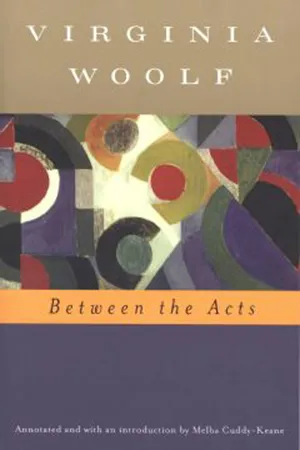
The annotated edition of the renowned author's last novel: a tale of an English village celebrating the nation's history as WWII looms.
Between the Acts takes place on a June day in 1939 at Pointz Hall, the Oliver family's country house in the heart of England. In the garden, everyone from the village has gathered to present the annual pageant—scenes from the history of England starting with the Middle Ages. As the story of England unfolds, the lives of the villagers also take shape. The past blends with the present and art blends with life in a narrative full of invention and lyricism.
Through her character's passionate musings and private dramas, and through the enigmatic figure of the pageant author, Miss La Trobe, Virginia Woolf's final novel both celebrates and satirizes Englishness. This edition of Between the Acts features annotation and an introduction by literary critic and Virginia Woolf specialist Melba Cuddy-Keane.
- 137 pages
- English
- ePUB (mobile friendly)
- Available on iOS & Android
eBook - ePub
Between the Acts
About this book
Information
Subtopic
Literature GeneralIndex
LiteratureIT WAS a summer’s night and they were talking, in the big room with the windows open to the garden, about the cesspool. The county council had promised to bring water to the village, but they hadn’t.
Mrs. Haines, the wife of the gentleman farmer, a goosefaced woman with eyes protruding as if they saw something to gobble in the gutter, said affectedly: “What a subject to talk about on a night like this!”
Then there was silence; and a cow coughed; and that led her to say how odd it was, as a child, she had never feared cows, only horses. But, then, as a small child in a perambulator, a great cart-horse had brushed within an inch of her face. Her family, she told the old man in the arm-chair, had lived near Liskeard for many centuries. There were the graves in the churchyard to prove it.
A bird chuckled outside. “A nightingale?” asked Mrs. Haines. No, nightingales didn’t come so far north. It was a daylight bird, chuckling over the substance and succulence of the day, over worms, snails, grit, even in sleep.
The old man in the arm-chair—Mr. Oliver, of the Indian Civil Service, retired—said that the site they had chosen for the cesspool was, if he had heard aright, on the Roman road. From an aeroplane, he said, you could still see, plainly marked, the scars made by the Britons; by the Romans; by the Elizabethan manor house; and by the plough, when they ploughed the hill to grow wheat in the Napoleonic wars.
“But you don’t remember . . .” Mrs. Haines began. No, not that. Still he did remember——and he was about to tell them what, when there was a sound outside, and Isa, his son’s wife, came in with her hair in pigtails; she was wearing a dressing-gown with faded peacocks on it. She came in like a swan swimming its way; then was checked and stopped; was surprised to find people there; and lights burning. She had been sitting with her little boy who wasn’t well, she apologized. What had they been saying?
“Discussing the cesspool,” said Mr. Oliver.
“What a subject to talk about on a night like this!” Mrs. Haines exclaimed again.
What had he said about the cesspool; or indeed about anything? Isa wondered, inclining her head towards the gentleman farmer, Rupert Haines. She had met him at a Bazaar; and at a tennis party. He had handed her a cup and a racquet—that was all. But in his ravaged face she always felt mystery; and in his silence, passion. At the tennis party she had felt this, and at the Bazaar. Now a third time, if anything more strongly, she felt it again.
“I remember,” the old man interrupted, “my mother. . . .” Of his mother he remembered that she was very stout; kept her tea-caddy locked; yet had given him in that very room a copy of Byron. It was over sixty years ago, he told them, that his mother had given him the works of Byron in that very room. He paused.
“She walks in beauty like the night,” he quoted.
Then again:
“So we’ll go no more a-roving by the light of the moon.”
Isa raised her head. The words made two rings, perfect rings, that floated them, herself and Haines, like two swans down stream. But his snow-white breast was circled with a tangle of dirty duckweed; and she too, in her webbed feet was entangled, by her husband, the stockbroker. Sitting on her three-cornered chair she swayed, with her dark pigtails hanging, and her body like a bolster in its faded dressing-gown.
Mrs. Haines was aware of the emotion circling them, excluding her. She waited, as one waits for the strain of an organ to die out before leaving church. In the car going home to the red villa in the cornfields, she would destroy it, as a thrush pecks the wings off a butterfly. Allowing ten seconds to intervene, she rose; paused; and then, as if she had heard the last strain die out, offered Mrs. Giles Oliver her hand.
But Isa, though she should have risen at the same moment that Mrs. Haines rose, sat on. Mrs. Haines glared at her out of goose-like eyes, gobbling, “Please, Mrs. Giles Oliver, do me the kindness to recognize my existence. . . .” which she was forced to do, rising at last from her chair, in her faded dressing-gown, with the pigtails falling over each shoulder.
Pointz Hall was seen in the light of an early summer morning to be a middle-sized house. It did not rank among the houses that are mentioned in guide books. It was too homely. But this whitish house with the grey roof, and the wing thrown out at tight angles, lying unfortunately low on the meadow with a fringe of trees on the bank above it so that smoke curled up to the nests of the rooks, was a desirable house to live in. Driving past, people said to each other: “I wonder if that’ll ever come into the market?” and to the chauffeur: “Who lives there?”
The chauffeur didn’t know. The Olivers, who had bought the place something over a century ago, had no connection with the Warings, the Elveys, the Mannerings or the Burnets; the old families who had all intermarried, and lay in their deaths intertwisted, like the ivy roots, beneath the churchyard wall.
Only something over a hundred and twenty years the Olivers had been there. Still, on going up the principal staircase—there was another, a mere ladder at the back for the servants—there was a portrait. A length of yellow brocade was visible half-way up; and, as one reached the top, a small powdered face, a great head-dress slung with pearls, came into view; an ancestress of sorts. Six or seven bedrooms opened out of the corridor. The butler had been a soldier; had married a lady’s maid; and, under a glass case there was a watch that had stopped a bullet on the field of Waterloo.
It was early morning. The dew was on the grass. The church clock struck eight times, Mrs. Swithin drew the curtain in her bedroom—the faded white chintz that so agreeably from the outside tinged the window with its green lining. There with her old hands on the hasp, jerking it open, she stood: old Oliver’s married sister; a widow. She always meant to set up a house of her own; perhaps in Kensington, perhaps at Kew, so that she could have the benefit of the gardens. But she stayed on all through the summer; and when winter wept its damp upon the panes, and choked the gutters with dead leaves, she said: “Why, Bart, did they build the house in the hollow, facing north?” Her brother said, “Obviously to escape from nature. Weren’t four horses needed to drag the family coach through the mud?” Then he told her the famous story of the great eighteenth-century winter; when for a whole month the house had been blocked by snow. And the trees had fallen. So every year, when winter came, Mrs. Swithin retired to Hastings.
But it was summer now: She had been waked by the birds. How they sang! attacking the dawn like so many choir boys attacking an iced cake. Forced to listen, she had stretched for her favourite reading—an Outline of History—and had spent the hours between three and five thinking of rhododendron forests in Piccadilly; when the entire continent, not then, she understood, divided by a channel, was all one; populated, she understood, by elephant-bodied, seal-necked, heaving, surging, slowly writhing, and, she supposed, barking monsters; the iguanodon, the mammoth, and the mastodon; from whom presumably, she thought, jerking the window open, we descend.
It took her five seconds in actual time, in mind time ever so much longer, to separate Grace herself, with blue china on a tray, from the leather-covered grunting monster who was about, as the door opened, to demolish a whole tree in the green steaming undergrowth of the primeval forest. Naturally, she jumped, as Grace put the tray down and said: “Good morning, Ma’am.” “Batty,” Grace called her, as she felt on her face the divided glance that was half meant for a beast in a swamp, half for a maid in a print frock and white apron.
“How those birds sing!” said Mrs. Swithin, at a venture. The window was open now; the birds certainly were singing. An obliging thrush hopped across the lawn; a coil of pinkish rubber twisted in its beak. Tempted by the sight to continue her imaginative reconstruction of the past, Mrs. Swithin paused; she was given to increasing the bounds of the moment by flights into past or future; or sidelong down corridors and alleys; but she remembered her mother—her mother in that very room rebuking her. “Don’t stand gaping, Lucy, or the wind’ll change . . .” How often her mother had rebuked her in that very room—“but in a very different world,” as her brother would remind her. So she sat down to morning tea, like any other old lady with a high nose, thin cheeks, a ring on her finger and the usual trappings of rather shabby but gallant old age, which included in her case a cross gleaming gold on her breast.
The nurses after breakfast were trundling the perambulator up and down the terrace; and as they trundled they were talking—not shaping pellets of information or handing ideas from one to another, but rolling words, like sweets on their tongues; which, as they thinned to transparency, gave off pink, green, and sweetness. This morning that sweetness was: “How cook had told ’im off about the asparagus; how when she rang I said: how it was a sweet costume with blouse to match;” and that was leading to something about a feller as they walked up and down the terrace rolling sweets, trundling the perambulator.
It was a pity that the man who had built Pointz Hall had pitched the house in a hollow, when beyond the flower garden and the vegetables there was this stretch of high ground. Nature had provided a site for a house; man had built his house in a hollow. Nature had provided a stretch of turf half a mile in length and level, till it suddenly dipped to the lily pool. The terrace was broad enough to take the entire shadow of one of the great trees laid flat. There you could walk up and down, up and down, under the shade of the trees. Two or three grew close together; then there were gaps. Their roots broke the turf, and among those bones were green waterfalls and cushions of grass in which violets grew in spring or in summer the wild purple orchis.
Amy was saying something about a feller when Mabel, with her hand on the pram, turned sharply, her sweet swallowed. “Leave off grubbing,” she said sharply. “Come along, George.”
The little boy had lagged and was grouting in the grass. Then the baby, Caro, thrust her fist out over the coverlet and the furry bear was jerked overboard. Amy had to stoop. George grubbed. The flower blazed between the angles of the roots. Membrane after membrane was torn. It blazed a soft yellow, a lambent light under a film of velvet; it filled the caverns behind the eyes with light. All that inner darkness became a hall, leaf smelling, earth smelling, of yellow light. And the tree was beyond the flower; the grass, the flower and the tree were entire. Down on his knees grubbing he held the flower complete. Then there was a roar and a hot breath and a stream of coarse grey hair rushed between him and the flower. Up he leapt, toppling in his fright, and saw coming towards him a terrible peaked eyeless monster moving on legs, brandishing arms.
“Good morning, sir,” a hollow voice boomed at him from a beak of paper.
The old man had sprung upon him from his hiding-place behind a tree.
“Say good morning, George; say ‘Good morning, Grandpa,’” Mabel urged him, giving him a push towards the man. But George stood gaping. George stood gazing. Then Mr. Oliver crumpled the paper which he had cocked into a snout and appeared in person. A very tall old man, with gleaming eyes, wrinkled cheeks, and a head with no hair on it. He turned.
“Heel!” he bawled, “heel, you brute!” And George turned; and the nurses turned holding the furry bear; they all turned to look at Sohrab the Afghan hound bounding and bouncing among the flowers.
“Heel!” the old man bawled, as if he were commanding a regiment. It was impressive, to the nurses, the way an old boy of his age could still bawl and make a brute like that obey him. Back came the Afghan hound, sidling, apologetic. And as he cringed at the old man’s feet, a string was slipped over his collar; the noose that old Oliver always carried with him.
“You wild beast . . . you bad beast,” he grumbled, stooping. George looked at the dog only. The hairy flanks were sucked in and out; there was a blob of foam on its nostrils. He burst out crying.
Old Oliver raised himself, his veins swollen, his cheeks flushed; he was angry. His little game with the paper hadn’t worked. The boy was a cry-baby. He nodded and sauntered on, smoothing out the crumpled paper and muttering, as he tried to find his line in the column, “A cry-baby—a cry-baby.” But the breeze blew the great sheet out; and over the edge he surveyed the landscape—flowing fields, heath and woods. Framed, they became a picture. Had he been a painter, he would have fixed his easel here, where the country, barred by trees, looked like a picture. Then the breeze fell.
“M. Daladier,” he read, finding his place in the column, “has been successful in pegging down the franc. . . .”
Mrs. Giles Oliver drew the comb through the thick tangle of hair which, after giving the matter her best attention, she had never had shingled or bobbed; and lifted the heavily embossed silver brush that had been a wedding present and had its uses in impressing chamber...
Table of contents
- Title Page
- Contents
- Copyright
- Preface: Virginia Woolf
- Chronology
- Introduction
- Between the Acts
- Notes to Between the Acts
- Suggestions for Further Reading: Virginia Woolf
- Suggestions for Further Reading: Between the Acts
- About the Author
- Footnotes
Trusted by 375,005 students
Access to over 1.5 million titles for a fair monthly price.
Study more efficiently using our study tools.
Frequently asked questions
Yes, you can cancel anytime from the Subscription tab in your account settings on the Perlego website. Your subscription will stay active until the end of your current billing period. Learn how to cancel your subscription
No, books cannot be downloaded as external files, such as PDFs, for use outside of Perlego. However, you can download books within the Perlego app for offline reading on mobile or tablet. Learn how to download books offline
Perlego offers two plans: Essential and Complete
- Essential is ideal for learners and professionals who enjoy exploring a wide range of subjects. Access the Essential Library with 800,000+ trusted titles and best-sellers across business, personal growth, and the humanities. Includes unlimited reading time and Standard Read Aloud voice.
- Complete: Perfect for advanced learners and researchers needing full, unrestricted access. Unlock 1.5M+ books across hundreds of subjects, including academic and specialized titles. The Complete Plan also includes advanced features like Premium Read Aloud and Research Assistant.
We are an online textbook subscription service, where you can get access to an entire online library for less than the price of a single book per month. With over 1.5 million books across 990+ topics, we’ve got you covered! Learn about our mission
Look out for the read-aloud symbol on your next book to see if you can listen to it. The read-aloud tool reads text aloud for you, highlighting the text as it is being read. You can pause it, speed it up and slow it down. Learn more about Read Aloud
Yes! You can use the Perlego app on both iOS and Android devices to read anytime, anywhere — even offline. Perfect for commutes or when you’re on the go.
Please note we cannot support devices running on iOS 13 and Android 7 or earlier. Learn more about using the app
Please note we cannot support devices running on iOS 13 and Android 7 or earlier. Learn more about using the app
Yes, you can access Between the Acts by Virginia Woolf in PDF and/or ePUB format, as well as other popular books in Literature & Literature General. We have over 1.5 million books available in our catalogue for you to explore.