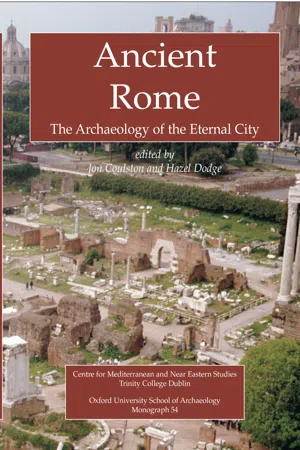
A major new book on the archaeology of Rome. The chapters, by an impressive list of contributors, are written to be as up-to-date and useful as possible, detailing lots of new research. There are new maps for the topography and monuments of Rome, a huge research bibliography containing 1,700 titles and the volume is richly illustrated. Essential for all Roman scholars and students.
Contents: Preface: a bird's eye view ( Peter Wiseman ); Introduction ( Jon Coulston and Hazel Dodge ); Early and Archaic Rome ( Christopher Smith ); The city of Rome in the Middle Republic ( Tim Cornell ); The moral museum: Augustus and the image of Rome ( Susan Walker ); Armed and belted men: the soldiery in Imperial Rome ( Jon Coulston ); The construction industry in Imperial Rome ( Janet Delaine and G Aldrete ); The feeding of Imperial Rome: the mechanics of the food supply system ( David Mattingly ); `Greater than the pyramids': the water supply of ancient Rome ( Hazel Dodge ); Entertaining Rome ( Kathleen Coleman ); Living and dying in the city of Rome: houses and tombs ( John Patterson ); Religions of Rome ( Simon Price ); Rome in the Late Empire ( Neil Christie ); Archaeology and innovation ( Hugh Petter ); Appendix: Sources for the study of ancient Rome ( Jon Coulston and Hazel Dodge ).
- 400 pages
- English
- ePUB (mobile friendly)
- Available on iOS & Android
eBook - ePub
About this book
Information
Subtopic
Roman Ancient HistoryIndex
History1. Introduction: the archaeology and topography of Rome
Throughout her history Rome has been a centre of power, on a small scale initially, but steadily growing to form an empire which, for the first and last time, unified the Mediterranean world. In economic terms the influence of Rome eventually encompassed the whole of Eurasia and northern Africa. The city as consumer of mass imports (foods, water, luxuries, slaves, animals, building materials and people) grew physically in both extent and architectural complexity. Evolving building materials and techniques acted as a barometer of wealth and territorial power. The earliest structures, the huts on the Palatine (Figs. 1.1, 2.5), left only the negative imprint of sunken floors and post-holes, but requirement for larger sacred and public buildings led to the use of less perishable inorganic materials, terracotta and local tufa stones (Smith, Cornell in this volume). These began to seriously impact the archaeological record, and an increasing range of stones reflected spreading control of the Tevere (Tiber) valley and Latium (Gabian, Alban and Veian tufas; DeLaine in this volume). Hellenising cultural influences from southern Italy and further east placed a premium on hard, white stones for buildings with fine sculptural detail (white-plastered tufa, travertine, eventually marble). Finally, under the emperors, the stone resources of the whole Mediterranean and its hinterlands were organised for exploitation in a polychrome display, which consciously emphasised territorial power and technical achievement.1 There was inflationary competition between emperors and their predecessors in the provision of public amenities, such as baths or games, on an ever-increasing scale and level of luxury (Dodge, Coleman in this volume). Hand in hand with the need for buildings of increasing size to serve an ever-growing population was the development of concrete (opus caementicium) as a building material. This employed economic, mass-producible local resources in efficient, durable, vaulted structures (DeLaine in this volume).
Ancient Rome was certainly a huge urban development for any pre-industrial society to maintain, and modern scholars have tried every means to quantify her scale. Population has been calculated using overall area, built up and open space hectarage, funerary inscription statistics, and comparative modern population densities. Ancient figures for numbers of domestic dwellings by type (domus and insula), corn-dole recipients, and quantities of corn imports have all been pressed into service. Thus it has been postulated that up to 1,200,000 people lived in Rome at her 1st–2nd century AD height.2 However, every method of calculation and set of statistics runs into problems. The most fundamental is that the modern desire to quantify Rome’s scale uses evidence provided by an ancient society which had no real necessity for, nor ability to achieve, exactitude. Figures were quoted in the sources precisely to express magnitude, to reflect glory on the metropolis, or to laud the beneficent patron. Thus, the 4th century AD Regionary Catalogues presented statistics, which appear authoritative through their very detail (see Appendix). Nevertheless, close examination reveals them to have been unusable for any ‘official’, administrative purpose, such as feeding or policing the city, or maintaining the urban fabric. The arithmetic is sloppy, with numbers spelt out in detail not tallying with quoted totals.3 Rather, these figures reflect the scale of Rome taking on a life of its own, drawing in the wonder and awe of observers by its sheer quantity of statues, temples, basilicas, theatres, amphitheatres, circuses, streets, houses, mansions, military bases, aqueducts, baths, fountains, warehouses, bakers, cemeteries, and even public lavatories, churches, and brothels.4
When the economic tide receded from the 3rd century AD onwards, the urban fabric remained for future generations to live in, adapt, and continue to marvel at. The skeletons of massive buildings, their original functions often forgotten, remained to constantly remind of past glories and to provide a language for expressing present and future aspirations. The transformation of Rome into a christian capital during the 4th century ensured her a continuing central place in medieval and modern history, and continuing patronage by a series of rulers concerned with a world stage.5 The ‘idea’ of Rome has been employed through epigraphy, numismatics, art and architecture to strengthen and project the successive regimes of Late Roman and Byzantine emperors, popes, Holy Roman Emperors and other western monarchs, secular local governments, Italian kings, a fascist dictator, and the post-war Italian republic.6 Rome, like an animal in hibernation living on stored resources, has always fed on herself for inspiration and physical means. The millions of tons of stone imported by the ancient emperors were thereafter available for recycling into churches, palazzi and other monuments. The thousands of inscriptions and artworks were there to be collected and emulated.7
Underlying and channelling this urban development are the fundamentals of geology, geomorphology and topography that are now rather difficult to envisage in the presence of the modern city. Much work has been done on hilltop and valley geology, dominated by volcanic deposits and fluvial erosion (Fig. 1.2).8 Indeed, the action of the Tiber and its tributary streams is critical to the city’s location (Dodge in this volume). Erosion of the Esquiline plateau created a series of peninsulas and linked or isolated hills, divided by steep-sided valleys, which open out onto the flood plain. The Palatine Hill was small enough to be defended at an early date but large enough for a growing community (Smith in this volume). The Capitoline Hill was suitably small and defensible for it to subsequently become the acropolis of the expanded regal city. The Tiber Island provided the lowest fording-point above the mouth of the river and an overland line of communication between Etruria to the north-west and Latium and Hellenized Campania to the south-east. The river valley facilitated movement up into the Apennines, particularly commerce in salt from the coastal pans.9 Thus the city was locally well placed with regard to communications and trade. It was also on a cultural frontier between Etruscans, Faliscans and Latins. The local geology provided soft tufas for building and volcanic sands for mortars (DeLaine in this volume). The geologically ancient volcanoes close by in South Etruria and the Colli Albani, and the more recent eruptions further afield in Campania, ensure that not only the past but the present city is periodically rocked by earthquakes, as in AD 1980 (Fig. 1.2).10
Until the late 19th and early 20th century canalisation of the Tevere, the river dominated the life of the city, not least because of perennial flooding of the low-lying areas.11 The Campo Marzio (Campus Martius, Mezza Luna) was particularly vulnerable when the Apennine snows melted (Fig. 1.2). At this time the river increased its rate of flow in a comparatively straight stretch to the north, then turned virtually ninety degrees to the west to pass round the meander core. The weight of water would burst over the bank flooding the flat area south of the turn. These inundations caused destruction of buildings and the spread of disease...
Table of contents
- Title Page
- Copyright Page
- List of Contributors
- Table of Contents
- Editors’ Preface
- Preface: A Bird’s-Eye View
- 1. Introduction: the archaeology and topography of Rome
- 2. Early and Archaic Rome
- 3. The City of Rome in the Middle Republic (c. 400–100 BC)
- 4. The Moral Museum: Augustus and the City of Rome
- 5. ‘Armed and belted men’: the soldiery in imperial Rome
- 6. Building the Eternal City: the construction industry of imperial Rome
- 7. The Feeding of Imperial Rome: The Mechanics of the Food Supply System
- 8. ‘Greater than the Pyramids’: the Water Supply of Ancient Rome
- 9. Entertaining Rome
- 10. Living and Dying in the City of Rome: houses and tombs
- 11. Religions of Rome
- 12. Lost Glories? Rome at the End of Empire
- 13. Back to the Future: Archaeology and Innovation in the Building of Roma Capitale
- Appendix: Sources for the Study of Ancient Rome
- Abbreviations
- Research Bibliography for the City of Rome
- Index
Trusted by 375,005 students
Access to over 1.5 million titles for a fair monthly price.
Study more efficiently using our study tools.
Frequently asked questions
Yes, you can cancel anytime from the Subscription tab in your account settings on the Perlego website. Your subscription will stay active until the end of your current billing period. Learn how to cancel your subscription
No, books cannot be downloaded as external files, such as PDFs, for use outside of Perlego. However, you can download books within the Perlego app for offline reading on mobile or tablet. Learn how to download books offline
Perlego offers two plans: Essential and Complete
- Essential is ideal for learners and professionals who enjoy exploring a wide range of subjects. Access the Essential Library with 800,000+ trusted titles and best-sellers across business, personal growth, and the humanities. Includes unlimited reading time and Standard Read Aloud voice.
- Complete: Perfect for advanced learners and researchers needing full, unrestricted access. Unlock 1.5M+ books across hundreds of subjects, including academic and specialized titles. The Complete Plan also includes advanced features like Premium Read Aloud and Research Assistant.
We are an online textbook subscription service, where you can get access to an entire online library for less than the price of a single book per month. With over 1.5 million books across 990+ topics, we’ve got you covered! Learn about our mission
Look out for the read-aloud symbol on your next book to see if you can listen to it. The read-aloud tool reads text aloud for you, highlighting the text as it is being read. You can pause it, speed it up and slow it down. Learn more about Read Aloud
Yes! You can use the Perlego app on both iOS and Android devices to read anytime, anywhere — even offline. Perfect for commutes or when you’re on the go.
Please note we cannot support devices running on iOS 13 and Android 7 or earlier. Learn more about using the app
Please note we cannot support devices running on iOS 13 and Android 7 or earlier. Learn more about using the app
Yes, you can access Ancient Rome by John Coulston,Hazel Dodge, Hazel Dodge in PDF and/or ePUB format, as well as other popular books in History & Roman Ancient History. We have over 1.5 million books available in our catalogue for you to explore.