Using archival sources, newspapers accounts, and trade publications, Stole demonstrates that the war elevated and magnified the seeming contradictions of advertising and allowed critics of these practices one final opportunity to corral and regulate the institution of advertising. Exploring how New Dealers and consumer advocates such as the Consumers Union battled the advertising industry, Advertising at War traces the debate over two basic policy questions: whether advertising should continue to be a tax-deductible business expense during the war, and whether the government should require effective standards and labeling for consumer products, which would render most advertising irrelevant. Ultimately the postwar climate of political intolerance and reverence for free enterprise quashed critical investigations into the advertising industry. While advertising could be criticized or lampooned, the institution itself became inviolable.
- English
- ePUB (mobile friendly)
- Available on iOS & Android
eBook - ePub
About this book
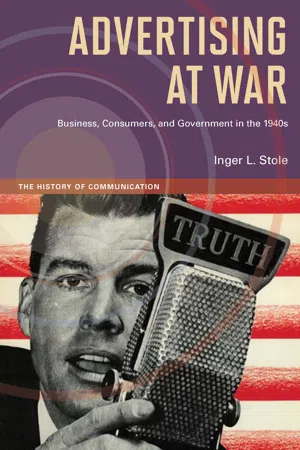
Advertising at War challenges the notion that advertising disappeared as a political issue in the United States in 1938 with the passage of the Wheeler-Lea Amendment to the Federal Trade Commission Act, the result of more than a decade of campaigning to regulate the advertising industry. Inger L. Stole suggests that the war experience, even more than the legislative battles of the 1930s, defined the role of advertising in U.S. postwar political economy and the nation's cultural firmament. She argues that Washington and Madison Avenue were soon working in tandem with the creation of the Advertising Council in 1942, a joint effort established by the Office of War Information, the Association of National Advertisers, and the American Association of Advertising Agencies.
Information
Publisher
University of Illinois PressYear
2012Print ISBN
9780252078651
9780252037122
eBook ISBN
9780252094231
1
Prelude to War
The advertising industry concluded the turbulent decade of the 1930s with some sense of accomplishment. Its public relations campaigns appeared to have marginalized the consumer movement’s most radical demands, and the five-year battle over federal regulation of advertising had culminated in the Wheeler-Lea Amendment, a law that for all practical purposes sanctioned existing advertising practices. Nonetheless, the years from 1938 through 1941 were fraught with danger in the minds of industry leaders, who perceived the notorious New Dealers to have intensified their critical stance toward advertising as the decade drew to a close. Many were of the opinion that the federal government was determined to crack down on advertising, or even destroy it.1
A series of events reinforced this notion. One was the formation of the Temporary National Economic Committee (TNEC) in 1938. Although the committee’s objective was not specifically to investigate advertising practices, its focus on monopoly building cast advertising as a tool used in the creation of uncompetitive markets and as an impediment to economic recovery. Subsequent investigations by the Federal Trade Commission (FTC) were more explicit in this regard and put the advertising industry in a defensive stance. While the industry worked frantically to debunk the claim that it was fostering monopolistic tendencies, the escalating war in Europe generated additional concerns. Raw materials were becoming increasingly scarce as production shifted from consumer to military markets, causing critics to question the need for advertising of consumer goods. Promotion of products that were in short supply might have an inflationary effect and could lead to the emergence of black markets. A series of bills were proposed in Congress that would have effectively halted advertising during the war, leaving advertisers to fear that the public might not be eager to return to an advertising-laden society once the fighting was over. The industry was faced with a formidable challenge in attempting to justify its role in the economy and fight back.
Advertising, Business Concentration, and Antitrust
Problems surrounding economic concentration and monopolistic tendencies had been an ongoing concern in the United States since the latter part of the nineteenth century. Congress had responded by passing the Sherman Antitrust Act in 1890, which prevented monopolies and cartels from obstructing competition and harming consumers in the marketplace. Enforced primarily by the Antitrust Division of the Justice Department, the law prohibited contracts, combinations, and conspiracies in restraint of trade, as well as monopolization, and it prescribed substantial fines, even prison terms, for violators. But the legislation was far from perfect. If a corporation violated the law, it could simply dissolve and reorganize as a new corporate entity. And because corporations had traditionally been created by state governments, they were not subject to federal control and oversight.2
Concerns about corporate dominance of markets continued into the twentieth century, becoming a cornerstone of Theodore Roosevelt’s presidency. In 1914, Congress augmented the Sherman Antitrust Act with the Clayton Antitrust Act, which addressed specific types of restraints not covered by the 1890 measure, including exclusive dealing arrangements, tie-in sales, price discrimination, mergers and acquisitions, and interlocking directorates. With the Justice Department’s Antitrust Division and the Federal Trade Commission jointly overseeing compliance, it was quickly apparent that the new law would not be vigorously enforced.
Business consolidation continued to strengthen after World War I and had become a problem by the time the nation plunged into the Great Depression in the 1930s. Many blamed the economic stagnation on monopolistic pricing structures and production restraints.3 Between 1930 and 1938, the per capita U.S. income was $397 a year, down from $606 in the previous decade. The decrease was shared by all segments of the population.4 By 1937 the economy had finally returned to 1929 output levels, and unemployment had been reduced from a peak of 25 percent to 14 percent. The Depression appeared to be over. Then the economy unexpectedly went into a tailspin: by early 1938, manufacturing had fallen 30 percent from its 1937 high, five million additional Americans were out of work, and the unemployment rate was nearing 20 percent.5 The economic crisis, now approaching a decade in length, began to look as if it might never end.
Some liberal economists, joined by Thurman Arnold, the assistant attorney general in charge of the Antitrust Division, saw this as an opportune moment to turn their attention to the question of monopoly and stagnation.6 They wanted to explore how concentration and market control were contributing to the sluggish economy, which had left factory capacity unused and millions of workers unemployed. They argued that firms in highly concentrated industries had gained the power to control prices, in terms not only of what to charge for their products but also what they were willing to pay their suppliers. This meant that a few large firms enjoyed immense power over their individual markets, thereby preventing the economy from becoming efficient. These giant firms in largely noncompetitive markets could use their economic leverage to force suppliers to sell raw materials at low prices. But because they had a large reserve of capital, they were not forced to sell their own products at low market prices; they were able to hold on to their inventory until higher prices could be commanded. This upset the economy. With few people buying products, production was cut to limit the accumulation of surpluses, which resulted in a vicious cycle of unemployment and weakened purchasing power.7 Monopolistic (or what we today would refer to as oligopolistic) markets, Arnold suspected, might well be exacerbating the economic stagnation and depression.
Seeking to get the economy back on track, Arnold and other influential members of the Roosevelt administration argued that stricter enforcement of the antitrust laws was the best strategy for securing free markets and policing monopolistic tendencies. If individual markets could be opened to a larger number of players, suppliers of raw materials would be able to sell at a fair market price instead of being limited to the artificial price ceilings set by a few powerful firms. Similarly, if producers had to compete for consumers on the basis of the price and quality of their products rather than trademarks developed through advertising, prices would come down and consumers would trickle back into the marketplace, gradually increasing the demand for goods and effectively bringing the economy back on track. Economic inequality would be lessened as workers’ incomes rose, and that money would be spent, thereby spurring more investment and economic growth. The key to economic recovery was to move back toward market freedom and away from monopoly.8 This, however, was easier said than done, because even business interests acknowledged that “the corporate form has a tendency toward concentration.”9
The Temporary National Economic Committee
In the late 1930s, the country found itself at a rare political moment. It was then that American corporate capitalism was subject to the most intense level of scrutiny in the nation’s history, accompanied by fundamental questioning about its suitability. Economists and New Dealers were increasingly gravitating toward the conclusion that monopoly (and its resulting inequality) was the explanation for the stagnation in the nation’s economy. Frustrated by not gaining traction for a serious antimonopoly program at the Department of Justice, Arnold was pleased to offer his blessing and promise of cooperation when Congress decided to pursue the matter.
After a series of legislative deliberations, the Temporary National Economic Committee—commonly referred to as the Monopoly Committee—was established by a joint congressional resolution on June 25, 1938, with a mandate to study the “concentration of economic power in American industry and the effect of that concentration upon the decline of competition.” Noting that “concentration of private power had escalated to unparalleled historical levels with the result of seriously impacting the economic effectiveness of private enterprise,” President Roosevelt expressed hope that an investigation into these practices might reveal strategies that could “make the American way of living work more effectively” and lead to a “more equitable distribution of income and earnings among American people.”10 While advertising was never the specific focus of any TNEC investigation, its role in protecting markets and preventing competition reappeared in hearing after hearing, leaving many industry leaders ill at ease.
Congress initially allocated $100,000 for the committee and an additional $400,000 for the government departments and agencies that were expected to work closely with the TNEC, including the Department of Justice’s Antitrust Division, the Federal Trade Commission, the Securities and Exchange Commission, the Treasury Department, the Commerce Department, and the Labor Department.11 In an effort to show that there was broad support for the effort, members were drawn from the administration and from both houses of Congress. Joseph O’Mahoney, a Democratic senator from Wyoming, was tapped as the TNEC’s first chairman, while Leon Henderson, the chief economist of the Public Works Administration, served as executive secretary.12
The Twentieth Century Fund, a philanthropic foundation started by the liberal businessman Edward Filene, had begun a study on “big business” in the United States as early as 1934, but a few years later the organization found itself overwhelmed by the scope of this undertaking. Thus its researchers were happy to transfer their records and findings to the TNEC, a government outfit with far more resources at its disposal.13 The committee’s first task was to review the existing federal economic policies in order to formulate a plan for better distribution of national income and full employment of “men, materials, machines, and money.”14 Working at breakneck speed during the fall of 1938, the group established the groundwork for public hearings on monopoly-related issues. In spite of loud grumbling from some business circles, in which the committee was viewed as yet another New Deal strategy for “putting the blame on business,” the National Association of Manufacturers, the American Bar Association, and the United States Chamber of Commerce lent their support.15 The time was not right for a business attack on government, and the government’s public pronouncements were all conciliatory toward free enterprise. “No one,” promised Chairman O’Mahoney, “will gain more than business from whatever steps are taken to define and clarify the role of Government as traffic officer in enforcing the rules of fair competition.”16 This meant taking stock of what individual companies and industries were doing to meet their social responsibilities.17
One year after the committee’s inception, more than twenty experts were at work writing and supervising the preparation of monographs on various aspects of concentrated economic power. The publications fell into three general categories. One group produced historical, analytical, and statistical surveys of the status of competition and the nature and extent of concentration of economic control. Another analyzed data and made recommendations on how to deal with problematic issues. The third group evaluated the applicability of available devices for freeing the economy from the effects of monopoly control.18 The TNEC’s intention, explained Leon Henderson, was to present through reports and hearings “a series of typical situations, drawn from different industries, and illustrating different problems,” and to analyze the significance of the varied situations for the “complicated and dynamic process which constitutes American industry.”19 If an investigation disclosed the existence of a harmful monopolistic condition, the corrective process under the antitrust laws would be set in motion, with the violator facing either criminal or civil prosecution or a combination of the two.20
The committee was quick to point out, however, that its purpose was not to single out businesses as bad, or to frighten anyone, but merely to apply antitrust regulations to determine whether an industry had gone so far along the path of monopoly control that competition was being hampered. The TNEC asked two basic questions in its detailed case study of American business. First, it asked whether a particular business combination had gone beyond the necessities of efficient mass production and become an instrument of arbitrary price control. Second, it asked whether the marketing practices in an industry—of which advertising was generally far and away the largest expense—tended merely to create orderly marketing conditions in which competitors could exist, or whether they were used to prop up rigid prices and maintain market control.21 The stakes were high. Unless the government was willing to close the door on the arbitrary power exercised by private organizations and give the free enterprise system a chance, warned O’Mahoney, “we shall have a terrible time preventing the exercise of arbitrary power by the Government.”22
Between 1939 and 1941, the TNEC spent more than $1 million, had a staff that included 182 experts, fully examined 95 different industries, and took testimony from 552 witnesses. It left a permanent record consisting of 37 volumes of printed testimony and 43 exhaustive monographs on various phases of its study. “There never was before, and may never be again, quite such an economic study as the committee closed its books on,” Time magazine wrote in 1941. “It made headlines month after month with sensational charges of patent monopoly in the glass-container industry, of international patent combines which put Germany’s finger in the U.S. magnesium and optical-glass industries, etc.”23 The publicity helped the TNEC generate large numbers of letters from citizens urging the government “to pursue the good work more vigorously and to take off the back of consumers the enormous spending of advertising.”24 One of the committee’s rather disturbing conclusions was that out of the hundreds of American industries, only four or five firms controlled between 50 and 75 percent of the output, which effectively gave them control over the smaller firms in their fields.25 And as manufacturers were soon to discover, advertising emerged as one of ...
Table of contents
- Cover
- Title
- Copyright
- Contents
- List of Illustrations
- Acknowledgments
- Introduction
- Chapter 1: Prelude to War
- Chapter 2: Advertising Navigates the Defense Economy
- Chapter 3: The Initial Year of the Advertising Council
- Chapter 4: The Consumer Movement’s Return
- Chapter 5: Advertising, Washington, and the Renamed War Advertising Council
- Chapter 6: The Increasing Role of the War Advertising Council
- Chapter 7: Peace and the Reconversion of the Advertising Council
- Epilogue
- Notes
- Index
Trusted by 375,005 students
Access to over 1.5 million titles for a fair monthly price.
Study more efficiently using our study tools.
Frequently asked questions
Yes, you can cancel anytime from the Subscription tab in your account settings on the Perlego website. Your subscription will stay active until the end of your current billing period. Learn how to cancel your subscription
No, books cannot be downloaded as external files, such as PDFs, for use outside of Perlego. However, you can download books within the Perlego app for offline reading on mobile or tablet. Learn how to download books offline
Perlego offers two plans: Essential and Complete
- Essential is ideal for learners and professionals who enjoy exploring a wide range of subjects. Access the Essential Library with 800,000+ trusted titles and best-sellers across business, personal growth, and the humanities. Includes unlimited reading time and Standard Read Aloud voice.
- Complete: Perfect for advanced learners and researchers needing full, unrestricted access. Unlock 1.5M+ books across hundreds of subjects, including academic and specialized titles. The Complete Plan also includes advanced features like Premium Read Aloud and Research Assistant.
We are an online textbook subscription service, where you can get access to an entire online library for less than the price of a single book per month. With over 1.5 million books across 990+ topics, we’ve got you covered! Learn about our mission
Look out for the read-aloud symbol on your next book to see if you can listen to it. The read-aloud tool reads text aloud for you, highlighting the text as it is being read. You can pause it, speed it up and slow it down. Learn more about Read Aloud
Yes! You can use the Perlego app on both iOS and Android devices to read anytime, anywhere — even offline. Perfect for commutes or when you’re on the go.
Please note we cannot support devices running on iOS 13 and Android 7 or earlier. Learn more about using the app
Please note we cannot support devices running on iOS 13 and Android 7 or earlier. Learn more about using the app
Yes, you can access Advertising at War by Inger L Stole in PDF and/or ePUB format, as well as other popular books in Business & Advertising. We have over 1.5 million books available in our catalogue for you to explore.