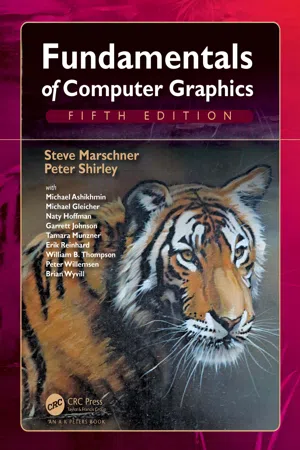
Fundamentals of Computer Graphics
eBook - ePub

Fundamentals of Computer Graphics

  1. 768 pages
  2. English
  3. ePUB (mobile friendly)
  4. Available on iOS & Android
eBook - ePub

Fundamentals of Computer Graphics

About this book

Drawing on an impressive roster of experts in the field, Fundamentals of Computer Graphics, Fifth Edition offers an ideal resource for computer course curricula as well as a user-friendly personal or professional reference.

Focusing on geometric intuition, this book gives the necessary information for understanding how images get onto the screen by using the complementary approaches of ray tracing and rasterization. It covers topics common to an introductory course, such as sampling theory, texture mapping, spatial data structure, and splines. It also includes a number of contributed chapters from authors known for their expertise and clear way of explaining concepts.

HIGHLIGHTS

  • Major updates and improvements to numerous chapters, including shading, ray tracing, physics-based rendering, math, and sampling
  • Updated coverage of existing topics
  • The absorption and reworking of several chapters to create a more natural flow to the book

The fifth edition of Fundamentals of Computer Graphics continues to provide an outstanding and comprehensive introduction to basic computer graphic technology and theory. It retains an informal and intuitive style while improving precision, consistency, and completeness of material, allowing aspiring and experienced graphics programmers to better understand and apply foundational principles to the development of efficient code in creating film, game, or web designs.

Frequently asked questions

Yes, you can cancel anytime from the Subscription tab in your account settings on the Perlego website. Your subscription will stay active until the end of your current billing period. Learn how to cancel your subscription.
No, books cannot be downloaded as external files, such as PDFs, for use outside of Perlego. However, you can download books within the Perlego app for offline reading on mobile or tablet. Learn more here.
Perlego offers two plans: Essential and Complete
  • Essential is ideal for learners and professionals who enjoy exploring a wide range of subjects. Access the Essential Library with 800,000+ trusted titles and best-sellers across business, personal growth, and the humanities. Includes unlimited reading time and Standard Read Aloud voice.
  • Complete: Perfect for advanced learners and researchers needing full, unrestricted access. Unlock 1.4M+ books across hundreds of subjects, including academic and specialized titles. The Complete Plan also includes advanced features like Premium Read Aloud and Research Assistant.
Both plans are available with monthly, semester, or annual billing cycles.
We are an online textbook subscription service, where you can get access to an entire online library for less than the price of a single book per month. With over 1 million books across 1000+ topics, we’ve got you covered! Learn more here.
Look out for the read-aloud symbol on your next book to see if you can listen to it. The read-aloud tool reads text aloud for you, highlighting the text as it is being read. You can pause it, speed it up and slow it down. Learn more here.
Yes! You can use the Perlego app on both iOS or Android devices to read anytime, anywhere — even offline. Perfect for commutes or when you’re on the go.
Please note we cannot support devices running on iOS 13 and Android 7 or earlier. Learn more about using the app.
Yes, you can access Fundamentals of Computer Graphics by Steve Marschner,Peter Shirley in PDF and/or ePUB format, as well as other popular books in Computer Science & Programming Games. We have over one million books available in our catalogue for you to explore.

Information

Table of contents

  1. Cover
  2. Half Title
  3. Title Page
  4. Copyright Page
  5. Table of Contents
  6. Preface
  7. Acknowledgments
  8. Authors
  9. 1 Introduction
  10. 2 Miscellaneous Math
  11. 3 Raster Images
  12. 4 Ray Tracing
  13. 5 Surface Shading
  14. 6 Linear Algebra
  15. 7 Transformation Matrices
  16. 8 Viewing
  17. 9 The Graphics Pipeline
  18. 10 Signal Processing
  19. 11 Texture Mapping
  20. 12 Data Structures for Graphics
  21. 13 Sampling
  22. 14 Physics-Based Rendering
  23. 15 Curves
  24. 16 Computer Animation
  25. 17 Using Graphics Hardware
  26. 18 Color
  27. 19 Visual Perception
  28. 20 Tone Reproduction
  29. 21 Implicit Modeling
  30. 22 Computer Graphics in Games
  31. 23 Visualization
  32. References
  33. Index