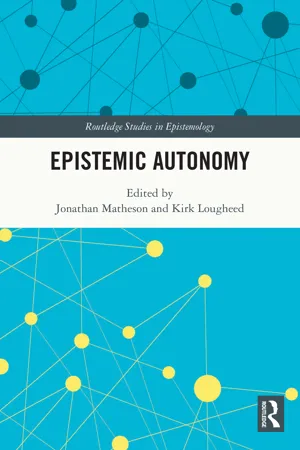
Epistemic Autonomy
  1. 344 pages
  2. English
  3. ePUB (mobile friendly)
  4. Available on iOS & Android
eBook - ePub

About this book

This is the first book dedicated to the topic of epistemic autonomy. It features original essays from leading scholars that promise to significantly shape future debates in this emerging area of epistemology.

While the nature of and value of autonomy has long been discussed in ethics and social and political philosophy, it remains an underexplored area of epistemology. The essays in this collection take up several interesting questions and approaches related to epistemic autonomy. Topics include the nature of epistemic autonomy, whether epistemic paternalism can be justified, autonomy as an epistemic value and/or vice, and the relation of epistemic autonomy to social epistemology and epistemic injustice.

Epistemic Autonomy will be of interest to researchers and advanced students working in epistemology, ethics, and social and political philosophy.

Information

Publisher
Routledge
Year
2021
Print ISBN
9781032052342
9780367433345
eBook ISBN
9781000423013

Part I
The Nature of Epistemic Autonomy

1 Epistemic Autonomy and Externalism

J. Adam Carter

1.1

Suppose Prometheus is tied to a ship, bound by ropes so that he can’t move an inch. Prometheus is considerably less autonomous than he would be were his ropes cut. But even in this predicament – where he is completely unable to physically act or affect his environment – there remains a sense in which Prometheus is autonomous in a way he would not be were he not only physically bound but also drugged and hypnotized.
This difference is a useful reference point for distinguishing between two broad types of personal autonomy: outward-directed autonomy – which is what Prometheus lacks in virtue of being tied up – and inward-directed autonomy, which is what he retains even when shackled (but not when drugged or hypnotized).1
The species of personal autonomy that this chapter will have as its focus is exclusively inward-directed personal autonomy – viz., autonomy of the mind. But the focus will be much more narrow than this. For one thing, there are two main ways of thinking about structure of the property that inward-directed autonomy picks out. Here we can distinguish between autonomy as (i) a global property of persons, taken as a whole, and as (ii) a property of particular attitudes of a person, such as beliefs and desires. My interest will be the latter – viz., in attitudinal autonomy.
Discussions of attitudinal autonomy are almost entirely restricted to the literature on moral responsibility.2 In such debates, the central focus has been how to spell out the kind of attitudinal autonomy that matters for the purposes of moral, rather than epistemic, evaluations. I suggest that there is also an interesting kind of attitudinal autonomy – what I’m calling epistemic attitudinal autonomy (hereafter: epistemic autonomy) – that matters for knowledge.
Here is the plan for what follows. Section 1.2 articulates a case for thinking that there is a distinctive kind of autonomy, autonomy of belief, that matters for propositional knowledge. Section 1.3 makes the case that this kind of attitudinal autonomy is importantly different from the kind that matters for moral responsibility. Section 1.4 shows what an internalist account of epistemic autonomy would look like and argues that any such account faces intractable problems. Section 1.5 considers two broad ways to be an externalist about epistemic autonomy: counterfactual externalism and history-sensitive externalism. The former is shown to have its own problems, whereas a version of the latter offers much more promise.3

1.2

Let’s take as a starting point Keith Lehrer’s (1990) classic case of Mr. Truetemp:
TRUETEMP: Suppose a person, whom we shall name Mr. Truetemp, undergoes brain surgery by an experimental surgeon who invents a small device which is both a very accurate thermometer and a computational device capable of generating thoughts. The device, call it a tempucomp, is implanted in Truetemp’s head so that the very tip of the device, no larger than the head of pin, sits unnoticed on his scalp and acts as a sensor to transmit information about the temperature to the computational system in his brain. This device, in turn, sends a message to his brain causing him to think of the temperature recorded by the external sensor. Assume that the tempucomp is very reliable, and so his thoughts are correct temperature thoughts. All told, this is a reliable belief-forming process. Now imagine, finally, that he has no idea that the tempucomp has been inserted in his brain, is only slightly puzzled about why he thinks so obsessively about the temperature, but never checks a thermometer to determine whether these thoughts about the temperature are correct. He accepts them unreflectively, another effect of the tempucomp. Thus, he thinks and accepts that the temperature is 104 degrees. It is. Does he know that it is?
(1990, 162–163)
The predominant view in mainstream epistemology is that Mr. Truetemp does not know that the temperature is 104 degrees in the above case, despite the reliability4 of his belief-forming process. There’s little consensus, though, as to why. Lehrer himself, along with William Alston (1988), both reason along the following lines: Truetemp lacks knowledge of the relevant temperature belief because (i) knowledge requires epistemic justification; and (ii) there is at least some additional justified belief that Truetemp lacks but which he’d need in order to be epistemically justified in believing that it is 104 degrees. For Lehrer, that “extra” belief is a “metabelief” about the reliability of the temperature-implant based process; for Alston, the extra belief just needs to be a belief that could serve as a good reason for believing that it’s 104 degrees (a reason Truetemp presently lacks). If Truetemp had those beliefs, and appropriately based his temperature belief on them, then he’d be a knower.
While something like this might look plausible as a diagnosis of Lehrer’s original version of the case, it’s not hard to think up variations on the case where neither the Lehrer nor Alston lines would work. For example, suppose we run a twist on the case that holds everything fixed except the following: what the scientists implant is more sophisticated than the tempucomp: call it the “TempucompDeluxe.” The TempucompDeluxe not only compels5 Truetemp to believe the target proposition (i.e., that it’s 104 degrees), but it also compels him to believe a further proposition “X,” where we can fill in “X” with either a Lehrer-style meta...

Table of contents

  1. Cover
  2. Half Title
  3. Series Page
  4. Title Page
  5. Copyright Page
  6. Table of Contents
  7. Contributors
  8. Acknowledgments
  9. Introduction: Puzzles Concerning Epistemic Autonomy
  10. Part I: The Nature of Epistemic Autonomy
  11. Part II: Epistemic Autonomy and Paternalism
  12. Part III: Epistemic Autonomy and Epistemic Virtue and Value
  13. Part IV: Epistemic xAutonomy and Social Epistemology
  14. Index

Trusted by 375,005 students

Access to over 1.5 million titles for a fair monthly price.

Study more efficiently using our study tools.

Frequently asked questions

Yes, you can cancel anytime from the Subscription tab in your account settings on the Perlego website. Your subscription will stay active until the end of your current billing period. Learn how to cancel your subscription
No, books cannot be downloaded as external files, such as PDFs, for use outside of Perlego. However, you can download books within the Perlego app for offline reading on mobile or tablet. Learn how to download books offline
Perlego offers two plans: Essential and Complete
  • Essential is ideal for learners and professionals who enjoy exploring a wide range of subjects. Access the Essential Library with 800,000+ trusted titles and best-sellers across business, personal growth, and the humanities. Includes unlimited reading time and Standard Read Aloud voice.
  • Complete: Perfect for advanced learners and researchers needing full, unrestricted access. Unlock 1.5M+ books across hundreds of subjects, including academic and specialized titles. The Complete Plan also includes advanced features like Premium Read Aloud and Research Assistant.
Both plans are available with monthly, semester, or annual billing cycles.
We are an online textbook subscription service, where you can get access to an entire online library for less than the price of a single book per month. With over 1.5 million books across 990+ topics, we’ve got you covered! Learn about our mission
Look out for the read-aloud symbol on your next book to see if you can listen to it. The read-aloud tool reads text aloud for you, highlighting the text as it is being read. You can pause it, speed it up and slow it down. Learn more about Read Aloud
Yes! You can use the Perlego app on both iOS and Android devices to read anytime, anywhere — even offline. Perfect for commutes or when you’re on the go.
Please note we cannot support devices running on iOS 13 and Android 7 or earlier. Learn more about using the app
Yes, you can access Epistemic Autonomy by Jonathan Matheson, Kirk Lougheed, Jonathan Matheson,Kirk Lougheed in PDF and/or ePUB format, as well as other popular books in Philosophy & Epistemology in Philosophy. We have over 1.5 million books available in our catalogue for you to explore.