DISTINGUISHED FAVORITE: NYC Big Book Award 2021 - Marketing & PR
Many organizations and leaders struggle to respond effectively to fast-evolving customer expectations driven by innovations in products, services and technologies such as AI and mobile. Failing to build the necessary strategy, culture and processes, they suffer from high costs, dissatisfied customers and brand damage.
The mandate to get customer experience right is real and urgent. Leading the Customer Experience is a guide to shaping experiences that win loyalty and deliver outstanding business results. It provides a bold, step-by-step approach that will get you and your team pointed in the right direction. And equipped to make sound decisions along the way.
Leading the Customer Experience is easy to understand and imminently practical. It is based on the author's extensive experience both as a founding partner of one of the world's most influential customer management organizations, and his work with B2B and B2C organizations in the private and public sectors.
The author's down-to-earth explanations cut through jargon and clutter, while stories and examples bring important principles to life. Leading the Customer Experience is relatable to anyone leading, managing or aspiring to better understand customer experience.
eBook - ePub
Leading the Customer Experience
How to Chart a Course and Deliver Outstanding Results
- English
- ePUB (mobile friendly)
- Available on iOS & Android
eBook - ePub
About this book
Information
Part One
Establish your approach
01
Getting started
Customer experience lives or dies in the trenches. Come with me on a consulting project, and I’ll show you an example.1
My assignment was to provide a series of workshops for a new and fast-growing company. Based in Toronto, they develop and provide business software packages. The company was (and is) committed to delivering outstanding customer experiences. Their innovative software products lead the industry, and they are committed to standing behind them with top-notch support.
The workshops they asked me to provide cover customer expectations and how they’re evolving. They wanted to be sure they were staying ahead of the curve. Managers from marketing, technical support, IT, and others participated in the sessions. Beforehand, I spent a few days on an assessment, which included meeting and talking with employees and getting a sense of their culture. The deeper I looked, the more questions I began to run into.
For example, there were obvious inconsistencies in their support center—the area that provides customer service and technical support over phone, chat, and other channels. (Customer experience is far broader than customer service, but we’ll get there.) Their director mentioned to me that she was grappling with a conundrum. Most technical support reps spent an average of 10 to 12 minutes with customers. One rep had an average handling time of over 20 minutes—double that of the others. “Is that normal?” she asked. “We want to ensure our customers have a good experience. But is there a limit to what that means?”
I spent some time that afternoon speaking with staff and listening to support calls. One employee had printed emails from customers tacked to his cubicle walls—dozens of them. “Thanks so much for the awesome service!” said one. “You helped us get unstuck—and then some,” wrote another. Guess who had the long handling time? Yep!
“He’s a bit of a braggart,” whispered one of his peers to me. “I help twice as many customers in a day,” said another. When I spoke to the rep in question, it was clear to me he loved his work and just wanted to deliver outstanding service. Their workload planners had run some “what if” scenarios. Should his handling time be the norm, they felt the expenses would threaten the viability of the business.
Back to the director’s office that afternoon. “What should I do?” she asked. She had options. One would be to force the issue—set a ceiling. Exceed the threshold and you’d get a warning. But the rep with the long handling time would protest that he was the one providing the best service. He might quit. Even worse, he might stay and poison the environment, grumbling that the company doesn’t live up to its promises. (You may recall working on a team with an unhappy employee—it can be so damaging to morale).
I had other questions. How did they know the average of 11 minutes was “right”? How would they know where to set a threshold? Perhaps 11 minutes was too long. Maybe it was too short. It was just a clock, an outcome. The fact that it was an average didn’t necessarily mean it was a good target.
Their director ended up taking an approach that was very wise. She assembled a small team of several employees, including the rep with the long handling time. She put them in a conference room with a long table and provided them with index cards and markers. “Settle on the most common support call we get,” she explained, “and write each step that you go through on a card; lay them out in order.” She returned a couple of hours later to see cards neatly arranged across most of the table. There were branches here and there, reflecting the typical paths a support interaction can take.
“What did you discover?” she asked. One employee (who had a relatively short handling time) spoke up first. “I learned that I’m not taking some steps that could minimize the chance for a repeat contact. Good to know, and I’d like to make some adjustments.”
The rep with the long handling time spoke next. “Well, I am clearly walking customers through features that others aren’t. Sometimes they don’t directly relate to the question, but our customers always appreciate the help. Many say, ‘Wow, I had no idea the software could do that!’”
Now they were getting somewhere! After a robust discussion, this rep and his peers determined that he was going beyond technical support and providing, essentially, personalized training. But customers need this information, they all agreed.
Some months later, I returned to the support center. The enthusiasm was evident. The handling times of all employees had fallen into what they felt was a sensible range. The team had developed concrete quality standards to guide services. But I was the most excited about the strategy they’d put in place to improve customer experience. The teams were involved in initiatives that included:
- product improvements
- improvements to user guides and online resources
- marketing initiatives that better described benefits
- launching and facilitating a customer community that enabled customers to help each other
Support reps enjoyed lending some hours each month to these working groups across the company. The employee who once had the long handling time was involved in developing online videos and references for customers—and loving it. “We’re working on things that help all of our customers, not just those who contact us for support!”
I’ve seen so many cases where the hero of this story would instead be the villain. Where stricter controls are established, support sticks to support, and outliers are coached into compliance. Where the creativity, humanity, and joy that once existed drains from the operation. Where great customer experiences begin to die.
Your organization might be very different than this one—different size, industry, or focus. And yet, there are characteristics of customer experience common to any organization. We’ll turn to them next. But first, allow me to explain how the rest of the book is structured. Every major subheading in each chapter is a recommendation—a step I encourage you to implement as part of your customer experience initiative. Each chapter concludes with a summary of the recommendations—five each. An overall summary of all 50 recommendations follows Chapter 10.
“My goodness,” you might be thinking, “that’s a lot!” Yep, there’s a lot to customer experience. And we’re going to cover it step by step.
“Is successful customer experience based on a formula?” you might ask. “Is this book like a cookbook?”
No. If customer experiences were simply a matter of mixing the right ingredients in the right way, effective leadership wouldn’t be in such high demand. You’ve got to make decisions that are right for your customers and your organization. And the answers for you will be different than for others. Cookbook, no. Guidebook, yes—one that can bring clarity and focus to your decisions and priorities.
Let me offer some friendly advice:
- Don’t try to implement all 50 recommendations by next Tuesday.
- Don’t get overwhelmed—this is a journey.
- Do begin taking inventory of where your organization is vis-à-vis the recommendations.
- Do begin moving some of the major recommendations along, beginning with those in this chapter.
- Do build support and involve others.
- Do track and celebrate progress along the way!
So, let’s get to it…
Establish a broad and accurate understanding of customer experience
There you have it—the first recommendation. The first step in leading customer experience is to understand what customer experience really is… and to ensure your team understands it in the same way.
Figure 1.1 What is customer experience?
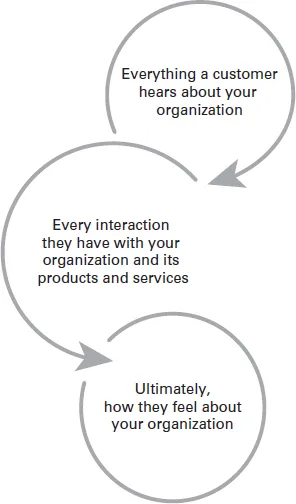
Figure 1.1 details
The customer experience can be explained as follows: Everything a customer hears about your organization; every interaction they have with your organization and its products and services; ultimately, how they feel about your organization.
Most customer experience definitions refer to “touchpoints”—customer experience is the sum of all of the touchpoints customers have with your organization. While I don’t disagree, I’ve found that description to be confusing to many. I think people get caught up on the meaning of touchpoint. It’s easy enough to gra...
Table of contents
- About the author
- Foreword
- Acknowledgements
- Introduction
- PART ONE Establish your approach
- 01 Getting started
- 02 Engaging your team
- PART TWO Listen and respond
- 03 Harnessing the power of feedback
- 04 Boosting the value of customer service
- PART THREE Educate and design
- 05 Telling your customer’s story
- 06 Shaping processes and technology
- PART FOUR Inspire and innovate
- 07 Building a culture of customer advocacy
- 08 Unleashing product and service innovation
- PART FIVE Build on the momentum
- 09 Rallying support for investments
- 10 Going from strength to strength
- Where to next?
- Recommendations at a glance
- List of figures
- Glossary
- Index
Trusted by 375,005 students
Access to over 1.5 million titles for a fair monthly price.
Study more efficiently using our study tools.
Frequently asked questions
Yes, you can cancel anytime from the Subscription tab in your account settings on the Perlego website. Your subscription will stay active until the end of your current billing period. Learn how to cancel your subscription
No, books cannot be downloaded as external files, such as PDFs, for use outside of Perlego. However, you can download books within the Perlego app for offline reading on mobile or tablet. Learn how to download books offline
Perlego offers two plans: Essential and Complete
- Essential is ideal for learners and professionals who enjoy exploring a wide range of subjects. Access the Essential Library with 800,000+ trusted titles and best-sellers across business, personal growth, and the humanities. Includes unlimited reading time and Standard Read Aloud voice.
- Complete: Perfect for advanced learners and researchers needing full, unrestricted access. Unlock 1.5M+ books across hundreds of subjects, including academic and specialized titles. The Complete Plan also includes advanced features like Premium Read Aloud and Research Assistant.
We are an online textbook subscription service, where you can get access to an entire online library for less than the price of a single book per month. With over 1.5 million books across 990+ topics, we’ve got you covered! Learn about our mission
Look out for the read-aloud symbol on your next book to see if you can listen to it. The read-aloud tool reads text aloud for you, highlighting the text as it is being read. You can pause it, speed it up and slow it down. Learn more about Read Aloud
Yes! You can use the Perlego app on both iOS and Android devices to read anytime, anywhere — even offline. Perfect for commutes or when you’re on the go.
Please note we cannot support devices running on iOS 13 and Android 7 or earlier. Learn more about using the app
Please note we cannot support devices running on iOS 13 and Android 7 or earlier. Learn more about using the app
Yes, you can access Leading the Customer Experience by Brad Cleveland in PDF and/or ePUB format, as well as other popular books in Business & Customer Relations. We have over 1.5 million books available in our catalogue for you to explore.