The
New York Times–bestselling author of
Gaining Ground introduces the local farmers who feed America—in stories, photos, and 50 recipes!
When Forrest Pritchard went looking for the unsung heroes of local, sustainable food, he found them at 18 exceptional farms all over the country.
In Detroit, Aba Ifeoma of D-Town Farm dreams of replenishing the local "food desert" with organic produce. On Cape Cod, Nick Muto stays afloat and eco-friendly by fishing with the seasons. And in Washington State, fourth-generation farmer Robert Hayton confides, "This farm has been rescued by big harvests . . . For every one great season, though, you've got ten years of tough."
With more than 50 mouthwatering recipes and over 250 photographs, this unique cookbook captures the struggles and triumphs of the visionary farmers who are
Growing Tomorrow.
"An honest book about simple food, grown well and prepared without pretense. Mr. Pritchard is a warm-hearted guide through the varied landscapes." —
The Wall Street Journal
"Gorgeous, delectable, and fascinating,
Growing Tomorrow provides food for the body, mind, and soul. Engaging to read, easy to cook from, delicious to eat, this is more than a cookbook; it is a meditation on the things that give us life." —Garth Stein,
New York Times–bestselling author of
The Art of Racing in the Rain
"Pritchard inspires his audience to support local farmers and to consume and/or grow provisions using sustainable practices. This book will appeal to foodies, environmentalists, and gardeners in general." —
Library Journal (starred review)
"This book is fabulous and worth a read if you love small-scale, sustainable farming." —
Edible New Orleans
"Highly recommended." —
The Washington Post
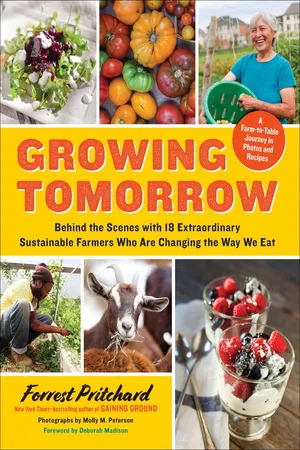
eBook - ePub
Growing Tomorrow
Behind the Scenes with 18 Extraordinary Sustainable Farmers Who Are Changing the Way We Eat
- 320 pages
- English
- ePUB (mobile friendly)
- Available on iOS & Android
eBook - ePub
Growing Tomorrow
Behind the Scenes with 18 Extraordinary Sustainable Farmers Who Are Changing the Way We Eat
About this book
Information
1
POTOMAC VEGETABLE FARMS

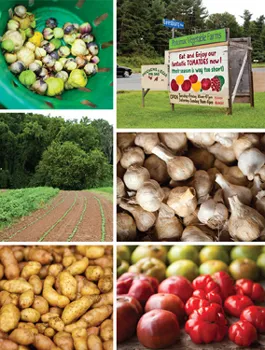
It’s eight thirty in the morning, and Route 7 is awash with commuters. Four lanes of traffic idle at a stoplight, awaiting the green light toward Washington, DC. As I stand in the parking lot of Potomac Vegetable Farms, the river of vehicles is no more than fifty feet away. Drivers are texting, scrolling through playlists, applying makeup. From time to time a face glances my way, studying the modest wooden vegetable stand just a few paces behind me. A moment later the light changes, and the median fills with exhaust. In the crush of the commute, with another long day on the horizon, how could anyone justify thoughts of heirloom vegetables?
Behind me, however, seventy-nine-year-old Hiu Newcomb is sorting freshly picked red, yellow, and orange tomatoes.
“These all have different names,” she says without looking up, “but we don’t organize them like that. We just ask folks what they’re going to use them for, then point them toward the right tomato. A name can’t tell you much, you know? But a farmer can.”
Wizened hands float across the table, organizing, examining, occasionally discarding. A checkerboard pattern emerges before my eyes, supple yellows and rosy pinks, with a row of purple-green beauties scattered throughout for contrast.
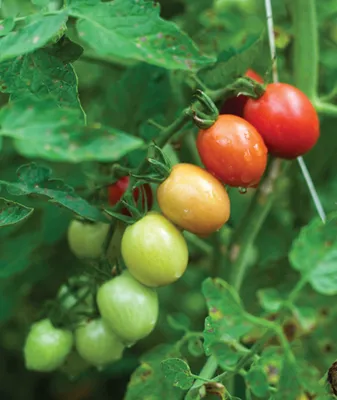
“Here,” she says, offering me a tomato the precise color of this morning’s sunshine. “Taste this.”
The plump orb fits neatly into my palm, and I take a bite without hesitating. The flavor is tangy and bright, with earthy notes of chicory and tarragon. No salt is required. I finish it in five satisfying bites, juice running down my fingers.
“What’s this variety called?” I ask.
She shrugs. “Can’t remember. But we’ve been growing it for forty years. Pretty good, huh?”
It’s hard to imagine now, but when farmer Hiu first set foot on this property in 1959, she was going to be an elementary school music teacher. “I grew up in Honolulu, and studied piano at Oberlin, in Ohio. That’s where I met this crazy farmer,” she recalls with a laugh. “Our first day of freshman orientation. Tony was a dreamer. A dreamer with big farming plans.”
Tony wanted to return east and create an agricultural community he grandly named “Kingdom on the James,” a reference to the nearby James River. But before breaking ground on this new project, the newlyweds decided they should actually learn a little something about farming. “As a teenager,” Hiu recalls, “Tony inherited a tractor. He figured that if you had a tractor and a plow and some seeds, then the farm would pretty much take care of itself. Boy, did we have a lot to learn.”

Did You Know?
In Nix v. Hedden, 1893, the Supreme Court unanimously ruled that the tomato is a vegetable, not a fruit, thereby settling an import tax dispute.
Now, Hiu’s farm is a fifteen-acre oasis in the center of Mid-Atlantic suburbia. It’s late August, and the summer has been especially kind: Cool temperatures and plentiful rains kept watering to a minimum. Verdant rows of green beans, zinnias, tomatillos, and blackberries contour the gently rolling Piedmont hills. As Hiu passes near her eastern property line, however, she frowns.
“This is a field we recently repurchased after many years. It served as an access road to the subdivision next door, and over the years it’s been bulldozed, paved over, you name it. Rather pathetic to look at, but we’re doing our best to bring it back to life.” She winks. “We’ve got a running joke: ‘This is the only place where asphalt was lost to farmland, and not the other way around.’”
Compared to the splendor of the rest of the farm, I can’t deny that this half acre looks particularly anemic. Triangular in shape, it points like an arrowhead toward the neighboring suburbs, the houses sitting no more than twenty feet away from the other side of the fence. “We’ve been adding compost, sowing cover crops. But you can see from the plants how weak this soil is, how different it is from the rest of the farm.” Suddenly, she brightens. “We’ll eventually bring it back to life, though. Everything just takes a little time.”
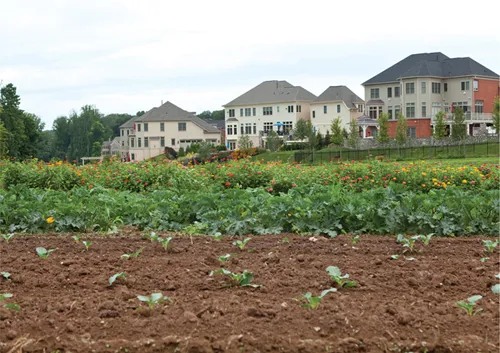
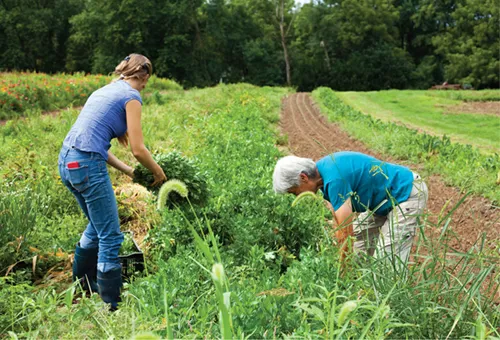
It’s precisely this sort of optimism—a faith in nature’s resilience and the healing power of time—that’s helped Potomac Vegetable Farms navigate decades of rocky terrain. These days, Hiu can occasionally take a risk or two, investing time into a piece of ground that might take an entire generation to rebuild. But it wasn’t always like this.
“When Tony and I started out, we could only afford to rent land year-to-year. We’d sign a lease on ten acres here, thirty acres there, and plant sweet corn. This was the early 1960s, and even back then development was going full tilt—no one was seriously thinking about farming for a living. We’d rent the fields for fifteen dollars an acre, and farm it until the developers showed up. Most of the ground we leased back then is a subdivision now, or a strip mall.”
After several seasons of farming, they finally decided to buy. Against the advice of fellow farmers and university agriculture specialists, the young couple bought a parcel of land on the sandy soils of southern Maryland, a narrow tract comprising 140 acres. It was rough going from the start. An old farmhouse on the property had been abandoned for decades, and there was no electricity or piped water. Before they knew it, they had two young children to look after, with a third on the way.
Hiu’s Farming Wisdom
“Rent land before buying it. Cash inflow must exceed outflow, and that’s hard to do with a mortgage.”
“Looking back, I’m not sure how we did it. Beyond the Maryland farm, we were still renting acreage here in northern Virginia, going back and forth several hours each week. Farming here and there, all the while trying to raise a family. Start a homestead. Pay the bills.
“But we were learning,” she adds thoughtfully. “Learning what type of vegetables we could grow, and how to market them. We gradually began to plant less sweet corn, and focused on diversifying: melons, beans, tomatoes. Squash and zucchini. A little less wholesale each year, a little more retail instead. More balance in the system.”
Hiu’s dreams of becoming a music teacher gradually faded. Now with a fourth child, crops to plant, and a business to r...
Table of contents
- Cover
- Title Page
- Copyright
- Dedication
- Contents
- Foreword
- Introduction
- 1 Potomac Vegetable Farms
- 2 Nichols Farm Orchard
- 3 Hayton Farms Berries
- 4 D-Town Farm
- 5 Ozark Forest Mushrooms
- 6 Lagier Ranches
- 7 Haystack Mountain Goat Dairy
- 8 Matt Romero Farms
- 9 Black Oak Holler Farm
- 10 Nick Muto and Backside Bakes
- 11 Texas Honeybee Guild
- 12 Kiyokawa Family Orchards
- 13 Paul’s Grains
- 14 Red Lake Nation Foods
- 15 Ronnybrook Farm Dairy
- 16 Joseph Fields Farm
- 17 Garcia Organic Farms
- 18 Riverview Farms
- Epilogue
- Acknowledgments
- Where to Find the Farmers
- Metric Conversion Charts
- Guide to Blanching and Canning
- Recipe Index
- About the Author, Photographer, and Foreword Author
Trusted by 375,005 students
Access to over 1.5 million titles for a fair monthly price.
Study more efficiently using our study tools.
Frequently asked questions
Yes, you can cancel anytime from the Subscription tab in your account settings on the Perlego website. Your subscription will stay active until the end of your current billing period. Learn how to cancel your subscription
No, books cannot be downloaded as external files, such as PDFs, for use outside of Perlego. However, you can download books within the Perlego app for offline reading on mobile or tablet. Learn how to download books offline
Perlego offers two plans: Essential and Complete
- Essential is ideal for learners and professionals who enjoy exploring a wide range of subjects. Access the Essential Library with 800,000+ trusted titles and best-sellers across business, personal growth, and the humanities. Includes unlimited reading time and Standard Read Aloud voice.
- Complete: Perfect for advanced learners and researchers needing full, unrestricted access. Unlock 1.5M+ books across hundreds of subjects, including academic and specialized titles. The Complete Plan also includes advanced features like Premium Read Aloud and Research Assistant.
We are an online textbook subscription service, where you can get access to an entire online library for less than the price of a single book per month. With over 1.5 million books across 990+ topics, we’ve got you covered! Learn about our mission
Look out for the read-aloud symbol on your next book to see if you can listen to it. The read-aloud tool reads text aloud for you, highlighting the text as it is being read. You can pause it, speed it up and slow it down. Learn more about Read Aloud
Yes! You can use the Perlego app on both iOS and Android devices to read anytime, anywhere — even offline. Perfect for commutes or when you’re on the go.
Please note we cannot support devices running on iOS 13 and Android 7 or earlier. Learn more about using the app
Please note we cannot support devices running on iOS 13 and Android 7 or earlier. Learn more about using the app
Yes, you can access Growing Tomorrow by Forrest Pritchard in PDF and/or ePUB format, as well as other popular books in Politics & International Relations & Agricultural Public Policy. We have over 1.5 million books available in our catalogue for you to explore.