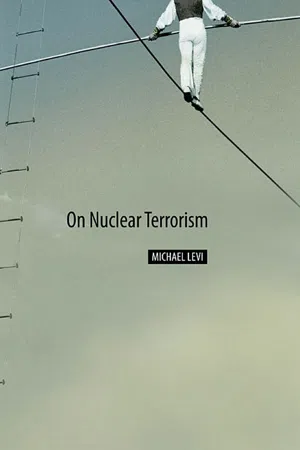
Nuclear terrorism is such a disturbing prospect that we shy away from its details. Yet as a consequence, we fail to understand how best to defeat it. Michael Levi takes us inside nuclear terrorism and behind the decisions a terrorist leader would be faced with in pursuing a nuclear plot. Along the way, Levi identifies the many obstacles, large and small, that such a terrorist scheme might encounter, allowing him to discover a host of ways that any plan might be foiled.
Surveying the broad universe of plots and defenses, this accessible account shows how a wide-ranging defense that integrates the tools of weapon and materials security, law enforcement, intelligence, border controls, diplomacy, and the military can multiply, intensify, and compound the possibility that nuclear terrorists will fail. Levi draws from our long experience with terrorism and cautions us not to focus solely on the most harrowing yet most improbable threats. Nuclear terrorism shares much in common with other terrorist threats--and as a result, he argues, defeating it is impossible unless we put our entire counterterrorism and homeland security house in order.
As long as we live in a nuclear age, no defense can completely eliminate nuclear terrorism. But this book reminds us that the right strategy can minimize the risks and shows us how to do it.
- English
- ePUB (mobile friendly)
- Available on iOS & Android
eBook - ePub
On Nuclear Terrorism
About this book
Information
Publisher
Harvard University PressYear
2009Print ISBN
9780674032385
9780674026490
eBook ISBN
9780674033566
—— 1 ——
Principles for Defense
On learning of the bombing of Hiroshima, Bernard Brodie, a leading strategist of his generation, declared, “Everything that I have written is obsolete.”1 Since the first atomic bomb exploded over sixty years ago, the awesome power of nuclear weapons—a Cold War nuclear exchange might have killed hundreds of millions within hours—has often driven even the most careful thinkers to similar conclusions. One scholar recounts the prevailing attitude in the 1950s: “In order to approach nuclear war properly, one had to become a perfect amnesiac, stripped of the intuitions, judgments, and habits cultivated over a lifetime.”2 Strategists once had viewed war as a complex interplay between enemies. By the 1950s, nuclear wizards were viewing war as mutually assured destruction: states could prevent nuclear war only by threatening to annihilate an adversary in response to any nuclear attack. These experts’ intellectual predecessors would not have recognized this strategy.
Yet as the Cold War evolved, many of the most influential strategists, Brodie among them, began to turn away from mutually assured destruction as it became clear that the strategy was far from guaranteed to work. The new approaches still differed from traditional military strategy, but they borrowed far more from its basic principles than mutually assured destruction had.
Similarly, though we must always remain mindful that nuclear weapons are in a class of their own, we can find the most effective strategies against nuclear terrorism only by drawing from our wealth of knowledge about traditional counterterrorism.3
Three principles intuitively obvious to most counterterrorism experts (and to military strategists too) should drive our approach to nuclear terrorism. First, no single tool can defeat nuclear terrorism: instead, we must combine all the means we have available—controls over nuclear materials and weapons, military power, diplomacy, intelligence, covert action, law enforcement, border security, and consequence management, among others—into a comprehensive system that is aimed at thwarting nuclear terrorists.4 Second, knowing the worst-case scenarios for nuclear terrorism is important, but these scenarios should not dominate our strategic thinking: instead, we should prepare to fight against a range of possible terrorist groups and terrorist plots. Finally, we should be realistic about our goals, recognizing that we will never build ironclad defenses: instead, we should seek to make nuclear terrorism as unlikely as possible, and we should also aim to minimize the consequences of any attack that might, despite our best efforts, occur.
Policymakers and experts have long recognized that the most powerful tools for preventing nuclear terrorism are those that directly deny nuclear materials and weapons to terrorists: locking up those weapons and materials as best we can in states like Russia and Pakistan, and keeping them from states like North Korea and Iran that are either unable or perhaps unwilling to keep their weapons away from terrorists. This view is reflected in a steady stream of books written over more than three decades; its dominance was recently confirmed in a major survey of leading experts on weapons of mass destruction.5 There is a growing realization, though, that a much broader defense can contribute to our security. But while careful and sophisticated discussions of locking up materials and preventing proliferation are commonplace, the quality of our debate over broader defenses is far poorer. Exceptions, of course, exist, most notably a partially unclassified 2004 Defense Department study aimed at promoting the integration of defenses against nuclear terrorism; some careful writing on shipping container security; and several other studies that advocate layered defenses but still devote most of their attention to the security of nuclear weapons and materials.6 Others have promoted a layered approach to defense against terrorism more generally, but without delving into the details of the nuclear threat.7 We still largely lack an understanding of how effective broader defenses can be against nuclear terrorism, and, most important, of how best to go about designing them. It will take hundreds of individuals with diverse experience and knowledge to design a comprehensive system. Before anyone does that, however, we must understand something more basic: how to think about nuclear terrorism.
Defense as a System
Defenses against nuclear terrorism make the most sense as integrated systems, with each part of the defense not only complementing other defensive elements but also reinforcing them. How can we make sense of such a vast system, with its thousands of distinct parts? Consider a simple analogy.
The New York Yankees, displaying remarkably bad judgment, hire a new manager who has no baseball experience. Lacking intuitive understanding of the game, he adopts a systematic approach to assessing his team. He begins by studying each player alone, examining his range of skills. But the manager cannot stop there—after all, he is looking at a team. To be sure, he could, for example, analyze each outfielder only in isolation, but he would come to the nonsensical conclusion that outfielders are useless—after all, with only a right-fielder, opposing batters would simply hit the ball to left field.
Should he then jump to studying the team as a whole? Perhaps, but he would quickly run into big problems. Still unguided by intuition, his obvious next step would be to analyze each pair of players, but with thirty-six possible pairs, doing so would be a tall order. If he went further and studied every possible combination of players—pairs, groups of three, and so on—he would have to look at over five hundred combinations. Almost certainly he would conclude that there must be a better way.
Instead, he divides the players into groups. He studies how the pitcher and catcher work together, how the infield operates as a team, and how the outfielders complement one another, all of which simplifies things a great deal. Only then does he look at the team as a whole, exploring how the groups interact. By studying the pitcher and the infielders together, for example, he discovers that with a bad pitcher, even good infielding might be useless, but with a pitcher who forces batters to hit easy balls, even relatively bad infielding may be effective. Indeed real baseball teams have sometimes used variations on this way of thinking in order to isolate the contributions of individual players.8
The manager then examines his limitations. How does his limited budget constrain the combinations of players he can field? How does his need for strong batting limit his flexibility in building the most effective possible defense?
A similar approach makes sense for studying defense against nuclear terrorism. It is impossible to look at every interaction—every “synergy”—between a policeman and a radiation detector, for example, each of which are deployed in the many thousands, but it is useful to study law enforcement as a whole and radiation detection as a whole, and then to look at how law enforcement and radiation detection work together. To understand nuclear terrorism, we must study the defense from its fine details to its broader structure.
A few numbers suggest the potential power of a broad defense. Imagine a scenario in which, at each step of its plot, a terrorist group has a 90 percent chance of success. Then a plot requiring ten steps will have less than a 40 percent chance of succeeding, since its overall odds of success are reduced with each step.9 This compounding effect also means that improvements in each layer of the defense are magnified. (A defense of this sort is called a “layered defense.”) Imagine that the defense doubles its odds of defeating the terrorist group at each layer, so that the chances of terrorist success are now 80 percent at each stage of its plot. Then the overall odds that a terrorist plot will succeed drops to 10 percent.
This perspective turns a cliché about terrorism on its head. It has often been said that defense against terrorism must succeed every time, but that terrorists must succeed only once. This is true from plot to plot, but within each plot, the logic is reversed. Terrorists must succeed at every stage, but the defense needs to succeed only once.
Even if this way of thinking makes perfect sense, we often ignore it. An intuitive explanation is suggested by what philosophers call the “lottery paradox.”10 In a large, simple lottery drawing, the chance that any given ticket will win is essentially zero, so, intuitively, the chances of winning, even with a large number of tickets, seems to be zero as well. But it is obvious that if you buy half of the available tickets, you have a 50 percent chance of winning. Still, many follow the first, patently wrong, way of thinking. (In moral philosophy, the result is that people are willing to accept many small wrongs even if they would never countenance a large evil.) Analysis of nuclear terrorism is often no different—each element of a defense might be intuitively dismissed because, alone, each may only have a small chance of working, leading to the possibly incorrect conclusion that the defense as a whole is ineffective. In evaluating defenses against nuclear terrorism, it is essential not only to avoid quickly dismissing relatively weak defensive tools, but indeed to deliberately look for small odds of terrorist failure. Among other things, this approach means searching for unusual ways that terrorists might fail, rather than just for unusual ways that they might succeed.
Perhaps the most fruitful source of potential terrorist failure is simple bad luck. Call it Murphy’s Law of Nuclear Terrorism: What can go wrong might go wrong. (In the traditional version of Murphy’s Law, of course, what can go wrong not only might go wrong—it will go wrong.) A 1995 plot to explode airliners over the Pacific Ocean was thwarted when plotters started a fire while preparing explosives.11 A plot to bomb the Los Angeles airport at the millennium was stopped by an officer who noticed a nervous terrorist at the Canada–U.S. border, leading to a “chance discovery” of explosives in the trunk of his car.12 The September 11, 2001, al Qaeda attacks on the United States, in contrast, might have been stopped had terrorist errors, such as conspicuous behavior at flight schools, been better exploited.13 A defense must be prepared to take advantage of such terrorist error or bad luck, lest a terrorist plot succeed despite such misfortune because the defense fails to exploit it.
Even the picture painted above tells only half the story. In thinking about nuclear terrorism, it is not enough simply to assess the odds that any piece of the defense will defeat a terrorist plot. In a true system, the ways defensive elements fail to stop terrorist plots are equally important. Just like our fictional policemen, we must think about the costs a terrorist group incurs in defeating a particular defensive component. A group may, for example, avoid recruiting skilled engineers to build its bomb in order to avoid detection by intelligence agents or law enforcement officers—but that decision will come at the expense of increased odds that the group will be unable to build a bomb.
Another numerical example makes this point more concrete. Imagine, just as in the last example, that against each of ten defensive measures, a terrorist group has a 10 percent chance of failure. The group dreams up ways to cut each chance of failure in half, letting it apparently improve its overall odds of success by 40 percent. But there is a catch: each change the terrorist group makes to evade one element of the defense doubles its odds of failure in another part of its plot. (Perhaps the terrorist group hires additional scientists to make bomb-building easier, but is now more vulnerable to law enforcement.) The net result is that none of the terrorist group’s clever ideas increase its overall chance of success. For any given terrorist group, plot, and defense, this system effect will differ in its precise details. It will, however, almost always exist, making a true defensive system more effective than a simple layered defense.
All these ideas have been the subjects of careful study outside the context of nuclear terrorism. Some systems analysis takes a top-down and heavily mathematical approach, describing the entire system in detail and then simulating it, just as many companies simulate and analyze their supply chains. But nuclear terrorism is so complex and so poorly understood that such an approach normally becomes intractable or meaningless.14 The better alternative is what is called a qualitative approach, through which one studies the basic properties of the system without making (often meaningless) numerical assessments of its effectiveness.15 Qualitative systems analysis focuses on identifying patterns. These patterns typically involve synergies, where the combined effect of several elements of the system is greater than the sum of the individual effects of each element alone. This approach, essentially the one our fictional baseball manager used, allows us to better understand the system without formal simulation or intensive computation.
Another technique developed by students of defense planning can help us too. Arthur Brooks and his colleagues at the RAND Corporation have studied the use of scenarios to understand complex systems. They distinguish two varieties of scenario analysis, traditional and exploratory.16 Traditional scenario analysis attempts to find the most likely scenario the defense will face and then studies slight variations on it. Exploratory analysis is far less restrictive in choosing scenarios; it looks, instead, at a wide range of possibilities. Since this book seeks to understand a broad universe of terrorist plots and defenses, such explanatory analysis will be enlightening.
Understanding the Enemies
Before we can design or judge a defense, we must know something about the enemies it might face and the plots that those enemies might construct. There may seem to be an obvious way to acquire this knowledge: figure out what the worst possible threat is, and design a defense that can defeat it. Intuitively, we might think that if a defense can do that, it can also stop any other, apparently lesser, group or plot.
History has shown, however, that this way of thinking often makes little sense. Take the Cold War as an example: the United States spent an enormous amount of money on defense, but it never came close to perfect security against the worst-case threat, an all-out Soviet attack. And yet the United States not only survived the Cold War but won it. Defenses that fall short against worst-case threats can still be very valuable.
Meanwhile, after the Cold War ended, the United States quickly learned that the military it had built to confront the Soviets—a more powerful opponent than those who confront the United States now—is ill suited to combat today’s supposedly lesser threats.17 A defense optimized against the worst case may not be the most effective defense against more likely threats.
Military planners often employ the so-called threat-based approach to deal with this problem. They measure their defensive options against a handful of likely threats rather than against a single worst...
Table of contents
- Cover
- Title
- Copyright
- Contents
- Preface
- List of Abbreviations
- Prologue
- 1 Principles for Defense
- 2 Security at the Source
- 3 Building Blocks
- 4 The Beginnings of a True System
- 5 Warning
- 6 A Wider Universe of Nuclear Plots and Defenses
- 7 The Way Forward
- Appendix: Radiation Detection and Weapons Effects Calculations
- Glossary
- Notes
- Acknowledgments
- Index
Trusted by 375,005 students
Access to over 1.5 million titles for a fair monthly price.
Study more efficiently using our study tools.
Frequently asked questions
Yes, you can cancel anytime from the Subscription tab in your account settings on the Perlego website. Your subscription will stay active until the end of your current billing period. Learn how to cancel your subscription
No, books cannot be downloaded as external files, such as PDFs, for use outside of Perlego. However, you can download books within the Perlego app for offline reading on mobile or tablet. Learn how to download books offline
Perlego offers two plans: Essential and Complete
- Essential is ideal for learners and professionals who enjoy exploring a wide range of subjects. Access the Essential Library with 800,000+ trusted titles and best-sellers across business, personal growth, and the humanities. Includes unlimited reading time and Standard Read Aloud voice.
- Complete: Perfect for advanced learners and researchers needing full, unrestricted access. Unlock 1.5M+ books across hundreds of subjects, including academic and specialized titles. The Complete Plan also includes advanced features like Premium Read Aloud and Research Assistant.
We are an online textbook subscription service, where you can get access to an entire online library for less than the price of a single book per month. With over 1.5 million books across 990+ topics, we’ve got you covered! Learn about our mission
Look out for the read-aloud symbol on your next book to see if you can listen to it. The read-aloud tool reads text aloud for you, highlighting the text as it is being read. You can pause it, speed it up and slow it down. Learn more about Read Aloud
Yes! You can use the Perlego app on both iOS and Android devices to read anytime, anywhere — even offline. Perfect for commutes or when you’re on the go.
Please note we cannot support devices running on iOS 13 and Android 7 or earlier. Learn more about using the app
Please note we cannot support devices running on iOS 13 and Android 7 or earlier. Learn more about using the app
Yes, you can access On Nuclear Terrorism by Michael Levi in PDF and/or ePUB format, as well as other popular books in Politics & International Relations & National Security. We have over 1.5 million books available in our catalogue for you to explore.