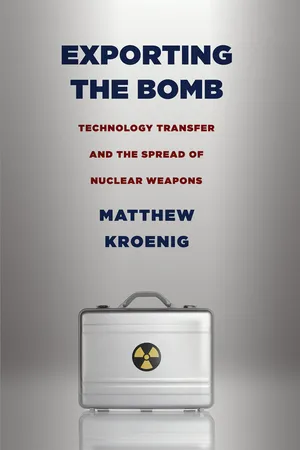
Exporting the Bomb
eBook - ePub

Exporting the Bomb

Technology Transfer and the Spread of Nuclear Weapons

  1. English
  2. ePUB (mobile friendly)
  3. Available on iOS & Android
eBook - ePub

Exporting the Bomb

Technology Transfer and the Spread of Nuclear Weapons

About this book

In a vitally important book for anyone interested in nuclear proliferation, defense strategy, or international security, Matthew Kroenig points out that nearly every country with a nuclear weapons arsenal received substantial help at some point from a more advanced nuclear state. Why do some countries help others to develop nuclear weapons? Many analysts assume that nuclear transfers are driven by economic considerations. States in dire economic need, they suggest, export sensitive nuclear materials and technology—and ignore the security risk—in a desperate search for hard currency.

Kroenig challenges this conventional wisdom. He finds that state decisions to provide sensitive nuclear assistance are the result of a coherent, strategic logic. The spread of nuclear weapons threatens powerful states more than it threatens weak states, and these differential effects of nuclear proliferation encourage countries to provide sensitive nuclear assistance under certain strategic conditions. Countries are more likely to export sensitive nuclear materials and technology when it would have the effect of constraining an enemy and less likely to do so when it would threaten themselves.

In Exporting the Bomb, Kroenig examines the most important historical cases, including France's nuclear assistance to Israel in the 1950s and 1960s; the Soviet Union's sensitive transfers to China from 1958 to 1960; China's nuclear aid to Pakistan in the 1980s; and Pakistan's recent technology transfers, with the help of "rogue" scientist A. Q. Khan, from 1987 to 2002. Understanding why states provide sensitive nuclear assistance not only adds to our knowledge of international politics but also aids in international efforts to control the spread of nuclear weapons.

Frequently asked questions

Yes, you can cancel anytime from the Subscription tab in your account settings on the Perlego website. Your subscription will stay active until the end of your current billing period. Learn how to cancel your subscription.
No, books cannot be downloaded as external files, such as PDFs, for use outside of Perlego. However, you can download books within the Perlego app for offline reading on mobile or tablet. Learn more here.
Perlego offers two plans: Essential and Complete
  • Essential is ideal for learners and professionals who enjoy exploring a wide range of subjects. Access the Essential Library with 800,000+ trusted titles and best-sellers across business, personal growth, and the humanities. Includes unlimited reading time and Standard Read Aloud voice.
  • Complete: Perfect for advanced learners and researchers needing full, unrestricted access. Unlock 1.4M+ books across hundreds of subjects, including academic and specialized titles. The Complete Plan also includes advanced features like Premium Read Aloud and Research Assistant.
Both plans are available with monthly, semester, or annual billing cycles.
We are an online textbook subscription service, where you can get access to an entire online library for less than the price of a single book per month. With over 1 million books across 1000+ topics, we’ve got you covered! Learn more here.
Look out for the read-aloud symbol on your next book to see if you can listen to it. The read-aloud tool reads text aloud for you, highlighting the text as it is being read. You can pause it, speed it up and slow it down. Learn more here.
Yes! You can use the Perlego app on both iOS or Android devices to read anytime, anywhere — even offline. Perfect for commutes or when you’re on the go.
Please note we cannot support devices running on iOS 13 and Android 7 or earlier. Learn more about using the app.
Yes, you can access Exporting the Bomb by Matthew H. Kroenig in PDF and/or ePUB format, as well as other popular books in Politics & International Relations & National Security. We have over one million books available in our catalogue for you to explore.

Table of contents

  1. Acknowledgments
  2. Abbreviations and Acronyms
  3. INTRODUCTION
  4. 1 EXPLAINING NUCLEAR ASSISTANCE
  5. 2 THE CORRELATES OF NUCLEAR ASSISTANCE
  6. 3 ISRAEL’S NUCLEAR PROGRAM
  7. 4 COMMON ENEMIES, GROWLING DOGS, AND A. Q. KHAN’S PAKISTAN
  8. 5 IMPORTING THE BOMB
  9. CONCLUSION
  10. APPENDIXES
  11. Bibliography