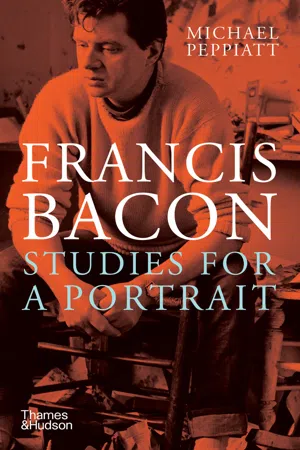
Francis Bacon was one of most elusive and enigmatic creative geniuses of the twentieth century. However much his avowed aim was to simplify both himself and his art, he remained a deeply complex person. Bacon was keenly aware of this underlying contradiction, and whether talking or painting, strove consciously towards absolute clarity and simplicity, calling himself simply complicated. Until now, this complexity has rarely come across in the large number of studies on Bacons life and work. Francis Bacon: Studies for a Portrait shows a variety of Bacons many facets, and questions the accepted views on an artist who was adept at defying categorization. The essays and interviews brought together here span more than half a century. Opening with an interview by the author in 1963, the year that he met Bacon, there are also essays written for exhibitions, memoirs and reflections on Bacons late work, some published here for the first time. Included are recorded conversations with Bacon in Paris that lasted long into the night, and an overall account of the artists sources and techniques in his extraordinary London studio. This is an updated edition of Francis Bacon: Studies for a Portrait (2008), published for the first time in a paperback reading book format. It brings this fascinating artist into closer view, revealing the core of his talent: his skill for marrying extreme contradictions and translating them into immediately recognizable images, whose characteristic tension derives from a life lived constantly on the edge.
- English
- ePUB (mobile friendly)
- Available on iOS & Android
eBook - ePub
Francis Bacon: Studies for a Portrait
About this book
Information
Topic
ArtSubtopic
Artist BiographiesINTERVIEW THREE: PROVOKING ACCIDENTS, PROMPTING CHANCE
The following interview was recorded in Francis Bacon’s London studio at the beginning of 1989 and was published later that year in the magazine Art International. When I listened to the tape again, I realized I had left out a number of exchanges – about Versailles, about Shakespeare – that had not seemed particularly relevant then. I have put these and other asides into this revised version because they give a more complete idea of the way the conversation ranged.
MICHAEL PEPPIATT: You told me recently that you’d been to the Science Museum and you’d been looking at scientific images.
FRANCIS BACON: Yes, but that’s nothing of any interest. You see, one has ideas, but it’s only what you make of them. Theories are no good, it’s only what you actually make. I had thought of doing a group of portraits, and I went there thinking that, amongst various things, I might find something that would provide a grid on which these portraits could be put, but I didn’t find what I wanted and I don’t think it’s going to come off at all.
Are there certain images that you go back to a great deal, for example Egyptian images? You look at the same things a lot, don’t you?
I look at the same things. I do think that Egyptian art is the greatest art that has happened so far – certain periods of Egyptian art at any rate. But for myself I get a great deal from poems, I get a lot from the Greek tragedies, and those I find tremendously suggestive of all kinds of things. It’s true that, not reading Greek, I don’t get them in all their vitality. But there was this man who did remarkable translations from the Greek called Stanford, and he wrote a very fascinating book called Aeschylus in his Style.
Do you find the word more suggestive than the actual image?
Not necessarily, but very often it is.
Do the Greek tragedies suggest new images when you reread them, or do they just deepen the images that are already there?
They very often suggest new images. I don’t think one can come down to anything specific, one doesn’t really know. I mean you could glance at an advertisement or something and it could suggest just as much as reading Aeschylus. Anything can suggest things to you.
For you, it’s normally an image that is suggested though, it’s not sound, it’s not words sparking off words. Words spark off images.
To a great extent. Great poets are remarkable in themselves and don’t necessarily spark off images, what they write is just very exciting in itself.
You must be quite singular among contemporary artists to be moved in that way by literature. Looking at Degas, for example, doesn’t affect you?
No. Degas is complete in himself. I like his pastels enormously, particularly the pastels of the female nudes. They are formally remarkable, but there they are, they’re very complete in themselves, so they don’t suggest as much.
Not so much as something less complete? Are there less complete things which do? For example, I know you admire some of Michelangelo’s unfinished things. And recently you were talking about some engineering drawings by Brunel and it sounded as though you were very excited by them.
Well, you see, this is where it’s so hopeless talking about it. In a certain mood, certain things start off a whole series of images and ideas which keep changing all the time. So what happens then and what happens now are two completely different things.
But you are a visual person, above all. There are specific images, aren’t there, that have been very important to you – that have haunted you?
Yes, I don’t think those are the things that I’ve been able to get anything from. You see, in my case, the best pictures just come about.
So that’s almost a different category of experience.
Yes, I think my paintings just come about. Like that 1946 picture of mine, it just came about. I couldn’t say where any of the elements came from.
Did you ever experiment with automatism?
No. I don’t really believe in that. What I do actually believe is that chance and accident are the most fertile things at any artist’s disposal at the present time. I’m trying to do some portraits now and I’m just hoping that they’ll come about by chance. I just long to capture an appearance without it being an illustrated appearance.
So it’s something that you couldn’t have planned consciously?
No. I wouldn’t know it’s what I wanted, but it’s what for me at the time makes a reality. Reality, that is, that comes about in the actual way the paint has been put down, which is a reality, but I’m also trying to make that reality into the appearance of the person I’m painting.
It’s a locking of two things?
It’s a locking of a great number of things, and it will only come about by chance. It’s prompted chance because you have in the back of your mind the image of the person whose portrait you are trying to paint. I mean, there’s no point in trying to make a portrait that doesn’t look like the person. You see, this is the point at which you absolutely cannot talk about the painting. It’s in the making.
You’re trying to bring two unlike elements together.
It has nothing to do with the Surrealist idea, because that’s bringing two things together which are already made. This thing isn’t made. It’s got to be made.
But I mean that there is the person’s appearance, and then there are all sorts of sensations about that particular person.
I don’t know how much it’s a question of sensations about the other person. It’s the sensations within yourself. It’s to do with the shock of two completely unillustrational things which come together and make an appearance. But again it’s all words, it’s all an approximation. I feel talking about painting is always superficial. We have lost our real directness. I mean if you read even in some of these translations from the Oresteia there are things that are so direct and so violent and so shocking in a way to us. We talk now in such a dreary, bourgeois kind of way. Nothing is ever directly said.
But that was of course drama, even then. I don’t suppose ordinary Greeks went around talking like that. Perhaps they were more direct than us. Perhaps the realities of life are more hidden, more under wraps, for us.
Almost anything in the Oresteia is more interesting. And when Cassandra says: ‘The reek of human blood smiles out at me.’ Now how are you going to make that into painting? I don’t know what it’s called, this kind of extraordinary figure of speech.
But are there things that really jolt you? I know you love Greek tragedy, Shakespeare, Yeats, Eliot and so on, but do odd things, like newspaper photographs, jolt you every now and then?
I don’t think photographs do it so much, just very occasionally.
You used to look at photographs a lot. Do you still look at books of photographs?
No. Dalí and Buñuel did something interesting with the Chien andalou, but that is where film is interesting and it doesn’t work as single photographs in the same way. The slicing of the eyeball is interesting because it’s in movement, though of course that kind of shock thing has been used so often since it’s not really shocking any more.
But is your sensibility still ‘joltable’? Does one become hardened to visual shock?
I don’t think so, but not much that is produced now jolts one. Everything that is made now is made to sell, for public consumption, for money, and it’s all become so anodyne. They might make it just slightly shocking, just enough for people to want to see it, so that it makes a little more money. That’s all it’s about now. It’s rather like this ghastly government we have in this country. The whole thing’s a kind of anodyne way of making money.
But do you still come across images that really strike you, like the nurse being shot in the Eisenstein film?
That was really to a large extent because Eisenstein was an artist and he made something of the whole film. That was just one instance. There were lots of other things that were very remarkable.
I suppose one doesn’t have to be jolted as such to be interested, to be moved. One can be persuaded or convinced by something without it actually shocking one’s sensibility. And I am sure that people come to accept images that begin by seeming extremely violent, war pictures for instance.
They are violent, and yet it’s not enough. Something much more horrendous is the last line in Yeats’s ‘The Second Coming’, which is a prophetic poem – after all, it was written in 1920 – ‘And what rough beast, its hour come round at last,/Slouches towards Bethlehem to be born?’ That’s stronger than any war painting. It’s more extraordinary than even one of the horrors of war pictures, because that’s just a literal horror, whereas the Yeats is a horror which has a whole vibration, in its prophetic quality.
It’s shocking too because it’s been put into a memorable form.
Well, of course, that’s the reason. Things are not shocking if they haven’t been put into a memorable form. Otherwise, it’s just blood spattered against a wall. In the end, if you see that two or three times, it’s no longer shocking. It must be a form that has more than the literal implication of blood splashed against a wall. It’s when it has much wider implications. It’s something which reverberates within your psyche, it disturbs the whole life cycle within a person. It affects the atmosphere in which you live and move. It’s a rather grandiose way of putting it, but it gets into the interstices of the body, of feeling, if it really works. After all, most of what is called art, your eye just flows over. It may be charming or nice, but it doesn’t change you.
Are they always disruptive, the things that change you? I don’t know why, for some reason I was thinking about Versailles. That’s a very different order of experience, I suppose.
Well, when you think of Versailles you certainly think of the grandeur in which everyday life was carried on, in which people woke up and washed and shat and everything else – and the whole banality of their lives must have been offset by the grandeur and size of the architecture.
Do you think about painting all the time, or do you just think about things?
I think about things really, about images, anything.
I remember your saying – that’s probably why I was thinking of Versailles – that when you were in France recently you spent the day in Versailles and had all these images for paintings simply dropping in. Do images keep dropping into your mind?
Images do drop in, constantly, but of course to crystallize all these phantoms that drop into your mind is also another thing, you see. The phantom and the image are two totally different things.
You never get what you imagine, of course.
No – very, very occasionally you get something slightly better.
That’s real luck.
That’s real luck.
Do you dream, or remember your dreams? Do they affect you at all?
No. I’m sure I do dream a lot but I’ve never remembered my dreams. About two or three years ago I had a very, very vivid dream, and I tried to write it down as soon as I woke up because I thought I could use it. But it was a load of nonsense. In the dream it seemed to have a form. But when I looked at what I’d written down the next day, it had no shape to it, it was just nothing. I’ve never used dreams in my work. They’ve never helped me at all. Anything that comes about does so by accident in the actual working of the painting. Suddenly something appears that I can grasp.
Do you often start blind?
No, I don’t start blind. I have an idea of what I would like to do, but as I start working that completely evaporates. If it goes at all well, something will start to crystallize.
Do you make a sketch of some sort on the canvas, a basic structure?
Sometimes, a little bit. It never, never stays that way. It’s just to get me into the act of doing it. Often, you just put on paint almost without knowing what you’re doing. You’ve got to get some material on the canvas to begin with. Then it may or may not begin to work. It doesn’t often happen within the first day or two. You can never tell. I just go on putting paint on or wiping it out. And sometimes the shadows of the marks left from this lead to another image and the possibility of something else coming up … But then, you see, this is a problem. Although I quite like them, I don’t think those free marks that Henri Michaux used to make really work. I mean, they’re better than most awful things, but they’re too arbitrary.
Are they not conscious enough, not willed enough?
Something is only willed when as it were the unconscious thing has begun to arise on which your will can be imposed.
You’ve got to have the feedback from the paint. It’s a dialogue in a strange sense.
It is a dialogue, yes.
The paint is doing as much as you are. It’s suggesting things to you. It’s a constant exchange.
It is. And one’s always hoping that the paint will do more for you. It’s rather like painting a wall. The very first brushstroke gives a sudden shock of reality, which is cancelled out when you paint the whole wall.
And you find that when you start painting. That must be very depressing.
Very.
Do you still destroy a lot?
Yes. Practice doesn’t really help. It should make you slightly more wily about realizing that perhaps something could come out of what you’ve done. But if that happens …
You become like an artisan?
Well, you always are an artisan. This is the thing. Once you become what is called an artist, there is nothing more awful, like those awful people who produce those awful images, and you know more or less what they’re going to be like. What you really want is a kind of complicated simplicity – you want simplicity, but with all the implications of everything else within it. A reduction, a compression. That thing that someone said years ago, ‘What modern man wants is the sensation without the boredom of its conveyance’, is absolutely true. One wants something that’s so much more concentrated than anything that’s gone before. But of course that almost never happens.
Why is it that we don’t have any kind of tolerance of a slow build-up?
It’s our consciousness of time. After all, people before weren’t so radically aware that we’re born, we die, and that’s it.
Not even in Greek times or in Shakespeare?
Shakespeare was such a phenomenon. He seems suddenly to have had the past and the future all rolled up together at one time. He was so extraordinary, whoever or whatever he was. It’s as though he knew the past and the future, because what he says and his attitude to life seem so immediate and contemporary now. Very little has become eroded by time. Of course it’s so absolutely without any religion or belief. He may have put in God every so often just to widen the area, but it’s so without belief of any kind.
Do you still get as engaged when you’re painting?
Yes. I think age makes you more alert, in a strange way. After all, why shouldn’t it? There it is. Life is absolutely nothing except what you make of it – it’s what you’ve done and the way you’ve worked on yourself.
But it doesn’t become any easier to paint?
No. Certainly not. I would say it becomes more difficult. You’re more conscious of the fact that nine-tenths of everything is inessential. What is called ‘reality’ becomes so much more acute. The few things that matter become so much more concentrated and can be summed up with so much less.
Francis Bacon in Paris
Bacon’s whole life was centred on London, and in particular on his South Kensington studio and his favourite restaurants, bars and clubs in Soho. But if there was a city he loved above all and escaped to regularly, it was Paris. The long friendship I was fortunate enough to have with Bacon began in London in 1963, but it was in Paris, where I moved to take up my first job in 1966, that it really got under way and flourished. Since I was virtually bilingual and soon at home in the city, I became useful to the artist not only in small, practical ways, but also in the conversations and meetings that led up to key events in his career, including the fateful retrospective that opened at the Grand Palais in 1971, and later finding a studio where he felt he could work. Going around Paris with the artist, often for whole days and nights, was of course an extraordinary experience that still reverberates in my memory, and for over twenty years I was in an ideal position to see and record how Bacon and the great French capital interacted.
Francis Bacon saw Paris not only as a uniquely beautiful, stimulating city, but also as the absolute centre of the art world. Even at the end of his long, turbulent life, when most artists thought of securing acclaim in New York as the litmus test for their careers, Bacon craved recognition in the French capital more than anywhere else.
It had been in Paris, after all, when he was only seventeen years old, that Bacon first glimpsed the possibility that he himself might become an artist. Having wandered into Paul Rosenberg’s influential gallery on rue La Boétie during an extended stay in 1927 (ostensibly to learn French), Bacon stood rooted in front of a show of Picasso drawings, mesmerized by the powerful sensations they triggered off in him and determined to take the timid sketches he had started doing further, however distorted or ridiculous they might appear to people back home.
From that moment on, Paris remained at the forefront of Bacon’s mind. It was the city of Picasso, Duchamp and Giacometti – the three contemporary artists he admired most – as well as the birthplace of Surrealism, which had transformed not only art and literature, but the way people thought and behaved. Bacon had in fact already eagerly absorbed the movement’s delirious and radical aura on his daily round of the galleries and bookshops in Saint-Germain and Montparnasse. And whatever he missed during the day, he would have picked up on at night from the talk at the Café Sélect, the fashionable gay bar that became the other pole of his Parisian existence.
In the 1930s, Bacon’s attempts to establish himself in the London art world while flitting from studio to temporary studio tended to preclude foreign travel, although he followed the latest artistic developments in Paris avidly through magazines such as Minotaure and Cahiers d’art. His trips to France in the late 1940s and the 1950s were mainly to Nice, Cannes and Monte Carlo, where, with his wealthy, older lover Eric Hall he was able to indulge his passion for gambling as well as for champagne and good food, still so difficult to find in post-war London. For all the obvious pleasure-seeking, however, Bacon was also working hard, tr...
Table of contents
- Cover
- Title Page
- About the Author
- Other Titles of Interest
- Contents
- Preface to the Revised Edition
- Introduction
- Interviewing Francis Bacon
- Interview One: From a Conversation with Francis Bacon
- Interview Two: Reality Conveyed by a Lie
- Interview Three: Provoking Accidents, Prompting Chance
- Notes
- Picture Credits
- Acknowledgments
- Index
- Copyright
Trusted by 375,005 students
Access to over 1.5 million titles for a fair monthly price.
Study more efficiently using our study tools.
Frequently asked questions
Yes, you can cancel anytime from the Subscription tab in your account settings on the Perlego website. Your subscription will stay active until the end of your current billing period. Learn how to cancel your subscription
No, books cannot be downloaded as external files, such as PDFs, for use outside of Perlego. However, you can download books within the Perlego app for offline reading on mobile or tablet. Learn how to download books offline
We are an online textbook subscription service, where you can get access to an entire online library for less than the price of a single book per month. With over 1.5 million books across 990+ topics, we’ve got you covered! Learn about our mission
Look out for the read-aloud symbol on your next book to see if you can listen to it. The read-aloud tool reads text aloud for you, highlighting the text as it is being read. You can pause it, speed it up and slow it down. Learn more about Read Aloud
Yes! You can use the Perlego app on both iOS and Android devices to read anytime, anywhere — even offline. Perfect for commutes or when you’re on the go.
Please note we cannot support devices running on iOS 13 and Android 7 or earlier. Learn more about using the app
Please note we cannot support devices running on iOS 13 and Android 7 or earlier. Learn more about using the app
Yes, you can access Francis Bacon: Studies for a Portrait by Michael Peppiatt in PDF and/or ePUB format, as well as other popular books in Art & Artist Biographies. We have over 1.5 million books available in our catalogue for you to explore.