What does it mean?
Is it really art?
Why does it cost so much?
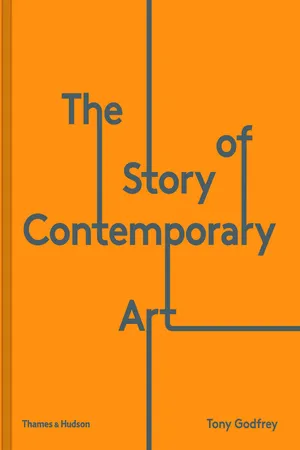
While these questions are perpetually asked about contemporary art, they are not the questions that E. H. Gombrich set out to answer in his seminal book The Story of Art. Contemporary art is very different from what came before. From the 1960s, where Gombrichs account concludes, artists began to abandon traditional forms of art and started to make work that questioned arts very definition. This is where Godfrey picks up the story.
Developments in contemporary art have followed no straightforward line of progress or sequence of movements. Recognizing this, Tony Godfrey creates a narrative from a series of often dramatic creative conflicts and arguments around what art is or should be. From object versus sculpture and painting versus conceptual to local versus global, gallery versus wider world, The Story of Contemporary Art traces a history in terms of drastic changes in social and political life over the last sixty years.
How do we experience being human in a world that seems to change so quickly? In exploring arts relationship to this question, Godfrey asserts that multiple voices must be heard: critics, theorists, curators and collectors, but also audiences and artists themselves. Key to the book is the story of how a perception that art was made almost exclusively by white men from North America and Western Europe has been radically overturned. Compelling and intelligent, but never academic, this book tells us how.
- English
- ePUB (mobile friendly)
- Available on iOS & Android
eBook - ePub
The Story of Contemporary Art
About this book
Information
Topic
ArtSubtopic
History of Contemporary ArtChapter 1

THE WRECKAGE OF MODERNISM AND AFTER
1945–1979
After the War
Where do we look first?
Prior to the Second World War, Paris had been the traditional centre of the art world for more than two hundred years; but after the war, people began to realize that New York was more active – and richer. With Europe and Japan in ruins, the United States was now the most powerful nation in the world. Elsewhere, enormous changes were underway: the great empires of the nineteenth century were starting to collapse, and a new, post-colonial world was beginning to emerge. So let us look first of all at both New York and Yogyakarta, the revolutionary capital of the Republic of Indonesia, whose independence from the Netherlands was declared on 17 August 1945 by the nationalist leader Sukarno.1
Seko: Guerrilla advanced guard (page 32), by the Indonesian artist S. Sudjojono, and Untitled (Violet, Black, Orange, Yellow on White and Red) (page 33), by the American painter Mark Rothko, were both made in 1949. Clearly, they look very different from each other, but they were also made for different reasons. Rothko’s painting, an example of the modernist abstraction pioneered by the likes of Mondrian and Kandinsky, is concerned with essentially private emotions: ‘confronting and transcending loss’ is one interpretation. It has no given title, no obvious subject, and was meant to be experienced by the individual privately. We look at the painting for its beauty; perhaps we also feel a sense of loss or something spiritual. Sudjojono’s work, by contrast, was intended as a public expression of anger and pride: anger at the Dutch for destroying part of Yogyakarta; pride that his fellow Indonesians had fought back against the colonizers. The painting is meant to be a communal experience: art for Sudjojono had a role in nation building (specifically, the unification of a diverse body of nations connected only by their previous subjugation by the Dutch).
Paradoxically, Sudjojono wanted to make art that was outside Western modernism, to make a specifically ‘Indonesian’ art, but Seko is clearly modernist in its lineage, stretching back to Manet, Degas and so on. Or, to put it another way, the painting shows how Sudjojono ingested or cannibalized Western modernism to the point where it became his own language. Indeed, automatically labelling modernism as ‘Western’ is now seen as problematic: although its roots might lie in the West (albeit much influenced by Japanese prints and African and Oceanic sculpture), over the course of the twentieth century other peoples contributed to its development, making it more of a global tradition and way of thinking and making.

S. Sudjojono, Seko: Guerilla advanced guard, 1949
Oil on canvas, 173 × 194 cm (68⅛ × 76½ in.)
For Sudjojono, as for other artists in similar, newly independent countries, or where communism had become dominant, art was about action – communal action. This was the opposite of what Rothko and his peers were seeking. Soon after making Seko, Sudjojono joined the Communist Party (he would give up membership in 1958; see Chapter 2) and began depicting reality more exactly and dispassionately.
In effect, Sudjojono and Rothko were asking two questions that are crucial to contemporary art: who is art for, and what is art for?
In 1952 the Japanese artist On Kawara painted Thinking Man. The man is naked, emaciated and blotched, isolated in an empty room. The outline of his body is covered with prickles or stitches. The figure seems pained and anxious, and so does the act of making this pared-down work. It seems to express the horror of the war in Japan and its subsequent effects: radiation sickness, starvation, a loss of faith. But this is not social realism: Kawara was seeking a new way to express such sensations of angst and dislocation. When he was thirteen the atomic bomb dropped and Japan surrendered. Kawara’s world and the belief system he had been brought up with collapsed. ‘Recently,’ he wrote in 1955, ‘the notion of humanity has been threatened by matter. In daily life I feel this every moment. Political and economic anxieties overwhelm individuals.’2

Mark Rothko, Untitled (Violet, Black, Orange, Yellow on White and Red), 1949
Oil on canvas, 207 × 167.6 cm (81½ × 66 in.)
The post-war trauma included a crisis of faith – indeed, a crisis of meaning. To many people, all the old belief systems seemed discredited: what could you now believe in? This loss of faith, and the need for it, was most acute in Japan: ‘Japan’s defeat and the subsequent collapse of a traditional order had shaken many to the core so that the chaos of post-war was also experienced as a personal crisis of existence.’3 In 1945 the number of officially registered religions in Japan was 43; but once the emperor had been shown to be merely human, the country experienced what has been called ‘the rush hour of the gods’: by 1951, another 677 religions had been registered.4
People wanted more than ever to believe in God (or gods) and a better world. For many, however, retaining their faith proved very difficult. Nowhere is this more apparent than in the paintings of the New Zealand artist Colin McCahon. From the start of his career, McCahon had a sense that ‘true communism means true Christianity, and I believe that by my painting I help to bring it about’.5 But what he fixated on was a scene of doubt: that moment when Christ, nailed to the cross, cries out, asking why God has forsaken him.
Like many others, McCahon wobbled from sect to sect: from Presbyterian to Quaker to Catholic. He had visions of a landscape before God – and a benevolent god at that – but his faith was always insecure: ‘I could never call myself a Christian,’ he once said.6 An avant-garde artist in a conservative country, he was much maligned, suffered, and drank too much. By the 1950s, images of people had disappeared from his paintings and been replaced with words. He prefigured much of what would happen a decade later, but he was ten thousand miles away from New York, on the periphery, unknown. At the end of his life, he remarked: ‘I think I am a Christian – perhaps I am.’7 With their giant scale and biblical or poetic phrases, his late paintings seem like statements of faith, such as a prophet might make. But they are really attempts to find faith and some certainty. Above all, McCahon wanted to reach out to an audience and be understood.
Uncertainty gives birth to questions and experiments. In 1956, at an exhibition of the avant-garde Gutai group, recently founded in Japan, Atsuko Tanaka appeared wearing her Electric Dress (page 36), an outfit composed of 190 light bulbs or tubes, half of them painted in various colours, which blinked on and off sporadically. Another of her pieces, Work (Bell) (1955), consisted of a series of electric bells spread out on the floor; the viewer (or listener) was invited to activate the bells by pressing a switch. In its use of nondescript, functional objects and its invitation to participate, Work (Bell) anticipated much later work. But like her Gutai contemporaries, Tanaka stopped making such experimental pieces, instead producing paintings that, although derived from the idea of electric circuits, were effectively abstract, looking not so different from all the other abstract paintings being made around the world – Art Informel in France, Abstract Expressionism in the United States. There was a market and context for such painting, but there was as yet no context, let alone a market, for more experimental work.
Tanaka and her peers had, however, been among the first artists to ask the third question that underlies contemporary art: what is art anyway?

Colin McCahon, The Marys at the Tomb, 1950
Oil on canvas on hardboard, 80.6 × 105.4 cm (31¾ × 41½ in.)

Atsuko Tanaka wearing her Electric Dress, 1956
Installation view, 2nd Gutai Art Exhibition, Ohara Hall, Tokyo
The 1960s
In 1960 the Indonesian artist Srihadi Soedarsono travelled to the United States to begin a two-year MFA at Ohio State University in Columbus. He was greeted by Roy Lichtenstein, who, as an artist-in-residence at the university, was making heavily textured abstract paintings. Although Srihadi had started his career in the 1940s, designing posters for the forces fighting to free Indonesia from Dutch colonial rule, he had chosen a modernist education and turned to abstraction. However, on returning to Indonesia, where the economy had collapsed in 1962, he was appalled by the poverty he saw. Suddenly, abstraction seemed strangely irrelevant. He wanted to make paintings that felt contemporary, but which also bore witness to what he saw around him: hungry people (page 38).
Everywhere there was a feeling that abstract painting had become too predictable and empty. By 1962, Lichtenstein had also forsaken abstraction and was helping to initiate Pop art. Like the London-born Pauline Boty, one of the few female artists in the Pop movement, Lichtenstein wanted an art that seemed NOW.8 They both looked to advertising and consumer goods for imagery and style. Boty’s painting 5-4-3-2-1 (page 39) is exuberant, funny and a statement of active female sexuality – ‘Oh for a fu …’, reads the text in t...
Table of contents
- Cover
- Title Page
- About the Author
- Other titles of interest
- Contents
- Preface
- Introduction – On Contemporary Art and Artists
- Chapter 1 – The Wreckage of Modernism and After: 1945–1979
- Chapter 2 – The Return to Painting: The Early 1980s
- Chapter 3 – Taking the Photograph Seriously: The 1980s Continued
- Chapter 4 – Sculpture, Installations or Commodities? Around 1987
- Chapter 5 – National Art or Global Art? 1989
- Chapter 6 – For a Community, Oneself or One’s Soul? The Late 1990s
- Chapter 7 – The Spectacular or the Everyday? 2000–2004
- Chapter 8 – Storytelling or Abstraction? 2005–2009
- Chapter 9 – Auction Art or Biennale Art? 2010–2014
- Chapter 10 – Art in the Age of Surveillance Capitalism: 2015 Onwards
- Afterword
- Notes
- Acknowledgments
- Picture Credits
- Index
- Copyright
Trusted by 375,005 students
Access to over 1.5 million titles for a fair monthly price.
Study more efficiently using our study tools.
Frequently asked questions
Yes, you can cancel anytime from the Subscription tab in your account settings on the Perlego website. Your subscription will stay active until the end of your current billing period. Learn how to cancel your subscription
No, books cannot be downloaded as external files, such as PDFs, for use outside of Perlego. However, you can download books within the Perlego app for offline reading on mobile or tablet. Learn how to download books offline
Perlego offers two plans: Essential and Complete
- Essential is ideal for learners and professionals who enjoy exploring a wide range of subjects. Access the Essential Library with 800,000+ trusted titles and best-sellers across business, personal growth, and the humanities. Includes unlimited reading time and Standard Read Aloud voice.
- Complete: Perfect for advanced learners and researchers needing full, unrestricted access. Unlock 1.5M+ books across hundreds of subjects, including academic and specialized titles. The Complete Plan also includes advanced features like Premium Read Aloud and Research Assistant.
We are an online textbook subscription service, where you can get access to an entire online library for less than the price of a single book per month. With over 1.5 million books across 990+ topics, we’ve got you covered! Learn about our mission
Look out for the read-aloud symbol on your next book to see if you can listen to it. The read-aloud tool reads text aloud for you, highlighting the text as it is being read. You can pause it, speed it up and slow it down. Learn more about Read Aloud
Yes! You can use the Perlego app on both iOS and Android devices to read anytime, anywhere — even offline. Perfect for commutes or when you’re on the go.
Please note we cannot support devices running on iOS 13 and Android 7 or earlier. Learn more about using the app
Please note we cannot support devices running on iOS 13 and Android 7 or earlier. Learn more about using the app
Yes, you can access The Story of Contemporary Art by Tony Godfrey in PDF and/or ePUB format, as well as other popular books in Art & History of Contemporary Art. We have over 1.5 million books available in our catalogue for you to explore.