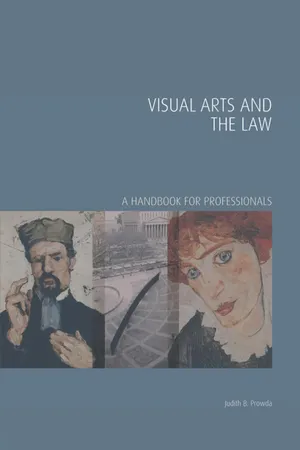
This essential handbook offers art professionals and collectors an accessible legal analysis of important principles in art law, as well as a practical guide to legal rights when creating, buying, selling and collecting art in a global market. Although the book is international in scope, there is a particular focus on the US as a major art centre and the site of countless key international court cases.
The book embraces the interdependence between legal, ethical, as well as art-historical considerations. It addresses fundamental topics such as: the role of due diligence in buying and selling art; the issues which can arise when relationships or transactions are not formalized by a written contract; critical differences in individual nations' copyright regimes, such as moral rights and artist resale rights; how courts analyse copyright infringement cases in visual art; specific laws relating to auctions and the relationships among the auction house, consignor and buyer; the balance between freedom of expression and an individual's rights of privacy and publicity; the liabilities of expert opinions on authenticity and on the valuation of works of art; and how the statutes of limitation apply to works that have been stolen or whose legal title is otherwise challenged.
This authoritative but accessible and wide-ranging volume is essential reading for arts advisors, collectors, dealers, auction houses, museums, investors, artists, attorneys, and students of art and law.
- 280 pages
- English
- ePUB (mobile friendly)
- Available on iOS & Android
eBook - ePub
About this book
Information
ARTISTS’ RIGHTS
Chapter 1
FREEDOM OF EXPRESSION AND CONTROVERSIAL ART
People have intense emotional responses to images.1 They are “sexually aroused by pictures and sculptures; they break pictures and sculptures; they mutilate them, kiss them, cry before them, and go on journeys to them; they are claimed by them, stirred by them, and incited to revolt.”2
Perhaps the greatest act of cultural vandalism so far this century—and the most visually memorable—was the carefully staged destruction by the Taliban of the great rock sculptures of the ancient Buddhas of Bamiyan in March 2001.3 During peacetime as well, artworks have been subject to destruction, banned and censored because of their social, political, or religious viewpoints, or sexually explicit content. Like other forms of speech, art can express controversial ideas in ways that some may find objectionable. Thus, there can be an innate conflict between freedom of expression and a given society’s restrictions that may incite violence, hate speech, and obscenity.
For many, there is great social value in artists having freedom to express their thoughts without restriction. It is an aspect of liberty and is often necessary for an artist’s search for truth. As Professor John Henry Merryman states, “[a]rt is often the vehicle for expression of the artist’s thought, and if we believe that the truth emerges from the free play of ideas we must express artistic expression.”4 How then does the law deal with governmental regulation of artistic freedom of expression?5
LIMITATIONS ON FREEDOM OF EXPRESSION FOR ARTWORK
Early Obscenity Law
Obscenity is a category of expression that is not legally protected in the US or the UK. It is therefore incumbent on artists and anyone working with artists to understand the risks involved in creating, selling, or exhibiting art containing provocative or controversial material that the public may find objectionable. As the term “obscenity” has evolved over the centuries and cannot be finally determined, it can be very difficult to know what is or will be prohibited.
In 17th-century England, the law was mainly concerned with suppressing political and religious views, and occasionally with prosecuting public obscenity that constituted a breach of the peace. In comparison, laws prohibiting obscenity in the US were not enacted until the 19th century.6 The experience in the US was nonetheless greatly influenced by Victorian era legal standards in England.7
Perhaps the earliest case to define obscenity was the English Victorian era case Regina v. Hicklin, which involved a pamphlet entitled The Confessional Unmasked; shewing the depravity of the Romish priesthood, the iniquity of the Confessional, and the questions put to females in confession.8 The pamphlet dealt mainly with the author’s perceived views of the dangers of the confessional, illustrated by the types of questions that Roman Catholic priests allegedly asked young women.9 The English court stated that the test for obscenity was “whether the tendency of the matter charged as obscenity is to deprave and corrupt those whose minds are open to such immoral influences, and into whose hands a publication of this sort may fall.”10 In other words, if the work falls into the hands of particularly susceptible persons and has a tendency to corrupt those minds toward “impure and libidinous” thought, then it is to be suppressed as obscene.11 Certain exceptions were made for classical literature,12 but several were declared obscene under this standard, including Theodore Dreiser’s An American Tragedy (1925) and D.H. Lawrence’s Lady Chatterley’s Lover (1928).13
The importance of Hicklin, which remains the test for publications in the UK and was subsequently adopted by US courts at the turn of the century, was twofold. First, the intent of the pamphlet was held to be irrelevant, which implied that a work was not considered as a whole, but page by page. Second, since the pamphlet was considered obscene per se, the burden was on the defendant to prove his innocence, not for the prosecution to prove his guilt.14
Modern-Day Obscenity Law in the UK
The law in the UK today is governed by the Obscene Publications Act, enacted in 1959.15 Under the Act obscenity is defined as content whose effect, if taken as a whole, will “tend to deprave and corrupt persons who are likely, having regard to all relevant circumstances, to read, see or hear the matter contained or embodied in it.”16 There is a defense in support of the “public good” if the defendant can produce expert evidence to prove that publication was in the interest of, for example, “science, literature, art or learning, or of other objects of general concern.”17
One of the most celebrated obscenity cases in the UK was brought in 1960 against Penguin Books for the posthumous publication of Lawrence’s infamous Lady Chatterley’s Lover.18 Penguin Books defended the novel’s literary merit under Section 4’s “public good defence,” relying on the expert testimony of luminaries such as E.M. Forster during a six-day trial at the Old Bailey.19 The case became a flash point for the ongoing duel between the conservative establishment and the increasingly liberal publishing industry. The ruling granted more freedom to publish explicit material20 and was seen as heralding “a new wave of sexual ‘morality’ for which the 1960s is now famous.”21 This case paralleled a case in the US, with the same result, although the process was different. The American case was based, for constitutional reasons, on freedom, not morality.22
In the 1970s, there were two seminal obscenity cases, both of which resulted in no finding of obscenity. One case concerned the Schoolkids OZ issue 28 of May 1970, and in the first instance resulted in the convictions of three editors in 1971 for “conspiracy to corrupt and debauch the morals of the young of the Realm.” This case concerned the publication of a cartoon montage of a highly sexualized Rupert Bear. On appeal, the convictions were overturned and sentences quashed.23 In the second case, a jury returned a verdict of not guilty for the publishers of Inside Linda Lovelace (1974), on the ground that the novel would not corrupt or deprave those who were likely to buy the book.24 Purely textual material has not been prosecuted in the UK since then, except for a case that was dropped in 2009 where an author of a violent rape fantasy was charged for posting obscenity on the Internet.25
Evolution of Obscenity Law in the US
Freedom of speech is among the most fundamental and cherished rights protected by the US Constitution. While the language in the First Amendment is expansive (“Congress shall make no law … abridging the freedom of speech”),26 it does not protect all forms of expression. The framers of the Constitution intentionally left the boundaries between protected and unprotected speech up to the courts to interpret as society evolved. To this day, the US Supreme Court has not given a clear definition of obscenity, although it has attempted on many occasions to analyze the problem. As a result, this area of First Amendment law is probably the most difficult to navigate.
There are many different forms of speech and expressive conduct that are protected under the First Amendment, but the law varies as to the level of protection for each. Verbal speech and written speech are generally the most protected. The law has recognized that speech may be non-verbal as well, beginning with the 1931 Supreme Court decision Stromberg v. California, which struck down a California statute banning the display of a red flag as a symbol of protest.27 The Court found that the statute, which prohibited the display of the flag as a sign of opposition to organized government, was unconstitutional because it could be construed to prohibit peaceful and orderly opposition to government by legal means.28 Artists also engage in symbolic, or expressive, conduct that is protected under the First Amendment, but courts often do not accord visual art the same level of protection as verbal or written communication, which is considered pure political speech. A final category of speech, physical conduct, has traditionally received the least protection.
The Mid-20th Century
Until the middle of the 20th century, US courts were applying the 1868 British Hicklin standard to define obscenity, such that material is obscene if it tends “to deprave and corrupt those whose minds are open to such immoral influences and into whose hands a publication of this sort may fall.”29 As American courts used the Hicklin standard to increasingly prosecute obscenity, the ironic social, economic, and cultural consequences included increased proliferation of erotic representations.30 Publishers turned to postal mail to market and distribute proscribed materials, created new genres of indecent literature, and used the obscenity prosecutions to advertise the emerging pornography trade spreading knowledge to potential consumers.31 Finally, in 1934 the Second Circuit Court of Appeals abandoned the Hicklin standard, legalizing James Joyce’s Ulysses (1922). The proper obscenity standard must not look at isolated passages, but must determine “whether a publication taken as a whole has a libidinous effect.”32
It was not until two decades later in 1957, in Roth v. United States, that the US Supreme Court squarely confronted the question of whether obscenity is a protected form of speech under the First Amendment of the US Constitution.33 In Roth, the Court affirmed a conviction of a New York publisher and distributor of books, photographs, and magazines for violating a federal obscenity statute by mailing obscene circulars and by advertising an obscene book.34 The Court, in a 6-3 opinion by Justice Brennan, held California and federal government restrictions on obscene expression did not violate the First Amendment because “obscenity is not within the area of constitutionally protected speech or press”35 as it is “utterly without redeeming social importance.”36 The Court defined “obscene material” as “material which deals with sex in a manner appealing to prurient interest,”37 and “prurient interest” as “lustful thoughts … itching, morbid, or lascivious longings … a shameful or morbid interest in nudity, sex, or excretion.”38
The Roth Court established a new test: “whether to the average person, applying contemporary community standards, the dominant theme of the material taken as a whole appeals to prurient interest.”39 If the...
Table of contents
- Cover Page
- Title Page
- Copyright Page
- Dedication
- Contents
- Acknowledgments
- Foreword
- Preface
- Introduction: What is Art in a Legal Context?
- Part One Artists’ Rights
- Part Two Artists’ Relationships
- Part Three Commercial Aspects of Art
- Conclusion
- Notes
- Bibliography
- Glossary of Legal Terms
- Index
Trusted by 375,005 students
Access to over 1.5 million titles for a fair monthly price.
Study more efficiently using our study tools.
Frequently asked questions
Yes, you can cancel anytime from the Subscription tab in your account settings on the Perlego website. Your subscription will stay active until the end of your current billing period. Learn how to cancel your subscription
No, books cannot be downloaded as external files, such as PDFs, for use outside of Perlego. However, you can download books within the Perlego app for offline reading on mobile or tablet. Learn how to download books offline
Perlego offers two plans: Essential and Complete
- Essential is ideal for learners and professionals who enjoy exploring a wide range of subjects. Access the Essential Library with 800,000+ trusted titles and best-sellers across business, personal growth, and the humanities. Includes unlimited reading time and Standard Read Aloud voice.
- Complete: Perfect for advanced learners and researchers needing full, unrestricted access. Unlock 1.5M+ books across hundreds of subjects, including academic and specialized titles. The Complete Plan also includes advanced features like Premium Read Aloud and Research Assistant.
We are an online textbook subscription service, where you can get access to an entire online library for less than the price of a single book per month. With over 1.5 million books across 990+ topics, we’ve got you covered! Learn about our mission
Look out for the read-aloud symbol on your next book to see if you can listen to it. The read-aloud tool reads text aloud for you, highlighting the text as it is being read. You can pause it, speed it up and slow it down. Learn more about Read Aloud
Yes! You can use the Perlego app on both iOS and Android devices to read anytime, anywhere — even offline. Perfect for commutes or when you’re on the go.
Please note we cannot support devices running on iOS 13 and Android 7 or earlier. Learn more about using the app
Please note we cannot support devices running on iOS 13 and Android 7 or earlier. Learn more about using the app
Yes, you can access Visual Arts and the Law by Judith B. Prowda in PDF and/or ePUB format, as well as other popular books in Law & Art General. We have over 1.5 million books available in our catalogue for you to explore.