- 256 pages
- English
- ePUB (mobile friendly)
- Available on iOS & Android
eBook - ePub
About this book
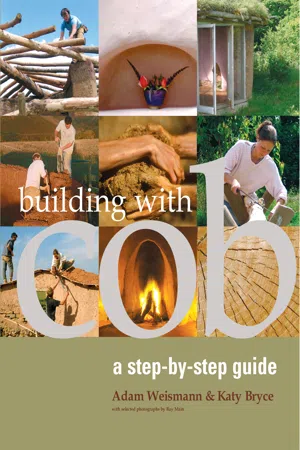
Building with Cob shows how to apply this ancient technique in a wide variety of contemporary situations, covering everything from design and siting, mixing, building walls, fireplaces, ovens and floors, lime and other natural finishes, and gaining planning permission and building regulation approval.
Frequently asked questions
Yes, you can cancel anytime from the Subscription tab in your account settings on the Perlego website. Your subscription will stay active until the end of your current billing period. Learn how to cancel your subscription.
At the moment all of our mobile-responsive ePub books are available to download via the app. Most of our PDFs are also available to download and we're working on making the final remaining ones downloadable now. Learn more here.
Perlego offers two plans: Essential and Complete
- Essential is ideal for learners and professionals who enjoy exploring a wide range of subjects. Access the Essential Library with 800,000+ trusted titles and best-sellers across business, personal growth, and the humanities. Includes unlimited reading time and Standard Read Aloud voice.
- Complete: Perfect for advanced learners and researchers needing full, unrestricted access. Unlock 1.4M+ books across hundreds of subjects, including academic and specialized titles. The Complete Plan also includes advanced features like Premium Read Aloud and Research Assistant.
We are an online textbook subscription service, where you can get access to an entire online library for less than the price of a single book per month. With over 1 million books across 1000+ topics, we’ve got you covered! Learn more here.
Look out for the read-aloud symbol on your next book to see if you can listen to it. The read-aloud tool reads text aloud for you, highlighting the text as it is being read. You can pause it, speed it up and slow it down. Learn more here.
Yes! You can use the Perlego app on both iOS or Android devices to read anytime, anywhere — even offline. Perfect for commutes or when you’re on the go.
Please note we cannot support devices running on iOS 13 and Android 7 or earlier. Learn more about using the app.
Please note we cannot support devices running on iOS 13 and Android 7 or earlier. Learn more about using the app.
Yes, you can access Building with Cob by Adam Weisman,Katy Brynce,Katy Bryce in PDF and/or ePUB format, as well as other popular books in Technology & Engineering & Construction & Architectural Engineering. We have over one million books available in our catalogue for you to explore.
Information
1
Earth building around the world
Vernacular buildings record lifestyles of the past, when people had to find a sustainable way of life or perish. Just as we will have to now. The new importance of vernacular building is that it has vital ecological lessons for today.
David Pearson, Earth & Spirit
vernacular traditions and natural building
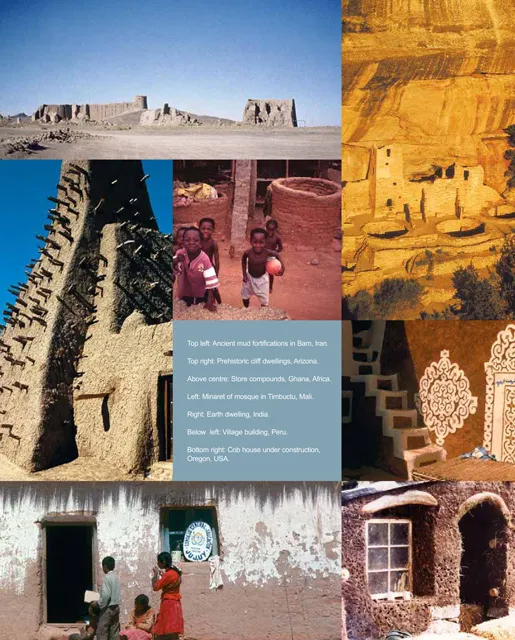
Mud has been used to create dwellings and structures since human beings first created shelter 10,000 years ago. It can be found in the simple shelters made of woven sticks covered in clay, the remains of which were discovered on the Nile Delta in Africa from 5,000 BC, to the rammed earth sections of the great wall of China, the majestic mud brick mosques of Djenne and Mopti in Mali, and the humble cob cottages of the British Isles. And before this, humans must have watched and learned from the swallows who weave their nests out of twigs held together by mud, and the termites who create huge mounds out of particles of earth piled delicately on top of each other.
The people making these buildings were (and in some societies continue to be) the children, women and men of the rural communities around the world. They were also the finest craftspeople of the world’s most ancient civilisations, as well as the peasant tenant farmers of pre-industrial Europe. Mud has always been, and continues to be, the most available, democratic and adaptive building material on the planet.
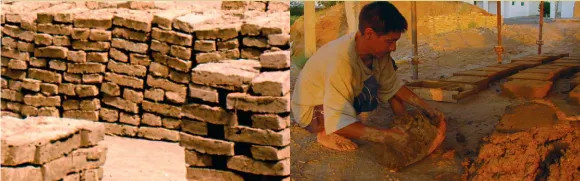
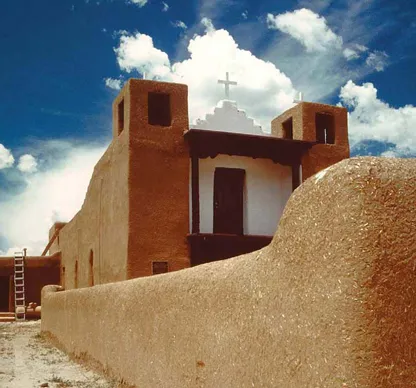
Opposite: Earthen adobe Pueblo church in Taos, New Mexico. Below: Making mud bricks by hand in Merv, Turkmenistan.
Vernacular building practices around the world
“Quietly and almost without notice, they outwit the might of modern machinery with simple tools and materials that welcome, encourage, and amplify the use of the human hand.” Bill and Athena Steen and Eiko Komatsu, Built By Hand: Vernacular Buildings Around the World.
Earth has predominantly been used for building by the indigenous peoples of the world, who live in pre-industrial societies, who work and live off of the land, and have little or no access to our so-called ‘modern’ technologies. Vernacular building techniques are used for the homes of ordinary people.
They are designed and built by the people who live in them, using the natural resources available locally, and using simple hand tools and a low-tech approach. They are designed to respond intimately to the local site on which they are built, and serve as an expression of the community’s and the individual’s cultural and social human needs. As Hughes and North said in 1908, regarding the vernacular buildings of Wales: “Just as the many-branched Welsh oaks are peculiar to the principality, so are these buildings the natural product of the country, the true growth as it were of the soil, and show as clearly as any written history the development of the life of the people.” – Eurwyn William, Home-made Homes: Dwellings of the rural poor in Wales.
Vernacular buildings can be thought of as the equivalent to folk speech, local dialects, folk art and folk music – they are unique, specific, and their beauty lies in their simplicity, functionality, humility, and the fact that they respond intricately to the world in which people live. Much of modern housing – often necessarily erected hastily, as a response to the need to house an ever-increasing population – is lacking in this sensitivity. Often it would seem that modern developments are the product of visions created by designers and architects, who act on theories about how they perceive people should live. This can be seen in the tenement high-rises that were erected in the 1960s and 70s. They were born out of a social housing theory which, as everyone can now see from the ghettoes of the inner cities, was horribly wide of the mark.
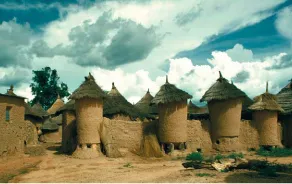
Earth dwellings, Africa.
30% of the world’s population live in homes built of earth
50% of the population of ‘developing’ countries live in earth buildings
Vernacular buildings are literally made by hand. Their beauty lies in their imperfections, irregularities, specific nuances and idiosyncrasies. It is ironic that most vernacular buildings, in which we find so much beauty, have often been made by people who have little money, no specialist knowledge, and who are simply striving to create shelter and protection from the elements with what materials they have got.
Most of the features that we find so desirable and beautiful in vernacular buildings, and that we strive to imitate in many modern ‘designed’ buildings, were born out of practicality and inherent common sense. Vernacular buildings are generally extremely efficient, and no feature emerges that does not serve a function – there was no room for embellishment.
We respond so deeply and positively to these features because we can feel and see the understanding that their creators had of the materials used and the environment in which they were building. It is ironic also that we now look to these buildings as models of ‘green’ practice in everything from siting, design, materials and methods. We have come full circle, and can begin to re-learn all that we have forgotten.
Earthen vernacular building in the UK, and the effects of the industrial revolution
“Probably indeed there is no county in the (United) Kingdom that has not considerable areas where the soil would, if tried, prove well adapted to cob building.” Clough Williams-Ellis, Cottage Building in Cob, Pise, Chalk and Clay.
The simple labourer’s cottage could be said to be Britain’s indigenous, vernacular building. It was always built with materials specific to the region, but was predominantly made out of stone and mud from the fields to make up the foundations and walls. Local trees were used for the roof timbers, and the grasses and reeds from the surrounding area for the thatch roof. It was generally built by its owner with the help of the pooled labour resources of the community, which comprised the poor, rural workforce that served the local estate, owned by the landed gentry. These made up the homes of the ordinary people in pre-industrial Britain.
The onset of the Industrial Revolution in the 1800s brought dramatic changes to all aspects of life. These directly affected how, where, and with what materials the homes of the ‘ordinary’ people were created. It brought about the beginning of the decline of vernacular building practices, and the onset of mass-produced housing. The Industrial Revolution created new factories in cities. They produced the standardised, machine- made and pre-fabricated materials that were used for all aspects of life, including buildings.
World Heritage of Earth Building – Past to present
Middle Stone Age
• 8000 BC: Oldest remains found so far, of earth structure at Jericho – town made of mud bricks.
• 7000 BC: India, on the banks of the river Indus – dwellings built with unbaked bricks. Fortress walls encircling village made of mud brick.
• 6000 BC: Oldest settlements in Europe – primitive dwellings on Aegean Coast of woven wood daubed with clay, and later sun-dried mud bricks.
• 5000 BC: Hunter-gatherer semi-permanent huts made of earth.
– first archaeologically recorded human settlements made out of earth on Nile Delta, Africa – woven reeds and branches covered with clay.
– China, dwellings dug out of loess clay in circular or oval shape.
New Stone Age
• 3000 BC: Athens – city established at base of Acropolis – earth brick buildings with thatched roofs.
• 2000 BC–2000 AD: China – earth brick as infill for timber frame.
Bronze Age
• 1800–570 BC: Mainland central Europe – wood and earth structures.
• 1600 BC: Peru Andean Region – earth structures and earth bricks for temple.
• 1552–1070 BC: Homes of artisans and nobles, palaces and temples built out of mud bricks in the New Kingdom, Middle Egypt.
• 1200 BC: Egyptian builders develop concept of mud brick vaulting – Lower Nubia.
Iron Age
• 650 BC: Central America – pyramid and houses built in earth.
Modern Era
• 300–400 AD: Rome – houses made of mud brick.
• 300–800 AD: Casa Grande, Arizona, USA – Native Americans in South-west of America – Hohokam tribe lived in houses of cob.
• 1100 AD: Islamic mosques constructed out of mud bricks, direct shaping or daub, depending on locality, e.g. Djenne and Mopti, mosques of Mali (both still remaining today).
• 1100–1300 AD: New Mexico, Arizona, North America – Anasazi Indians used widespread adobe brick construction.
• 1270 AD: Chapel La Salle de Diana – the oldest remaining complete earth structure in Europe, in Montbrisson, France. Now it is the town library for moisture-sensitive books.
• 1700–1800 AD: Earth building popular in Central Europe – Denmark, United Kingdom, Germany.
• Post-First World War: Earth building popular in Europe.
• Post-Second World War: Decline in popularity of earth building in Europe.
• 1972: UNESCO World Heritage Convention – three heritage sites included that used earth as predominant building material.
• 1974: CRATerre – Grenoble, France. Grenoble School of Architecture to undertake task of updating scientific and technical knowledge of unbaked earth construction.
• 1982: Exhibition & conference at Pompidou Centre, Paris, France, entitled A forgotten building practice for the future, about earth as a building material.
• 1993: United Kingdom, The Devon Earth Building Association (DEBA) formed.
• 1993–2006: Revival in Europe and North America of earth as environment-friendly building material. Earth remains the predominant building material in South and Central America, China and Africa.
“Their pictures tell the story of a disappearing world of buildings that have been constructed by ordinary people who as builders and homesteaders have given artistic, modest, and sensible form to their daily needs and dreams. Sometimes accidental, often asymmetrical, and utilising materials that are naturally close at hand, these buildings, with their moulded curves and softened lines, convey a personal and human beauty.”
Athena and Bill Steene and Eiko Komatsu, Built by Hand: Vernacular Buildings around the World
These factories provided a draw for much of the rural workforce; people moved from the country to the city in search of perceived improved living conditions and a hope for financial gains. The new factory workforce was provided with housing by the industrialists, which was pre-built using the new industrial materials such as brick, steel, and cement. These mass-produced houses consisted of back-to-back, identical structures that lacked the regional idiosyncrasies and individuality of the vernacular buildings. Artificial communities were created, and the rhythms of nature disrupted. Here began the decline of the owner-built home, and the ability of people to provide for themselves in all aspects of life. A new generation of specialists rapidly emerged, who began to lose touch with the well-rounded skills and practices of the generation before them. A new model of progress began to consume people’s lives. Consequently, earth building i...
Table of contents
- Cover
- Halftitle
- Dedications
- Copyright
- Title Page
- Contents
- Introduction
- 1. Earth building around the world
- 2. Site & design
- 3. Identifying & testing soils
- 4. How to make a cob mix
- 5. Foundations
- 6. Building with cob
- 7. Roofs
- 8. Insulation
- 9. Lime & other natural finishes
- 10. Earthen floors
- 11. Fireplaces
- 12. Restoration
- 13. Planning permission & building regulations
- About the authors
- Resources & suppliers
- Index