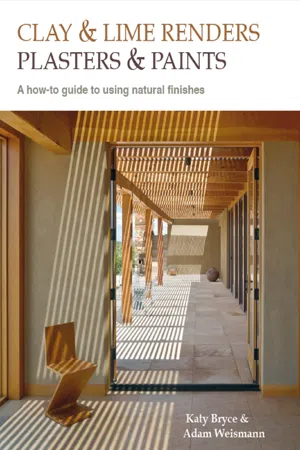
This book was previously published under the title Using Natural Finishes. With the increasing awareness of eco-building techniques alongside the desire to make our homes healthier, the historical benefits of using natural renders and paints are being rediscovered. Clay and Lime Renders, Plasters and Paints is an in-depth guide to the selection, mixing and application of lime and clay based plasters, renders, paints and washes. It includes step-by-step instructions for applying lime and clay based plasters, renders and paints and information on the benefits of natural finishes for personal health, the environment, and for buildings. It draws on traditional methods and materials for new and historic buildings, providing a comprehensive and up-to-date online resource guide to suppliers, practitioners and courses. Easy to follow DIY projects guide the reader through all aspects of using these natural finishes, with beautiful photographs of techniques and examples from the UK and abroad.
eBook - ePub
Clay and lime renders, plasters and paints
A how-to guide to using natural finishes
- 264 pages
- English
- ePUB (mobile friendly)
- Available on iOS & Android
eBook - ePub
Clay and lime renders, plasters and paints
A how-to guide to using natural finishes
About this book
Information
Subtopic
Gestione ambientale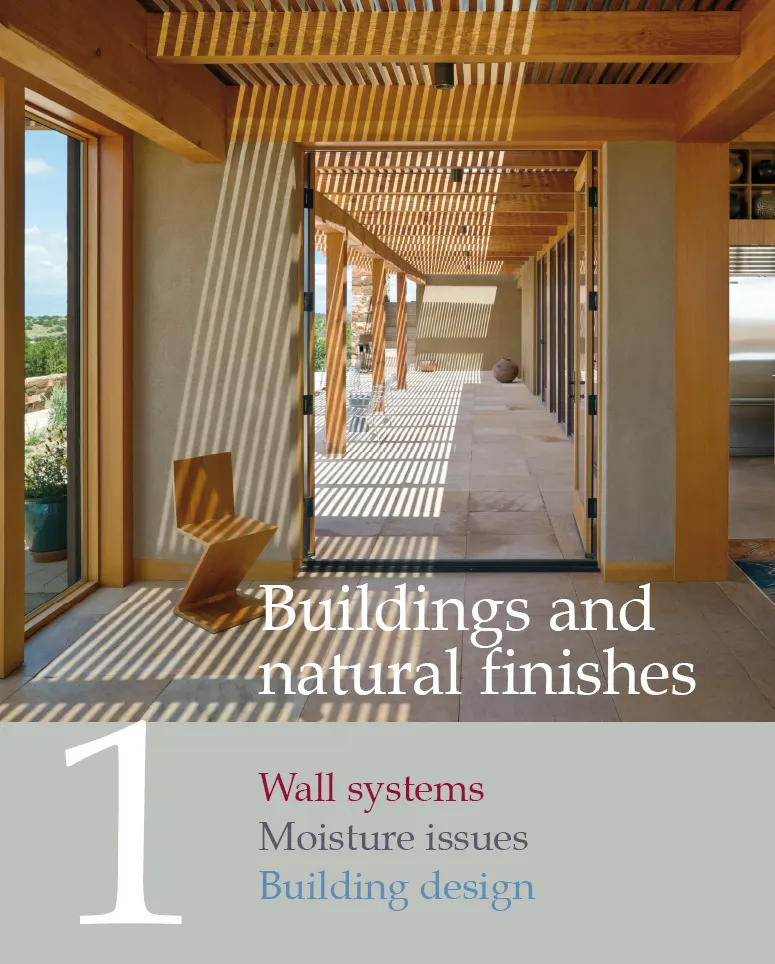
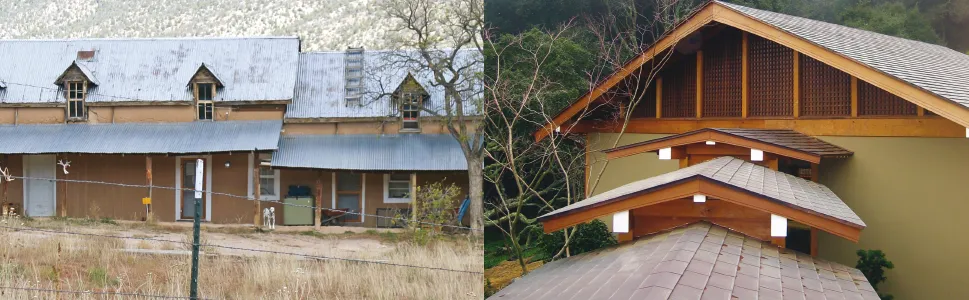
Lime- and earth-based plasters, renders and paints are highly suitable, if not essential, for use in conjunction with sustainable and traditional wall-building materials. Examples include earth (clay), timber, hemp, reed, straw-bale, low-energy bricks and stone. Many of these traditional walling materials have been used successfully for thousands of years and are now enjoying a renaissance, as the foundation for many of the contemporary ‘eco-building’ methods. A unifying characteristic between these walling materials is that they are all, to a degree, porous. They allow the free passage of moisture into and out of them, and therefore need to ‘breathe’ to remain healthy. Because of this, they are highly responsive to changes in relative humidity and temperature in the atmosphere. This means that structures made out of these materials will naturally move in response to these differences. All finishes applied to these materials must therefore match the hardness and porosity of the walling substrate below. They must be flexible enough to accommodate natural movements in the building without cracking, and need to have a high degree of vapour permeability to eliminate the potential for trapping moisture within the wall. A case can also be argued for the use of lime- and earth-based plasters, renders and paints (with certain preparatory measures in place) on some of the modern, conventional building materials, such as concrete block and plasterboard. Though their qualities of softness, breathability and flexibility are not essential when used with these conventional materials, lime- and earth-based finishes can bring benefits in the areas of decreased impact on the environment (their production, toxicity and ease of disposal), improved internal air quality, and by improving the look and general ‘feel’ of the building and the spaces inside.
Wall systems

T his section introduces different walling systems that are compatible with lime and earth-based finishes. It also outlines the suitability of applying the various finishes to different substrates.
Earth walls
Earth walls can be constructed in many different ways. Building with earth (clay-rich subsoils) is the most ancient of all building methods. Many variations of earth building have been used throughout the world since man began building shelters. Most earth building methods consist of mixing together a clay-rich subsoil with other ingredients. These are most commonly some form of fibre (straw) to provide tensile strength, and aggregates to provide strength and stability to the mix. Most buildings made out of earth must be raised off the ground at least 450 mm (18″), and should have large roof overhangs to protect the walls from rain.
Many of the earth building methods are currently enjoying a revival because they provide a sustainable way of building. This is because most forms of building with earth have an incredibly low environmental impact, especially when locally resourced materials and simple techniques are used. Earth building materials can be indefinitely recycled, and biodegrade easily. They have tremendous health benefits, such as temperature and humidity regulation, high thermal mass (they can absorb and store large amounts of heat), good toxin and odour absorption, and excellent sound insulation properties. Some of the earth building variations include:
Monolithic earth walls, such as cob, clob, wychert, clom, mud, clat, clay & clunch
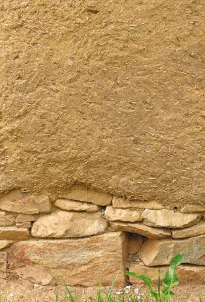
A load-bearing walling system – an ancient building technique and material that is used throughout the world, with regional variations, such as ‘cob’ in the southwest of England. It is composed of clay subsoil, aggregate and straw. These ingredients are mixed together with water to produce a homogenous, malleable and sticky material, which is laid in ‘lifts’ of 300-600 mm (12-24″) in one building session. Once the previous one has hardened, consecutive lifts are laid until full wall height has been reached. The cob is built up without forms or shuttering, but is compressed in place by foot or with a garden fork. It is then trimmed with a sharp spade to maintain a plumb line.
Cob
Unfired earth blocks, such as adobe, cob block, and clay lump
A load-bearing material used throughout the world for thousands of years. This is a system of creating building blocks out of raw clay-rich subsoil, aggregate and sometimes fibre. The material is either moulded in a plastic state into forms, or compressed by machine in a dry state. The blocks are laid in bonded courses, with either a mud or lime mortar, or simply wetted down and bonded through suction if the blocks are made with dry material.
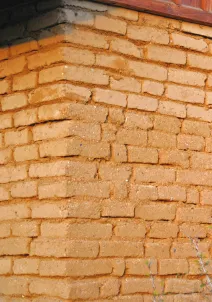
Adobe block
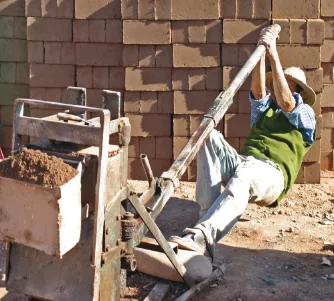
Making compressed adobe blocks
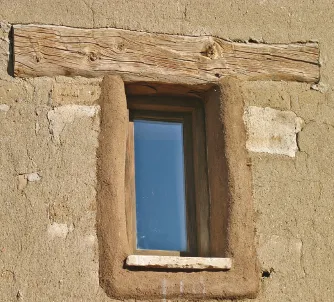
Adobe with earth plaster
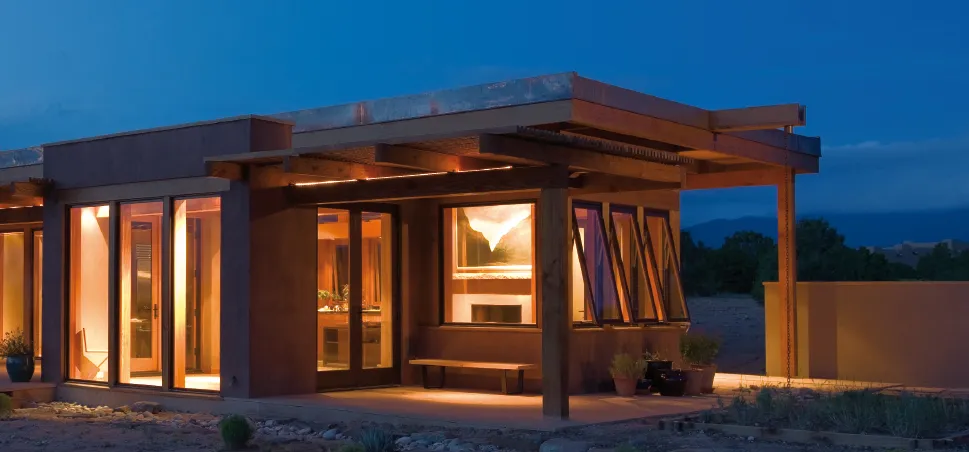
Modern adobe construction designed by Tony Atkins and built by Crocker Ltd.
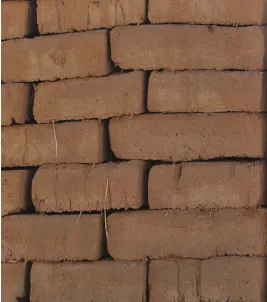
Cob block
Rammed earth & ‘pise de terre’
Monolithic earth walls built up between temporary shuttering. A load-bearing material, which is sometimes mixed (slightly moistened) with aggregate, or it can be used in its raw form if the right proportions naturally exist. It is tamped by hand or with a pneumatic tamper, between wood or steel shuttering. The shuttering is moved up until full wall height is reached.
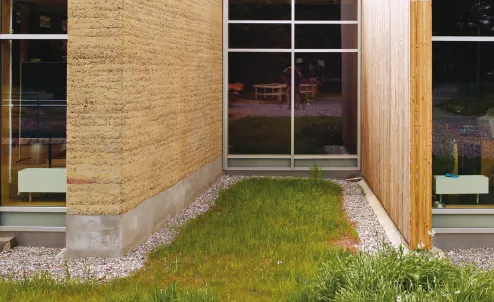
Rammed earth
Light clay & light straw clay ‘Leichlem’ (pronounced ‘lie-klem’)
A non-load-bearing walling material. Straw is coated with a clay-rich slip which is compacted between temporary shuttering, set within a timber structure.
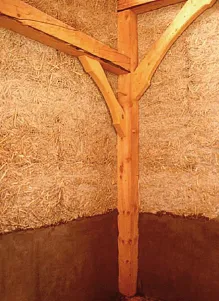
Light clay
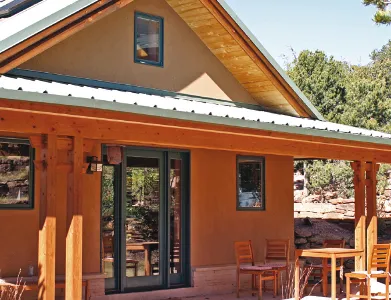
Light clay
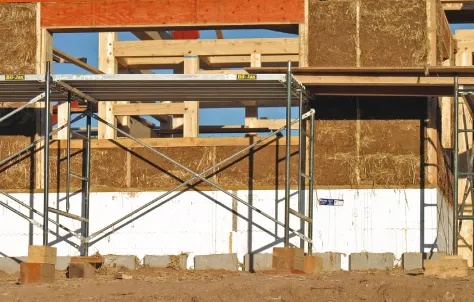
Light clay
Wattle & daub
A non-load-bearing walling system of tightly woven sticks (usually a green and flexible wood, such as hazel, willow or maple), set within a timber-framed panel. This lattice (the wattle) is then coated with a ‘daub’ mixture: a thick clay-rich subsoil mixed with chopped straw or hair, and sometimes animal dung for extra weather resistance and durability. This is squeezed into place between the sticks. The daub can either be finished with a limewash or coated in a lime plaster/render for extra protection. It can be used for exterior walls or interior partition walls.
All lime- and earth-based finishes are ideally suited for all types of raw earth construction. Cement and synthetic paints must not be used.
Straw-bale wall construction
Straw-bale wall construction originated in the USA around the end of the nineteenth century. It coincided with the development of baling machines. The straw bales are used like large building blocks, stacked on top of one another in staggered courses. They are usually speared onto pins – often sharp rods of hazel or steel. This ties them into the foundation and provides structural stability for the walls. There are many different methods of building with straw bales, but these can be broadly categorized into (a) load-bearing, where the bales take the full weight of the roof, and (b) non-load-bearing, where the bales are set within a timber structure and used as a wall infill between the posts. As with walls made out of earth, it is essential that the bales are built onto a raised plinth so that they do not come into contact with water. They also require large roof overhangs to direct moisture away from the wall face.
Straw-bale construction generally has a very low environmental impact, especially when materials are sourced locally. The use of large amounts of plant materials in buildings has the added advantage of being able to create ‘carbon sinks’. This is due to the absorption of CO2 from the atmosphere as the plant grows, and turns this CO2 into oxygen. The more plant material that can be used in building construction, the more potential there is for decreasing the damaging levels of CO2 currently present in the atmosphere. Straw-bale walls are highly breathable and have excellent insulative properties. This gives straw-bale buildings the potential to provide a very healthy living environment. Straw bales are fully biodegradable and will last for hundreds of years if protected with breathable coatings and utilised within a well designed building.
Straw-bale walls must be protected from moisture, and need to be sealed to keep out draughts and protect them from hungry animals.
Straw is a breathable material, and hence must not be coated with any non-breathable renders, plasters and paints, such as cement and synthetic paints. These could lead to moisture getting trapped in the bales, which will eventually cause them to rot. Lime- and earth-based finishes are ideal. Straw-bale walls that are exposed to extreme conditions, such as on the weather-facing wall, may require additional protection from the elements such as timber cladding.
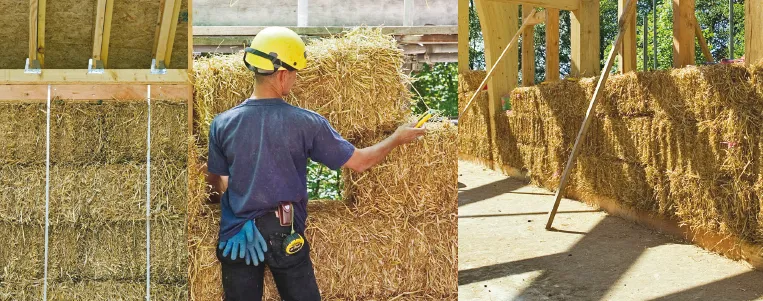
Straw bale
Lath & plaster
Lath and plaster is made up of thin, narrow strips of wood which are attached to wood battens, joists or studding and then plastered. This system can be used as an external and internal wall structure when set within a timber frame. It can also be used to create ceilings. Alternatively it can be used as a system on solid walls which are unable to receive plaster/render directly, such as impervious materials or damp substrates. The substrate is battened and then lathed with a suitable air gap for adequate air circulation. The wood laths can be split by hand (riven lath), or mechanically sawn. Straight-grained wood is necessary, and hand-split laths are considered to be stronger. Sweet chestnut, oak and Scots pine are the most suitable woods to use. The laths can vary in size, but the optimum size is 30mm (1...
Table of contents
- Cover
- Title Page
- Dedications
- Contents
- Chapter 1: Buildings and natural finishes
- Chapter 2: Preparations
- Chapter 3: Lime-based plasters & renders
- Chapter 4: Earth-based plasters & renders
- Chapter 5: Lime- and earth-based paints & washes
- Chapter 6: Finishes from around the world
- Resources and suppliers
- Bibliography
- Index
- Copyright
Trusted by 375,005 students
Access to over 1.5 million titles for a fair monthly price.
Study more efficiently using our study tools.
Frequently asked questions
Yes, you can cancel anytime from the Subscription tab in your account settings on the Perlego website. Your subscription will stay active until the end of your current billing period. Learn how to cancel your subscription
No, books cannot be downloaded as external files, such as PDFs, for use outside of Perlego. However, you can download books within the Perlego app for offline reading on mobile or tablet. Learn how to download books offline
Perlego offers two plans: Essential and Complete
- Essential is ideal for learners and professionals who enjoy exploring a wide range of subjects. Access the Essential Library with 800,000+ trusted titles and best-sellers across business, personal growth, and the humanities. Includes unlimited reading time and Standard Read Aloud voice.
- Complete: Perfect for advanced learners and researchers needing full, unrestricted access. Unlock 1.5M+ books across hundreds of subjects, including academic and specialized titles. The Complete Plan also includes advanced features like Premium Read Aloud and Research Assistant.
We are an online textbook subscription service, where you can get access to an entire online library for less than the price of a single book per month. With over 1.5 million books across 990+ topics, we’ve got you covered! Learn about our mission
Look out for the read-aloud symbol on your next book to see if you can listen to it. The read-aloud tool reads text aloud for you, highlighting the text as it is being read. You can pause it, speed it up and slow it down. Learn more about Read Aloud
Yes! You can use the Perlego app on both iOS and Android devices to read anytime, anywhere — even offline. Perfect for commutes or when you’re on the go.
Please note we cannot support devices running on iOS 13 and Android 7 or earlier. Learn more about using the app
Please note we cannot support devices running on iOS 13 and Android 7 or earlier. Learn more about using the app
Yes, you can access Clay and lime renders, plasters and paints by Adam Weismann,Katy Bryce in PDF and/or ePUB format, as well as other popular books in Tecnologia e ingegneria & Gestione ambientale. We have over 1.5 million books available in our catalogue for you to explore.