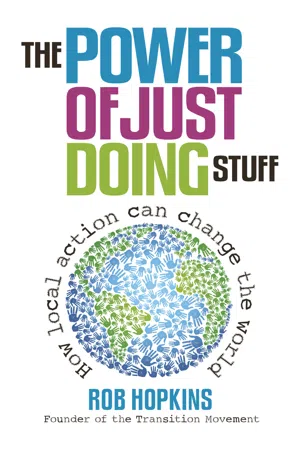
Something is stirring. People around the world are deciding that the wellbeing of their local community and its economy lies with them. They're people like you. They're rolling up their sleeves, getting together with friends and neighbours and doing something about it. Whether they start small or big, they find that just doing stuff can transform their neighbourhoods and their lives. This book is packed with inspiring real-life examples, and the voices of people who have created innovative local businesses and invested in all manner of new enterprises. This is the seed of a new economy - the answer to our desperate search for a new way forward. At its heart is people deciding that change starts with them. Communities worldwide are already modelling a more local economy rooted in place, in wellbeing, in entrepreneurship and in creativity. And it works. Reviving the place you live in starts with a small group of people making the decision to do something. One of that group could be you.
- 160 pages
- English
- ePUB (mobile friendly)
- Available on iOS & Android
eBook - ePub
About this book
Information
CHAPTER ONE
WHY WE NEED TO DO SOMETHING
How good a society does human nature permit? How good a human nature does society permit?
Abraham Maslow, psychologist (1971)1
Why we need a new Big Idea
I have a lot of sympathy for governments that see the immediate problems and strive to deal with them, but I have much less sympathy if they don’t have a longer-term vision that makes sense of where we’re heading. I’m very concerned that trying to pull out all the stops to re-stimulate economies, to use the cliché ‘to get back on track’, is actually a formula for far worse things to happen, probably in the not-too-distant future.
Peter Victor, author, Managing without Growth2
Peter Victor, author, Managing without Growth2
The idea underpinning this book is that local action can change the world. Between the things we can do as individuals and the things that governments and business can do to respond to the challenges of our times, lies a great untapped potential, what I am calling ‘The Power of Just Doing Stuff’. It’s about what you can create with the help of the people who live in your street, your neighbourhood, your town. I want to excite you about the possibilities of what we can create in the communities around us, and how, if enough of us do it, it can lead to real impact, to real jobs, and to real transformation of the places we live and beyond.
One of the reasons I wrote this book was that in late 2012 I attended a two-day meeting of local authority Chief Executive Officers from across a region of the UK: an annual occasion for them to relax with each other, share new ideas and be exposed to some new thinking. I was there as part of the ‘new thinking’ bit, but the most fascinating part was at the beginning, where each was asked to share where they thought we are headed economically. Are we headed for a gradual return to growth, a bumping along a plateau for a while, or a more sustained contraction? I expected most to speak enthusiastically of the new era of growth lying just around the corner, given that that would be what they are stating publically.
In the event, only about a quarter of them shared that kind of optimism. One said “If we ever get out of this recession, nothing will be as it was in the past.” Another said “Every generation has had things better than its parents. Not any more.” And another, “Future generations will look back and say this was the start of the end of the Western world.” The one that stunned me the most was the man who said that he was fascinated by history, and had been reading about the last days of the Roman Empire in England, where in AD 308 there were roads, agriculture, central heating and so on, and 20 years later the country was back in the Iron Age. “No civilisation has lasted forever,” he said. “There is a very real chance of collapse.”
It was compelling to hear, in that safe space where people felt comfortable with each other, these honest assessments and deep concerns about our situation. In public, of course, these CEOs would be talking up the ‘growth agenda’, but here they were stating that they just didn’t believe it. I have seen the same thing on several occasions since, when I have spoken to people in similar positions who have confided that they have little or no faith that we will ever see economic growth such as we have known in recent decades again. In this book we will go on to look at the reasons why I think that a relentless growth in GDP is no longer an appropriate or desirable idea, and why I think these public leaders were right to be concerned. Their comments reminded me of the story of The Emperor’s New Clothes, and how it took a child to point out what everyone knew – that the Emperor was naked.
Current thinking across Europe seems to be that in order to re-stimulate growth we have to remove all obstacles to business doing what it wants to do wherever it wants to do it, and we need big infrastructure projects. The thinking seems to be that if only businessmen can travel faster on high-speed trains, that somehow the economy will haul itself up off the stretcher and start growing again. That if we build new airports, more businessmen will fly into them and create new businesses that will fuel the economy. That growth, in and of itself, is always a Good Thing.
The irony, of course, is that in a world of increasingly scarce resources, with a climate nearing its tipping point into runaway climate change, and an economy groaning beneath staggering levels of debt, this kind of approach is the last thing we need; this is the last kind of economic activity we need.
‘Austerity’ versus the ‘New Deal’
At the moment, when the future of our economy and the question of how we might get out of our financial hole are debated, we hear only two contrasting stories as to where next. I propose that it’s time for a third story to take its place by their side – in debates on TV, on the radio, online, at parties …
The first story we’ll call ‘Austerity’: the idea that we need to cut back government spending in the same way that you might prune a rose bush back hard in the hope of stimulating fresh growth. In practice this means deep cuts in public services, economic hardship and a widening gap between rich and poor, all with the promise that this will lead to renewed economic growth at some point. The second option, which we’ll call the ‘New Deal’, suggests that actually what we need to do is to borrow more money from future generations to spend on trying to stimulate renewed economic activity. Some propose a ‘Green New Deal’, where money is borrowed in order to stimulate the shift to a low-carbon – but still growth-based – economy.
“The austerity versus Keynsian spending debate is about as useful as arguing whether the Earth is f lat or sitting on the back of a pile of turtles.”
Graham Barnes, The Foundation for the Economics of Sustainability (FEASTA) (2013)3
The Austerity story recognises that we have partied too hard, that rather than just coming up with more clever mechanisms for dumping our huge accumulated debts on to future generations we need to be grown-up about the debt crisis and get our excesses under control, to learn to cut our coats to suit our cloth. It is interesting to note that in other languages and cultures, the term ‘austerity’ has different implications. For example, in Germany, Greece, China and Italy it has a positive meaning, referring to simplicity, frugality, sobriety, whereas in the UK, the Netherlands and France it is regarded as being puritanical and severe. There is a potentially positive way of looking at austerity, where other things in life that we value (family, friends, creativity, stillness, helping others) fill the hole that consumerism has filled. The failure of the austerity approach, though, is that the cuts made in its name fall hardest on the poorest and most vulnerable in society, and the pursuit of growth at all costs can lead to the ‘unfettering’ of large businesses at the cost of worker protection, local economic resilience and diversity.
The ‘New Deal’, which we hear a lot less about but which is usually presented as the only alternative to austerity, recognises that we need to roll up our sleeves and do something proactive about our situation, that we need to protect the most vulnerable in society, and also that we need to invest what remaining financial reserves we have in the creation of a society more appropriate to the future we a...
Table of contents
- Cover
- Title Page
- Dedication
- Contents
- Acknowledgements
- Introduction
- Chapter One: Why we need to do something
- Chapter Two: Opening the door to new possibilities
- Chapter Three: The power of just getting on with it
- Chapter Four: Daring to dream: where we could end up
- A few closing thoughts
- Next steps
- Resources
- Index
- About Green Books
- Copyright
- Advertisement
Trusted by 375,005 students
Access to over 1.5 million titles for a fair monthly price.
Study more efficiently using our study tools.
Frequently asked questions
Yes, you can cancel anytime from the Subscription tab in your account settings on the Perlego website. Your subscription will stay active until the end of your current billing period. Learn how to cancel your subscription
No, books cannot be downloaded as external files, such as PDFs, for use outside of Perlego. However, you can download books within the Perlego app for offline reading on mobile or tablet. Learn how to download books offline
Perlego offers two plans: Essential and Complete
- Essential is ideal for learners and professionals who enjoy exploring a wide range of subjects. Access the Essential Library with 800,000+ trusted titles and best-sellers across business, personal growth, and the humanities. Includes unlimited reading time and Standard Read Aloud voice.
- Complete: Perfect for advanced learners and researchers needing full, unrestricted access. Unlock 1.5M+ books across hundreds of subjects, including academic and specialized titles. The Complete Plan also includes advanced features like Premium Read Aloud and Research Assistant.
We are an online textbook subscription service, where you can get access to an entire online library for less than the price of a single book per month. With over 1.5 million books across 990+ topics, we’ve got you covered! Learn about our mission
Look out for the read-aloud symbol on your next book to see if you can listen to it. The read-aloud tool reads text aloud for you, highlighting the text as it is being read. You can pause it, speed it up and slow it down. Learn more about Read Aloud
Yes! You can use the Perlego app on both iOS and Android devices to read anytime, anywhere — even offline. Perfect for commutes or when you’re on the go.
Please note we cannot support devices running on iOS 13 and Android 7 or earlier. Learn more about using the app
Please note we cannot support devices running on iOS 13 and Android 7 or earlier. Learn more about using the app
Yes, you can access The Power of Just Doing Stuff by Rob Hopkins in PDF and/or ePUB format, as well as other popular books in Biological Sciences & Ecology. We have over 1.5 million books available in our catalogue for you to explore.