Why violence in the Congo has continued despite decades of international intervention
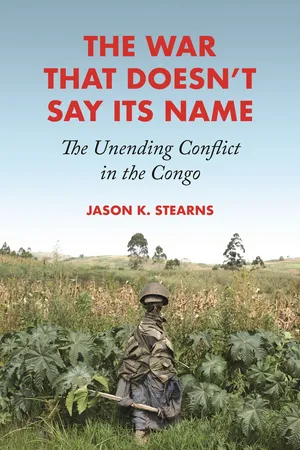
Well into its third decade, the military conflict in the Democratic Republic of the Congo has been dubbed a "forever war"—a perpetual cycle of war, civil unrest, and local feuds over power and identity. Millions have died in one of the worst humanitarian calamities of our time. The War That Doesn't Say Its Name investigates the most recent phase of this conflict, asking why the peace deal of 2003—accompanied by the largest United Nations peacekeeping mission in the world and tens of billions in international aid—has failed to stop the violence. Jason Stearns argues that the fighting has become an end in itself, carried forward in substantial part through the apathy and complicity of local and international actors.
Stearns shows that regardless of the suffering, there has emerged a narrow military bourgeoisie of commanders and politicians for whom the conflict is a source of survival, dignity, and profit. Foreign donors provide food and urgent health care for millions, preventing the Congolese state from collapsing, but this involvement has not yielded transformational change. Stearns gives a detailed historical account of this period, focusing on the main players—Congolese and Rwandan states and the main armed groups. He extrapolates from these dynamics to other conflicts across Africa and presents a theory of conflict that highlights the interests of the belligerents and the social structures from which they arise.
Exploring how violence in the Congo has become preoccupied with its own reproduction, The War That Doesn't Say Its Name sheds light on why certain military feuds persist without resolution.
- 240 pages
- English
- ePUB (mobile friendly)
- Available on iOS & Android
eBook - ePub
About this book
Information
Publisher
Princeton University PressYear
2022Print ISBN
9780691224510
9780691194080
eBook ISBN
9780691224527
1
Introduction
Die ich rief, die Geister, / Werd’ ich nun nicht los(The spirits I called / I cannot drive away)—JOHANN WOLFGANG VON GOETHE
IN EARLY 2008, I set up my research base at the VIP hotel in downtown Goma, a trade hub in the eastern Congo nestled between the Nyiragongo Volcano and the shores of Lake Kivu. A peace conference was being held close by, and many of its attendees were staying at the hotel, where they also dined. After a year and a half of fighting, the Congolese government had decided to sit down with several dozen armed groups to talk peace.
Expectations ran high. While the main Congo wars, which had lasted from 1996 to 2003, had ended in a comprehensive peace deal, the fighting had escalated to the north of where we sat, displacing hundreds of thousands of people. This time, the peace brokers wanted to go further than just elite pacts and deal with the root causes of the conflict. “For the first time, the sons and daughters of North and South Kivu have come together to speak about peace, security, and development,” announced the minister of the interior in his speech. Envoys from the United States, the European Union, and the United Nations rubbed shoulders with armed group commanders, NGO workers, and civil society leaders.
The peace conference was, in many aspects, a positive and cathartic experience. It situated conflict as the historical product of local tensions over land and identity; community leaders were given space and time to express their anger and grief over decades of war, voicing emotions they had never had a chance to put into words in front of their rivals. I met a preacher and peace activist from the Banyamulenge community of South Kivu province who carried in his briefcase a fifty-page-long list—handwritten, on yellowing paper—of all the people from his community who had been killed in the previous fifteen years. “This is why our youths are fighting,” he said. Jeannot Muhima, a combatant from just outside of Goma, described to me eloquently, calmly, how his sister had been raped and his younger brother killed by an armed group. He turned his head to show a shiny scar parting his hair on the back of his head. “I barely escaped,” he said. “That is why I fight. But it is also why, more than anything, I want peace.”1
And yet, in the end, despite the best intentions of many of the participants, the Goma Peace Conference became a source of profiteering and accomplished little. Initially, six hundred people were sup...
Table of contents
- Cover Page
- Title Page
- Copyright Page
- Dedication
- Contents
- 1. Introduction
- 2. The Historical Background
- 3. Explaining the Congolese Conflict
- 4. The Role of the Congolese and Rwandan States
- 5. The Theory: Involution, Fragmentation, and a Military Bourgeoisie
- 6. The CNDP and the M23
- 7. The Raia Mutomboki
- 8. Ituri and the UPC
- 9. Peacemaking and the Congo
- Acknowledgments
- Notes
- Bibliography
- Index
Trusted by 375,005 students
Access to over 1.5 million titles for a fair monthly price.
Study more efficiently using our study tools.
Frequently asked questions
Yes, you can cancel anytime from the Subscription tab in your account settings on the Perlego website. Your subscription will stay active until the end of your current billing period. Learn how to cancel your subscription
No, books cannot be downloaded as external files, such as PDFs, for use outside of Perlego. However, you can download books within the Perlego app for offline reading on mobile or tablet. Learn how to download books offline
We are an online textbook subscription service, where you can get access to an entire online library for less than the price of a single book per month. With over 1.5 million books across 990+ topics, we’ve got you covered! Learn about our mission
Look out for the read-aloud symbol on your next book to see if you can listen to it. The read-aloud tool reads text aloud for you, highlighting the text as it is being read. You can pause it, speed it up and slow it down. Learn more about Read Aloud
Yes! You can use the Perlego app on both iOS and Android devices to read anytime, anywhere — even offline. Perfect for commutes or when you’re on the go.
Please note we cannot support devices running on iOS 13 and Android 7 or earlier. Learn more about using the app
Please note we cannot support devices running on iOS 13 and Android 7 or earlier. Learn more about using the app
Yes, you can access The War That Doesn't Say Its Name by Jason K. Stearns in PDF and/or ePUB format, as well as other popular books in Politics & International Relations & African History. We have over 1.5 million books available in our catalogue for you to explore.