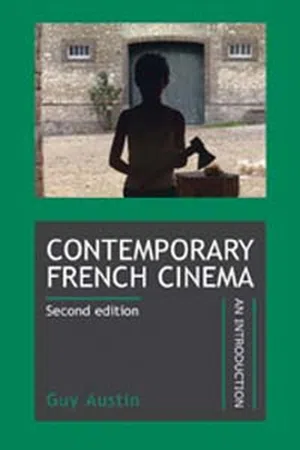
Contemporary French cinema is an essential introduction to popular French film of the last 35 years. It charts recent developments in all genres of French cinema with analyses of over 120 movies, from Les Valseuses to Caché.
Reflecting the diversity of French film production since the New Wave, this clear and perceptive study includes chapters on the heritage film, the thriller and the war movie, alongside the 'cinéma du look', representations of sexuality, comedies, the work of women film makers and le jeune cinéma. Each chapter introduces the public reception and critical debates surrounding a given genre, interwoven with detailed accounts of relevant films.
Confirmed as a major contribution to both Film Studies and French Studies, this book is a fascinating volume for students and fans of French film alike.
- 254 pages
- English
- ePUB (mobile friendly)
- Available on iOS & Android
eBook - ePub
About this book
Information
The birth of cinema
The year 1995 saw France celebrating the centenary of cinema as a national achievement, a celebration enhanced by the recent victory over the United States regarding the exemption of films from the GATT free-trade agreement. Numerous film exhibitions and retrospectives were organised, including a showing of the entire catalogue of 1,400 short films made by the pioneering Lumière brothers. A hundred years after the Lumières’ break-through in 1895, the film industry remained the barometer by which the French measured the cultural state of their nation.
The pioneers of moving pictures
The development of moving pictures was a piece-meal process, dependent on experimentation and advancement in the recording, reproduction and projection of photographic images. The first steps in this process were the invention of the magic lantern in the seventeenth century, and of photography and various moving-image toys – such as Jacob Plateau’s phénakistiscope – in the 1830s. By 1895, developments were coming to a head on both sides of the Atlantic. In the States, Eadweard Muybridge had made his photographic studies of people and animals in motion, and Thomas Edison had patented and exported his kinetoscope, whereby a single spectator could watch a tiny image on film. The first kinetoscope parlour in France opened in late 1893, and Parisians could also watch the animated cartoons of Émile Reynaud’s Théâtre optique. But the first truly collective film show, and hence the birth of cinema, took place on 28 December 1895, when the Lumière brothers’ cinématographe was watched by an audience paying one franc each at the Grand Café, boulevard des Capucines in Paris. The cinématographe, a combined motion-picture camera, projector and printer, had first been patented by the photographers and inventors Auguste and Louis Lumière in February 1895. Whereas Edison’s early films had to be shot in the studio, the cinématographe was light enough to be used for filming in the street, and the Lumières captured such unstaged events as a baby playing or workers leaving a factory. Their famous short film of 1895, L’Arrivée d’un train en gare de La Ciotat, ‘is said to have made the unprepared audiences scatter in alarm as the locomotive seemed to approach them’ (Robinson 1994: 9), while L’Arroseur arrosé of the same year, the world’s first (albeit brief) fiction film, established the visual gag as the basis for film comedy. Besides initiating what later became the documentary and comedy genres, the Lumières also developed film techniques which were to prove fundamental to the grammar of cinema. Their series Les Pompiers de Lyon (1895) linked together various shots taken from different angles in a pioneering example of editing; a year later one of their agents developed the tracking shot while shooting from a gondola in Venice (Sadoul 1962: 7).
If the Lumières pioneered the recording of action on film, and the techniques of open-air filming and montage (editing), their contemporary Georges Méliès used mise en scène (staging) to create artful and fantastical tableaux. The two strands of cinema that they inaugurated can be traced throughout film history, the Lumières influencing documentary, neo-realist and nouvelle vague film, Méliès the fantasy film, literary adaptation, historical reconstruction and la tradition de qualité (see below). A professional magician, Méliès built the precursor of the film studio in 1897, a glasshouse with a central stage, which was filmed from a point of view identical to that of the spectator watching a play. This concern with filmed theatre even led Méliès to move the titles of his films up the screen in imitation of the curtain going up on a stage play. Spurning camera movement for static tableaux and close-ups for a wide composition showing all the stage, Méliès had to exaggerate the size of important objects, hence the enormous key in Barbe-Bleue (1901). As already noted, the genres established by Méliès were numerous, but he was most famous for his fantasy films, either fairy-tales and legends like Cendrillon (1899) or science-fiction films adapted from the novels of Jules Vernes, like 20 000 lieues sous les mers (1907). He prefigured the heritage film’s obsession with authenticity (see chapter 7) in his careful researching of recent events for films like L’Affaire Dreyfus (1899). His tight control over all aspects of staging and filming – including the introduction of innovative effects like the double exposure and the dissolve – and his idiosyncratic style also make Méliès the first auteur in French cinema (see below). He seems to have recognised this himself when declaring that the success of film as a medium was due not to its inventors the Lumières, but to those who used it to record their own personal productions (Sadoul 1962: 8).
Early French cinema as a global force
Following Méliès’ lead, the cinema entrepreneurs Charles Pathé and Léon Gaumont built studios in Paris in the early years of the twentieth century. Both men also headed powerful French companies, Pathé Frères originally specialising in the phonograph, L. Gaumont et Compagnie in photography. Between them, they established the French film industry as a commercial force of such global influence that in the years 1908 to 1910 the majority of films distributed in the world were French (Billard 1994: 56). Commercialising the new medium far more rapidly than their American counterparts, Pathé and Gaumont were responsible not only for developing technical hardware, but also for producing and distributing films, and for setting up chains of cinemas in France and in England.
While Méliès, having failed to adapt his rigid film style, ceased independent production in 1909, the directors employed by Pathé and Gaumont ensured that innovation continued, particularly by launching new and extremely popular genres. At Pathé, for example, Ferdinand Zecca introduced the crime film and the use of seedy, realistic settings with L’Histoire d’un crime (1901) and Les Victimes de l’alcoolisme (1902). In the ensuing years, the melodramas, crime stories and comedies of Zecca and his colleagues at Pathé were distributed with great success through a series of agencies in Europe, Japan and America, and in 1908 Pathé sold twice as many films to the United States as all the American production companies combined (Sadoul 1962: 12). Meanwhile Léon Gaumont, who had given up directing in 1900, turned to his secretary Alice Guy, who thus became the first woman film-maker. Guy directed numerous films before setting up a branch of Gaumont in New York in 1907. After Guy’s departure, her co-director on La Vie du Christ (1906), Victorien Jasset, launched the detective film with the Nick Carter series, filmed between 1908 and 1910 for the third major production company, Éclair. The immediate popularity of the genre led Louis Feuillade, Guy’s replacement at Gaumont, to emulate and indeed surpass Jasset’s success, by filming the Fantômas novels written by Pierre Souvestre and Marcel Alain. If Nick Carter was the world’s first film detective, Feuillade’s Fantômas, star of a cycle of adventures shot in 1913 and 1914, was its first arch-villain, known as ‘the emperor of crime’. Set in realistic urban surroundings, and combining a documentary attention to the streets of pre-war Paris with an evocation of mystery and lyricism, the Fantômas series was to prove a major influence on surrealism (see below). It also ensured, along with Jasset’s Nick Carter films, French dominance in popular cinema before World War One. The formula employed by Jasset and Feuillade was imitated across the world, by the Homunculus series in Germany, Ultus in Britain, Tigris in Italy and The Perils of Pauline (filmed for Pathé by a French director) in the United States.
France was pre-eminent in the field of the art film. Founded in 1908 and reliant first on Pathé and later on Éclair for production and distribution, the Film d’Art company brought the ‘high’ culture of the theatre into the realm of cinema. Using stage actors from the Comédie Française and prestigious writers from the Académie, the company achieved its greatest success with Charles Le Bargy’s film L’Assassinat du duc de Guise (1908), followed by literary adaptations from Victor Hugo, Eugène Sue, and others. Like the work of Méliès, the film d’art is a major precursor of la tradition de qualité and the heritage film. But in pre-war cinema, it was overshadowed by popular genres, notably the crime story and also the Pathé comedies starring the first international film star, Max Linder.
French dominance of world cinema was curtailed by the outbreak of the First World War in 1914. The Russian and eastern European markets were lost immediately, while the threat to Paris from the German army halted film production for a year, and subsequent French production included nationalistic propaganda films which were far less successful than the pre-war offerings. Moreover, as was to happen in 1940, a number of French technicians and directors left the country to work elsewhere. Coincidentally, American cinema was beginning to compete successfully both in the United States and in Europe. In return for exporting French productions, Pathé, Éclair and Gaumont imported American films into France, notably the popular comedies of Mack Sennett and Charlie Chaplin. Aware that France was on the point of losing its Anglophone markets in Britain and the United States, Charles Pathé decided in 1918 to pull out of film financing and production, and to concentrate on distribution. Emerging from the war victorious but damaged, France found that in terms of cinema, the United States was now the dominant force. By 1919, only 10 per cent of films on French screens were home-produced, and an unprecedented 50 per cent were American (Billard 1994: 57).
The first and second avant-gardes
In the aftermath of World War One, not only was French cinema commercially in decline, it was also aesthetically stagnant. While Germany, the United States, Britain and Sweden all boasted emergent national film movements of considerable artistic importance – the most influential being German expressionism – French productions were still in the pre-war vein. Yet within ten years, France had provided cinema with its first avant-garde movement – impressionism – and with surrealist film, known as ‘the second avant-garde’.
Impressionism
The prime mover behind impressionism was Louis Delluc, a journalist and director who is often credited with inventing film criticism. Having established the first ciné-club in 1920 to promote alternative films, the following year Delluc launched the review Cinéa, in which he declared: ‘Que le Cinéma français soit du cinéma, que le Cinéma français soit français’ [Let French Cinema be true cinema, let French Cinema be truly French] (Sadoul 1962: 24). Reacting against the literary adaptations of the film d’art – although far from commending the popular genres of comedy and crime story – Delluc asserted that cinema was an artistic medium in its own right, distinct from theatre or literature. Influenced by D. W. Griffith’s Broken Blossoms (1919), Delluc sought in his own films to convey, through editing, the motions of human psychology, and to this end developed the flashback technique in La Femme de nulle part (1922). Similar aims were held by the film-makers associated with Delluc and forming the impressionist avant-garde. Germaine Dulac, who had directed La Fête espagnole from Delluc’s scenario in 1919, summarised impressionist practice in assessing her film La Mort du soleil (1920): ‘I used, in addition to facial expressions, […] objects, lights and shadows, and I gave these elements a visual value equivalent in intensity and cadence to the physical and mental condition of the character’ (Williams 1993: 101). The innovations in film technique which resulted from the impressionists’ desire to evoke human subjectivity included close-ups, camera movements, rapid editing, flashbacks and subjective point-of-view shots. Marcel L’Herbier’s El Dorado (1921) featured ‘semi-subjective’ sequences to express a character’s psychological state: ‘The most famous of these is set in a cabaret where a dancer […] distractedly sits with other women, thinking about her sick young son. She is out of focus, the other characters perfectly in focus’ (Williams 1993: 105). Rhythmic cutting to express a drunken or unstable state of mind, first evident in Abel Gance’s La Roue (1922) and subsequently in Jean Epstein’s Cœur fidèle (1923), was perhaps the technique most closely linked with the movement. In Napoléon vu par Abel Gance (1927), the most famous and idiosyncratic member of the group combined a commercial, conventional subject – the historical epic – with radical new forms. His use of three screens for the projection of the film predated Hollywood’s Cinerama by over twenty years, while the subjective camera was employed in a number of startling new ways, all facilitated by the portable movie cameras available in France at the time. For chase scenes, Gance attached a camera to a horse; when Napoléon dived into the sea, a camera was thrown off a cliff to record his point of view; at the staging of the siege of Toulon, a tiny camera in a football evoked the experience of a soldier blown into the air.
With the exception of Gance’s Napoléon and L’Herbier’s L’Argent (1928) – neither of which was purely impressionist – no major productions came out of the movement after 1923. Out of favour with the large production companies and the public, impressionism had nevertheless established film in France as a complex artistic medium supported by a critical discourse and an alternative screening and debating network, the ciné-clubs. It was this network, and in particular the avant-garde Parisian cinemas, Studio des Ursulines and Studio 28, which provided the second avant-garde – surrealism – with an audience.
Surrealism
Born out of the pacifist and absurdist Dada group, surrealism developed as a major artistic movement in Paris during the 1920s, under the authoritarian leadership of André Breton. The year saw the publication of Breton’s first surrealist manifesto, and the group proceeded to demand a revolution in the arts and indeed in lifestyle, subverting received norms of expression in many fields including literature, painting, photography and cinema, and aiming to liberate the unconscious from codes of civilised behaviour. The first surrealist film was the ironically titled Le Retour à la raison (1923), a short collection of animated photos by the American photographer Man Ray. The film’s première, a Dadaist evening, in fact degenerated into a riot. The riot produced a schism out of which the sur realist group was formed. The following year René Clair, a young film-maker not directly associated with either group, was asked by the Dadaist painter Francis Picabia to direct his short scenario. The result, Entr’acte (1924), was an absurdist ‘rewriting of a pre-war chase movie’ (Williams 1993: 144), in which a coffin chased by mourners zoomed about the streets of Paris. Clair’s subsequent success as a director of comedies such as Un chapeau de paille d’Italie (1927) was however dependent on the very narrative structures subverted in Entr’acte. In a 1924 review of Jean Epstein’s Cœur fidèle, Clair compared impressionism’s gratuitous optical effects unfavourably with ‘American film technique, which is completely at the service of the progression of the story’ (Williams 1993: 134), and in the 1940s he was to work in Hollywood as part of that classical narrative tradition.
Another director from outside the group who nonetheless created a seminal surrealist work was the former impressionist Germaine Dulac. Her adaptation of a scenario by Antonin Artaud, La Coquille et le clergyman (1928), used optical effects and...
Table of contents
- Cover
- Half Title Page
- Dedication
- Title Page
- Copyrights
- Contents
- List of illustrations
- Preface
- Acknowledgements
- 1 French cinema from 1895 to 1968, a brief survey
- 2 The Occupation, colonial conflicts, and national identity
- 3 Representations of sexuality
- 4 Women film-makers in France
- 5 The polar
- 6 Fantasy film
- 7 The heritage film
- 8 Comedy
- 9 Le jeune cinéma and the new realism
- Filmography
- Index
Trusted by 375,005 students
Access to over 1.5 million titles for a fair monthly price.
Study more efficiently using our study tools.
Frequently asked questions
Yes, you can cancel anytime from the Subscription tab in your account settings on the Perlego website. Your subscription will stay active until the end of your current billing period. Learn how to cancel your subscription
No, books cannot be downloaded as external files, such as PDFs, for use outside of Perlego. However, you can download books within the Perlego app for offline reading on mobile or tablet. Learn how to download books offline
Perlego offers two plans: Essential and Complete
- Essential is ideal for learners and professionals who enjoy exploring a wide range of subjects. Access the Essential Library with 800,000+ trusted titles and best-sellers across business, personal growth, and the humanities. Includes unlimited reading time and Standard Read Aloud voice.
- Complete: Perfect for advanced learners and researchers needing full, unrestricted access. Unlock 1.5M+ books across hundreds of subjects, including academic and specialized titles. The Complete Plan also includes advanced features like Premium Read Aloud and Research Assistant.
We are an online textbook subscription service, where you can get access to an entire online library for less than the price of a single book per month. With over 1.5 million books across 990+ topics, we’ve got you covered! Learn about our mission
Look out for the read-aloud symbol on your next book to see if you can listen to it. The read-aloud tool reads text aloud for you, highlighting the text as it is being read. You can pause it, speed it up and slow it down. Learn more about Read Aloud
Yes! You can use the Perlego app on both iOS and Android devices to read anytime, anywhere — even offline. Perfect for commutes or when you’re on the go.
Please note we cannot support devices running on iOS 13 and Android 7 or earlier. Learn more about using the app
Please note we cannot support devices running on iOS 13 and Android 7 or earlier. Learn more about using the app
Yes, you can access Contemporary French cinema by Guy Austin in PDF and/or ePUB format, as well as other popular books in Médias et arts de la scène & Histoire et critique du cinéma. We have over 1.5 million books available in our catalogue for you to explore.