eBook - ePub
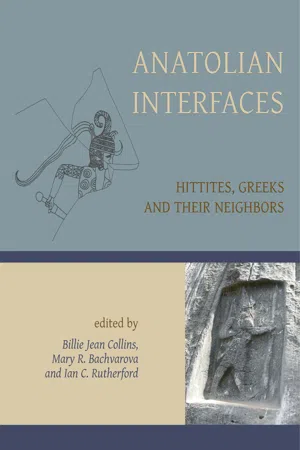
Anatolian Interfaces
Hittites, Greeks and their Neighbours
- 216 pages
- English
- ePUB (mobile friendly)
- Available on iOS & Android
eBook - ePub
Anatolian Interfaces
Hittites, Greeks and their Neighbours
About this book
The papers in this collection are the product of the conference "Hittites, Greeks and Their Neighbors in Ancient Anatolia: An International Conference on Cross-Cultural Interaction," hosted by Emory University in Atlanta, Georgia. They cover an impressive range of issues relating to the complex cultural interactions that took place on Anatolian soil over the course of two millennia, in the process highlighting the difficulties inherent in studying societies that are multi-cultural in their make-up and outlook, as well as the role that cultural identity played in shaping those interactions. Topics include possible sources of tension along the Mycenaean-Anatolian interface; the transmission of mythological and religious elements between cultures; the change across time and space in literary motifs as they are adapted to new milieus and new audiences; the ways in which linguistic data can refine our understanding of the interrelations between the various peoples who lived in Anatolia; and the role that the Anatolian kingdoms of the first millennium played as cultural filters and conduits through which North Syrian or Near Eastern ideas or materials were transmitted to the Greeks.
Information
Topic
HistoireSubtopic
Histoire de la Grèce antique1
TROY AS A “CONTESTED PERIPHERY”: ARCHAEOLOGICAL PERSPECTIVES ON CROSS-CULTURAL AND CROSS-DISCIPLINARY INTERACTIONS CONCERNING BRONZE AGE ANATOLIA
Achilles, Agamemnon, Menelaus, and Helen. Hector, Paris, Priam, Cassandra and Andromache.... These names have resonated down through the ages to us today, courtesy of Homer’s Iliad and Odyssey, the epic stories of the Trojan War.
Even for those who had never heard of Troy and its story before, the plot and the names of those involved are now familiar territory, courtesy of Brad Pitt, Peter O’Toole, Orlando Bloom, Eric Bana, Sean Bean and Diane Kruger. They appeared in an epic of their own – the movie Troy, made by Warner Brothers and released during the summer of 2004. The film was neither particularly accurate nor faithful to the original story, but occasionally it stumbled close to the truth. “I’ve fought many wars in my time,” says Priam at one point. “Some are fought for land, some for power, some for glory. I suppose fighting for love makes more sense than all the rest.” Later, however, Agamemnon disputes this point. “This war is not being fought because of love for a woman; it is being fought for power, wealth, glory, and territory, as such wars always are,” he says. I agreed with Agamemnon so much that I stood up and cheered in the theater, to the great embarrassment of my students sitting around me.
But was there really a Trojan War? Did Homer exist? Did Hector? Did Helen really have a face that launched a thousand ships? How much truth is there behind Homer’s story? Was the Trojan War fought because of one man’s love for a woman ... or was that merely the excuse for a war fought for other reasons - land, power, glory?
POSITION OVERVIEW
First and foremost, during the Late Bronze Age Troy was a “contested periphery” located between the Mycenaeans to the west and the Hittites to the east. There is both direct and indirect evidence that each group regarded the Troad as lying on the periphery of its own territory and attempted to claim it for itself. As I have argued in previous articles, whereas the Hittite king Tudhaliya II sent troops to quell the Assuwa rebellion in the late-fifteenth century and later Hittite kings left their mark as well, Ahhiyawan warriors apparently also fought on occasion in this region from the fifteenth through the thirteenth centuries BC (Cline 1996, 1997).
Second, perhaps because of its status as a “contested periphery,” the city of Troy itself, and possibly also surrounding communities, such as Beşiktepe, were likely to have been home, or at least played host, to a variety of people of different cultures and ethnicities during the Late Bronze Age, whether permanent inhabitants, traveling merchants, sailors or warriors. The archaeological remains should reflect this diversity to a certain extent, as indeed they do in some cases (see the various finds in the Beşiktepe cemetery, for example; Basedow 2000, 2001).
However, I suggest that early excavators, such as Heinrich Schliemann with his hordes of workmen, will not have been nuanced enough in their approach necessarily to have discerned such diversity. Fortunately, the manner in which archaeology has been conducted in Anatolia has changed dramatically over the past century, in part because of the new questions being asked, in part because of the increasingly multidisciplinary nature of the new projects, and in part because of the new approaches being undertaken – particularly the cross-disciplinary efforts between archaeologists, historians, linguists, anthropologists, and other scholars. The recent efforts of Manfred Korfmann, with his integrated team of archaeologists and scientists, have sent us in new and interesting directions since the late 1980s and allow us to study the excavated material more carefully than ever before.
As my third and final point, I will suggest that Troy may be used as a specific case study not only of a “contested periphery” in terms of its geographical location in Anatolia during the Late Bronze Age but also as a “contested periphery” today in terms of its scholarly location, for the study of Troy and the Trojan War is positioned on the periphery between academic and popular scholarship. As Professor Spyros Iakovides, one of my original dissertation advisors with whom I have stayed in contact, wrote to me recently: “Be careful about the Trojan War. It is a slippery slope on which much has been said and written” (personal communication, 31 July 2004).
TROY AND THE TROAD AS A “CONTESTED PERIPHERY”
Several years ago I published an article in which I argued that Megiddo and the Jezreel Valley in Israel could be viewed as a “contested periphery” throughout history. The term “contested periphery” was first coined by Mitchell Allen for use in his 1997 UCLA dissertation concerned with Philistia, the Neo-Assyrians, and World Systems Theory. Allen identified “contested peripheries” as “border zones where different systems intersect.” Chase-Dunn and Hall immediately adopted this term and defined it more formally as “a peripheral region for which one or more core regions compete” (Allen 1997, 49-51, 320-21, fig. 1.4; cf. also Berquist 1995a, 1995b; Chase-Dunn and Hall 1997, 37; Cline 2000).
In my original article on Megiddo, which appeared in the Journal of World-Systems Research in 2000, I said that if this concept of a “contested periphery” is to become a viable part of World Systems Theory, it must be able to explain more than a single case. Now I will suggest that it can. Back then, I suggested that additional areas in the world that might also qualify as “contested peripheries” were the area of Troy and the Troad, Dilmun in the Persian Gulf region, areas in the North American Midwest or Southwest, perhaps various regions in Mesoamerica, and the Kephissos River Valley commanded by Boeotian Thebes in central Greece. I have not yet had time to investigate the other suggestions, but I would now argue that the region of Troy and the Troad does indeed qualify as a “contested periphery” (Cline 2000).1
As I have argued previously, the term “contested periphery” has geographical, political and economic implications, since such a region will almost always lie between two larger empires, kingdoms or polities established to either side of it. Moreover, I would still argue that “contested peripheries” are also likely to be areas of intense military activity, precisely because of their geographical locations and constantly changing political affiliations. Thus, Mitchell Allen’s phrase is not only applicable to the area of Megiddo and the Jezreel Valley in northern Israel, which has seen thirty-four battles during the past 4,000 years, but is also, I would argue, applicable to the area of Troy and the Troad. This region has similarly been the focus of battles during the past 3,500 years or more, from at least the time of the Trojan War in the Late Bronze Age right up to the infamous battle at Gallipoli across the Hellespont during World War I. (The Hellespont is, of course, also known as the Dardanelles and is the strait leading from the Aegean Sea into the Sea of Marmara, which then connects with the Black Sea.)
Like Megiddo in Israel, which commands the Jezreel Valley, the region of Troy and the Troad in Anatolia, commanding the Hellespont was always a major crossroads, controlling routes leading south to north, west to east, and vice versa. Whoever controlled Troy and the Troad, and thus the entrance to the Hellespont, by default also controlled the entire region both economically and politically, vis á vis the trade and traffic through the area, whether sailors, warriors, or merchants. As “a thriving centre of... commerce at a strategic point in shipping between the Aegean and Black seas,” it is not difficult to see why this region was so desirable for so many centuries to so many different people. 2
In the specific case of the Trojan War, I would argue that Troy and the Troad region was caught between the Mycenaeans, located to the west but interested in expanding ever eastward, and the Hittites, located to the east and interested in expanding ever westward.3 Moreover, I would argue that it was the Trojan War itself that partially gave this region its geographical je ne sais quoi from then on, bringing great conquerors together through time and space in a way that no other circumstance has or can. Xerxes, the Persian king, stopped by in 480 BC, while en route to his invasion of Greece. Alexander the Great came to visit the site in 334 BC, making sacrifices to Athena and dedicating his armor in a temple there, before continuing on to conquer Egypt and much of the ancient Near East. Later, Julius Caesar, Caracalla, Constantine, and Mehmet II (the conqueror of Constantinople) all went out of their way to visit the site and pay their respects (Sage 2000). Like Megiddo in Israel, Troy and the Troad is among the elite sites and areas of the world that can claim to have seen many different armies and many famous leaders march through their lands during a sustained period from the Bronze Age to the Nuclear Age.
A continuous stream of armies should actually be expected as a natural occurrence in a region such as the Troad or the Jezreel Valley, which sit astride important routes where different geographical, economic, and political world-systems came into frequent contact, and which may have grown wealthy in part by exploiting international connections. Such desirable peripheral regions would likely gain the covetous gaze of rulers in one or more neighboring cores and thus would be highly contested. Like Megiddo, Troy may have had insufficient hinterland and natural resources to become a true core on its own, but it certainly became a major entrepôt and an important periphery, waxing and waning in a complex series of cycles with the nearby major players and world-systems who competed for control of this lucrative region each time they pulsed outward and bumped into each other (cf. Hall 1999, 9-10).
If an area is truly a “contested periphery,” I would expect to find shifts in key trading partners, particularly if the region changed hands or political affiliations every so often. Such changes can also take place even if the region doesn’t change hands or political affiliations, especially if the area, like the Jezreel Valley or the Troad, is located on a major trade route. Indeed, both regions fit the definition of an entrêpot or a crossroads area, providing a zone of cross-fertilization for the ideas, technology, and material goods that came into and passed through the region (cf. Teggart 1918, 1925; Bronson 1978; Bentley 1993).
As a perfect example of such cross-fertilization, I would offer the bronze sword from the time of the Hittite king Tudhaliya II, dating to about 1430 BC, which was found in 1991 by a bulldozer operator working near ancient Hattusa’s famous Lion Gate. The sword, which has generated much publicity and many publications concerning its origin, looks suspiciously like a Mycenaean Type B sword generally manufactured and used in mainland Greece – by Mycenaeans – during this period. As I have suggested in two previously published and related articles, if this sword is not actually a product of a Mycenaean workshop, then it is an extremely good imitation of such a Type B sword, perhaps manufactured on the western coast of Anatolia. Either way, this sword is an excellent example of the transmission of either actual material goods, or ideas about such goods, during the Late Bronze Age in the region of the Troad.4
Even more importantly, inscribed on the blade of the sword is a single line in Akkadian, which reads in translation: “As Duthaliya [Tudhaliya] the Great King shattered the Assuwa-Country, he dedicated these swords to the Storm-God, his Lord.” The inscription thus confirms other accounts written during Tudhaliya’s reign concerning a rebellion by a group of twenty-two small vassal kingdoms, collectively known as Assuwa, along the northwestern coast of Anatolia. Tudhaliya, the accounts tell us, marched west to crush this so-called Assuwa Rebellion. This is potentially extremely important for the history of Troy, for it seems that the city was a member of this Assuwa coalition that rebelled against the Hitttites – the last two named polities of this coalition are Wilusiya and Taruisa.5
The literary texts from Tudhaliya’s reign suggest that one of the allies of the Assuwa league were men from “Ahhiyawa:” This place name comes up frequently in Hittite documents. It has been the cause of debates among Hittitologists ...
Table of contents
- Title Page
- Copyright Page
- Table of Contents
- PREFACE
- ABBREVIATIONS
- INTRODUCTION
- 1 - TROY AS A “CONTESTED PERIPHERY”: ARCHAEOLOGICAL PERSPECTIVES ON CROSS-CULTURAL AND CROSS-DISCIPLINARY INTERACTIONS CONCERNING BRONZE AGE ANATOLIA
- 2 - PURPLE-DYERS IN LAZPA
- 3 - MULTICULTURALISM IN THE MYCENAEAN WORLD
- 4 - HITTITE LESBOS?
- 5 - THE SEER MOPSOS (MUKSAS) AS A HISTORICAL FIGURE
- 6 - SETTING UP THE GODDESS OF THE NIGHT SEPARATELY
- 7 - THE SONGS OF THE ZINTUḪIS: CHORUS AND RITUAL IN ANATOLIA AND GREECE
- 8 - HOMER AT THE INTERFACE
- 9 - THE POET’S POINT OF VIEW AND THE PREHISTORY OF THE ILIAD
- 10 - HITTITE ETHNICITY? CONSTRUCTIONS OF IDENTITY IN HITTITE LITERATURE
- 11 - WRITING SYSTEMS AND IDENTITY
- 12 - LUWIAN MIGRATIONS IN LIGHT OF LINGUISTIC CONTACTS
- 13 - “HERMIT CRABS,” OR NEW WINE IN OLD BOTTLES: ANATOLIAN AND HELLENIC CONNECTIONS FROM HOMER AND BEFORE TO ANTIOCHUS I OF COMMAGENE AND AFTER
- 14 - POSSESSIVE CONSTRUCTIONS IN ANATOLIAN, HURRIAN, URARTIAN AND ARMENIAN AS EVIDENCE FOR LANGUAGE CONTACT
- 15 - GREEK MÓLYBDOS AS A LOANWORD FROM LYDIAN
- 16 - Kybele as Kubaba in a Lydo-Phrygian Context
- 17 - KING MIDAS IN SOUTHEASTERN ANATOLIA
- 18 - THE GALA AND THE GALLOS
- 19 - PATTERNS OF ELITE INTERACTION: ANIMAL-HEADED VESSELS IN ANATOLIA IN THE EIGHTH AND SEVENTH CENTURIES BC
- 20 - “A FEAST OF MUSIC”: THE GRECO-LYDIAN MUSICAL MOVEMENT ON THE ASSYRIAN PERIPHERY
- INDEX
Trusted by 375,005 students
Access to over 1.5 million titles for a fair monthly price.
Study more efficiently using our study tools.
Frequently asked questions
Yes, you can cancel anytime from the Subscription tab in your account settings on the Perlego website. Your subscription will stay active until the end of your current billing period. Learn how to cancel your subscription
No, books cannot be downloaded as external files, such as PDFs, for use outside of Perlego. However, you can download books within the Perlego app for offline reading on mobile or tablet. Learn how to download books offline
Perlego offers two plans: Essential and Complete
- Essential is ideal for learners and professionals who enjoy exploring a wide range of subjects. Access the Essential Library with 800,000+ trusted titles and best-sellers across business, personal growth, and the humanities. Includes unlimited reading time and Standard Read Aloud voice.
- Complete: Perfect for advanced learners and researchers needing full, unrestricted access. Unlock 1.5M+ books across hundreds of subjects, including academic and specialized titles. The Complete Plan also includes advanced features like Premium Read Aloud and Research Assistant.
We are an online textbook subscription service, where you can get access to an entire online library for less than the price of a single book per month. With over 1.5 million books across 990+ topics, we’ve got you covered! Learn about our mission
Look out for the read-aloud symbol on your next book to see if you can listen to it. The read-aloud tool reads text aloud for you, highlighting the text as it is being read. You can pause it, speed it up and slow it down. Learn more about Read Aloud
Yes! You can use the Perlego app on both iOS and Android devices to read anytime, anywhere — even offline. Perfect for commutes or when you’re on the go.
Please note we cannot support devices running on iOS 13 and Android 7 or earlier. Learn more about using the app
Please note we cannot support devices running on iOS 13 and Android 7 or earlier. Learn more about using the app
Yes, you can access Anatolian Interfaces by Billie Jean Collins,Mary R. Bachvarova,Ian Rutherford, Mary R. Bachvarova, Ian Rutherford in PDF and/or ePUB format, as well as other popular books in Histoire & Histoire de la Grèce antique. We have over 1.5 million books available in our catalogue for you to explore.