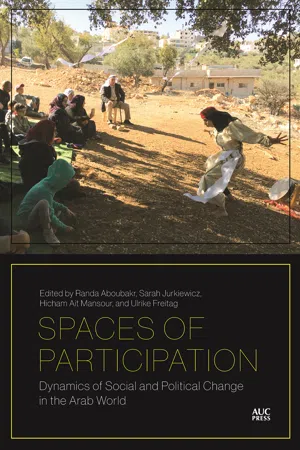
A rich interdisciplinary study of the relationships between space, both physical and virtual, and social and political participation
Where do people meet, form relations of trust, and begin debating social and political issues? Where do social movements start? In this fascinating collection, scholars and activists from a wealth of disciplinary backgrounds, including sociology, anthropology, history, and political science, take a fresh look at these questions and the factors leading to political and social change in the Arab world from a spatial perspective. Based on original field work in Egypt, Kuwait, Morocco, and Palestine, Spaces of Participation connects and reconnects social, cultural, and political participation with urban space. It explores timely themes such as formal and informal spaces of participation, alternative spaces of cultural production, space reclamation, and cultural activism, and the reconfiguring of space through different types of contestation. It also covers a range of spaces that include sports clubs, arts centers, and sites of protest and resistance, as well as virtual spaces such as social media platforms, in the process of examining the relationships and tensions between physical and virtual space.
Spaces of Participation underlines the temporal and transformative quality of participatory spaces and how they are shaped by their respective political contexts, highlighting different forms of access, control, and contestation.
Contributors:
Randa Aboubakr, Cairo University, Egypt
Hicham Ait-Mansour, Mohamed V University, Rabat, Morocco
Fadma Aït Mous, Hassan II University of Casablanca, Morocco
Mouloud Amghar, Cadi Ayyad University, Marrakesh, Morocco
Yazid Anani, A.M. Qattan Foundation, Ramallah, Palestine
Mai Ayyad, Cairo University, Egypt
Youness Benmouro, Mohamed V University, Rabat, Morocco
Yasmine Berriane, Centre Maurice Halbwachs (CNRS), Paris, France
Mokhtar El Harras, Mohamed V University, Rabat, Morocco
Ulrike Freitag, Leibniz-Zentrum Moderner Orient, Berlin, Germany
Sarah Jurkiewicz, Leibniz-Zentrum Moderner Orient, Berlin, Germany
Mona Khalil, Cairo University, Cairo, Egypt
Azzurra Sarnataro, La Sapienza University of Rome, Italy
Renad Shqeirat, Khalil Sakakini Cultural Center, Ramallah, Palestine
Dorota Woroniecka-Krzy?anowska, German Historical Institute, Warsaw, Poland
eBook - ePub
Spaces of Participation
Dynamics of Social and Political Change in the Arab World
- English
- ePUB (mobile friendly)
- Available on iOS & Android
eBook - ePub
Spaces of Participation
Dynamics of Social and Political Change in the Arab World
About this book
Information
Part I
Rethinking Participation in Formal and Informal Spaces
1
Protests as a Space for Contentious Politics and Political Learning among Youth in Morocco: The Case of Mohamed V Avenue in Rabat
For decades, Morocco was home to protests about multiple social and economic issues that ultimately culminated in 2011 in the February 20 movement, an unprecedentedly massive political youth movement that called for mainly political reforms as the main driver of economic and social reforms. Well before the 2011 protests, a study the National Council of Human Rights conducted in 2010 on the freedom of peaceful protests in Morocco found that between January and October 2008, about 5,508 protest gatherings were held, involving about 330,000 citizens. The city of Rabat was at the top of the list, with 1,660 such meetings. The council’s report highlights the highly peaceful nature of these protests compared with those of earlier decades, when protests involved violence of some kind or the other and/or damage to public utilities and buildings (National Council for Human Rights 2008).
Thus, the 2011 political protests built a long tradition of protests that considerably increased, at least since the structural adjustment reforms of the 1980s. The neoliberal turn, characterized among other things by the privatization of public social services, as well as by reduced public spending in general, provided the context in which a new wave of protests took place (Gautney 2010; Bogaert and Emperador 2011). This trend has been observed worldwide. A study conducted in 2013 by the Initiative for Policy Dialogue at Columbia University and the Friedrich-Ebert-Stiftung New York located about 843 protests occurring between January 2006 and July 2013 in eighty-four countries (Ortiz et al. 2013). The main areas of concern of such protests included, in order, economic justice and opposition to austerity policies, the failure of political representation and political systems, global justice (including opposition to international financial institutions and other supranational groups’ policies), and people’s rights. The most significant finding of the study was related not to the issue of economic justice per se but to the political factor, that is, the lack of real democracy, which it considered the main obstacle to economic justice. The authors write that this finding applies not only to authoritarian governments but also to representative democracies that fail to listen to the views of ordinary people (Ortiz et al. 2013, 3).
Youth protests in Morocco, and more widely in the Middle East and North Africa, have been extensively studied in the last few years; these studies start from a set of assumptions. First, it is often acknowledged that Moroccan youth lack interest in political participation due to their distrust in the traditional political elites and to the latter’s failure to listen to their concerns.1 This is now a widely shared assumption, not only in authoritarian or semi-authoritarian contexts but also in established representative democracies (Ortiz et al. 2013, 3). Second, other studies argue that the weak participation of youth in mainstream politics does not imply a lack of participation. Instead, youth participate in politics in different ways, through protests, sharing ideas in blogs, and using other, alternative means to express their views (Zerhouni and Akesbi 2016). Other research papers attempt to make sense of the dynamics of protests and explain how alliances and oppositions are formed in the light of, or in relationship to, some significant external events that are thought to also shape such dynamics (Bennani-Chraïbi and Jeghlally 2012).
Drawing on extended fieldwork in the city of Rabat, home to the majority of major protests in Morocco, this chapter focuses on additional dimensions that are often overlooked in the protest literature on Morocco. Most significant protests take place in a highly symbolic place, Mohamed V Avenue in Rabat as a space for contentious politics (Tilly 2008, 8); thus, the protest is not only an indicator of the failure of traditional political elites to address youth claims and needs but also of their failure as political socializing agents and institutions. The protest is thus an alternative opportunity for youth to learn about politics and to engage in action for change. Last but not least, this chapter examines the relationship between physical and virtual spaces.
The research questions that guided this investigation include the following: What are the factors that contributed to the emergence of spaces such as Mohamed V Avenue as venues for political learning and action? How were these spaces created by youth movement activists who choose protest as their main means of action? How did they shape and create their own collective identities as apart from mainstream political parties (Goodwin and Jasper 2015, 9)? What impact do alternative processes of political socialization and engagement have on the physical and social dimension of the studied space? Finally, what is the relationship between virtual and physical space? Do socialization and politicization unfold differently in each of these domains?
This research is based on fieldwork and mostly direct observation of protests, as well as on in-depth interviews,2 which comprise a sample of forty-nine young protestors that represent four main movement groups: eleven of the unemployed university graduates (four males and seven females), seventeen from the February 20 movement (eleven males and six females), twelve from the teacher trainees’ movement (eight males and four females), and nine medical students (five males and four females). The age of the members of the sample ranged between 20 and 38 years. Most of them have earned, or are in the process of earning, a university degree. Degrees range from a degree of two years of study after high school (a minority of degree holders) to master’s and PhD students, as well as students pursuing a medical doctorate degree and teacher trainees. The data was collected between April and July 2016.3
Conceptualizing Protest in Public Space
This chapter attempts to conceptualize youth protests taking place on Mohamed V Avenue in Morocco to make sense of both its dynamics and its outcomes. However, the multilayered activists’ action poses a challenge to this endeavor. As Charles Tilly puts it (2008, 8), there are at least three classes of activity: routine social life; contention-connected social interaction; and public participation in collectively making claims. The question remains, Tilly argues: How do we distinguish among these three classes of what we are explaining, and what is explained?
Tilly argues that a broader view would take change and variation in routine social life as the explanatory factor, and the remaining two classes as the explained phenomena, which he describes as a “thick object,” whereas a narrow view, which he names a “thin object,” would take into consideration both change and variation in routine social life and connected interaction, to account for public participation in claim-making (Tilly 2008, 9).
Such a classification of explanatory and explained aspects of protest has the heuristic capacity to make sense of social movements in general and of protest in public space in particular. Following Tilly’s framework, in order to make sense of protests continuously taking place on Mohamed V Avenue as youth participation in public claim-making, one needs to first look at what has changed in the social life of the activists: educational opportunities, employment opportunities, inequality, and so forth—in short, what Bourdieu calls the dissonance between the subjective aspirations of agents and the objective opportunities available to them, or in other words, the emergence of a crisis. The opposite situation, which means a perfect fit between objective structures and subjective or mental structure, reflects the social world as self-evident or taken for granted (Bourdieu and Wacquant 1992; Crossley 2002). Secondly, the ways in which activists connect and recruit protest participants in accordance with common interests and areas of concern need to be examined. And thirdly, the massive participation in claim-making in public space in the form of organized marches should be explained. For the purposes of this chapter, the nature of change and variation in routine social life is evident from the nature of the protestors’ claims; they are related mainly to inequality and to the lack of participation in policy-making, to education and health employment policy, as well as to unemployment in general. The situation is even more stark if we take into account the profile of the protestors interviewed in this research; this includes the precarity of young university graduates who are unemployed, or who are teachers and medical trainees, entering an uncertain future because of the increasing privatization of public services, especially in education and in health. To a large extent, this explains the participation in collective claim-making in the public space. Contention-connected social interaction among activists is at least partially covered by the relationship between virtual and physical space sections. Connections among activists work mainly through common causes in which movement leaders are able to attract those who bear the same claims on the government, regardless of their social background.
The relevance to this research of the concept of public space remains to be discussed. First, the concept of space has many dimensions that are shaped by various theoretical perspectives. Adjectives are often used to describe how a given space is conceptualized. Hence, the vast literature on the concept has identified numerous subconcepts such as social space, physical space, public space, critical discourse space, and so forth. This is the case in the classical literature, such as Michel Foucault’s “Des espaces autres” (1984) and Henri Lefebvre’s “La production de l’espace” (1974), which attempts to bridge mental and social space; and Bourdieu’s distinction between physical and social space (1996). Other major works include Habermas’ oeuvre highlighting the centrality of communication in modern society, implying that public space, or the public sphere, is defined as an area of our social life in which public opinion is formed, whose main function is the critique of all that is made public (Habermas 1985). However, more closely related to the notion used in this chapter is Cassegård’s (2014) distinction between public sphere and public space.
The first is closer to Habermas’ notion of deliberation with the political system based on reason between rational actors taking place in non-state forums and leading to a consensus. More particularly, Habermas traced the notion of the bourgeois public sphere “as the sphere [where] private people come together as a public” (Habermas 1989, 27). The main feature of this bourgeois public sphere is its deliberative character and its recourse to reason in the critique of government regulation. This space does not allow for contestation and is based on a civility that hides the inequalities inherent in the public taking part in the deliberation or, put otherwise, on a “bracketing” (Cassegård 2014). On the other hand, public space, Cassegård argues, refers to demonstrations where incivility occupies center stage. Interestingly, the authorities can construct the protesters’ occupation of public space as a mechanism of control. Marching, chanting slogans, holding banners, wearing signaling clothes, and talking to the media—all these are a momentary adoption of a group identity (as when attending a football game) that lasts the duration of the performance, after which the demonstrator resumes his or her regular identity and abides by the norms of the public space.
One last terminological specificity, the term ‘demonstration,’ in Arabic tazahur, illustrates a key dimension in the demonstrators’ exercise of politics and means of protesting publicly and of appearing or making themselves visible. In this fashion, protestors do not merely speak truth to power, they also make fun of power. They perform a politics of dissent and subversion. They do away with the fear of authority and with obedience. Authority is ridiculed and trivialized.
To sum up this discussion, the following concepts guided this research: space refers first to physical space in which protest takes place and, specifically for this study, to Mohamed V Avenue in Rabat as a space for contentious politics among youth. Nevertheless, since the whole process of protests starts in or is extended to virtual space, a more appropriate term would be ‘the space of protest,’ which includes both physical and virtual dimensions. Political learning or socialization is taken to mean, in its broadest sense, what activists actually learn in the process of protests, rather than what they have learned during their lifespan. The term ‘ideal-typical protestor’ refers to the common patterns observed among various groups of activists. Therefore, idiosyncratic attributes of individual protestors fall outside the scope of this chapter.
Mohamed V Avenue as a Space for Contentious Politics
Mohamed V Avenue has always been a historically privileged site for protests. It is a central avenue in the city of Rabat, and due to its strategic position, it hosts protests expressing issues that range from claims for employment, education, health and human rights to wider political issues of national scale, such as claims for comprehensive political reform, as was the case during the February 20 movement in 2011. According to a female protestor from the teacher trainees group,
this avenue is itself a means of great pressure on the government. It is very close to the Parliamen...
Table of contents
- Cover
- Half Title Page
- Title Page
- Copyright Page
- Contents
- List of Illustrations
- Notes on Contributors
- Acknowledgments
- Notes on Transliteration
- Introduction
- Part I: Rethinking Participation in Formal and Informal Spaces
- Part II: Reconfiguring Space through Contestation
- Part III: Alternative Spaces of Cultural Production
- Part IV: Space Reclamation and Cultural Activism
Trusted by 375,005 students
Access to over 1.5 million titles for a fair monthly price.
Study more efficiently using our study tools.
Frequently asked questions
Yes, you can cancel anytime from the Subscription tab in your account settings on the Perlego website. Your subscription will stay active until the end of your current billing period. Learn how to cancel your subscription
No, books cannot be downloaded as external files, such as PDFs, for use outside of Perlego. However, you can download books within the Perlego app for offline reading on mobile or tablet. Learn how to download books offline
Perlego offers two plans: Essential and Complete
- Essential is ideal for learners and professionals who enjoy exploring a wide range of subjects. Access the Essential Library with 800,000+ trusted titles and best-sellers across business, personal growth, and the humanities. Includes unlimited reading time and Standard Read Aloud voice.
- Complete: Perfect for advanced learners and researchers needing full, unrestricted access. Unlock 1.5M+ books across hundreds of subjects, including academic and specialized titles. The Complete Plan also includes advanced features like Premium Read Aloud and Research Assistant.
We are an online textbook subscription service, where you can get access to an entire online library for less than the price of a single book per month. With over 1.5 million books across 990+ topics, we’ve got you covered! Learn about our mission
Look out for the read-aloud symbol on your next book to see if you can listen to it. The read-aloud tool reads text aloud for you, highlighting the text as it is being read. You can pause it, speed it up and slow it down. Learn more about Read Aloud
Yes! You can use the Perlego app on both iOS and Android devices to read anytime, anywhere — even offline. Perfect for commutes or when you’re on the go.
Please note we cannot support devices running on iOS 13 and Android 7 or earlier. Learn more about using the app
Please note we cannot support devices running on iOS 13 and Android 7 or earlier. Learn more about using the app
Yes, you can access Spaces of Participation by Randa Aboubakr,Ulrike Freitag,Sarah Jurkiewicz,Hicham Ait-Mansour, Randa Aboubakr, Ulrike Freitag, Sarah Jurkiewicz, Hicham Ait-Mansour in PDF and/or ePUB format, as well as other popular books in Social Sciences & Art Theory & Criticism. We have over 1.5 million books available in our catalogue for you to explore.