![]()
Introduction to Marketing Management
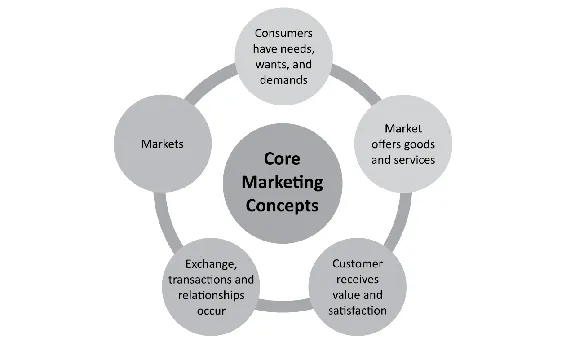
Marketing affects everyone, every day. We all engage in marketing on a daily basis, so it is important that we understanding what marketing is. A market can be defined by Philip Kotler as, “…all the potential customers sharing a particular need or want who might be willing and able to engage in exchange to satisfy that need or want. ”Marketing is a function of an organization. It is a group of processes or procedures for developing, connecting, and providing value to consumers. It is also for dealing with customer relations in ways that profit the organization and its stakeholders. Marketing is achieved by social and managerial processes. These processes consist of consumers and groups of consumers acquiring their needs and wants by developing and swapping products and value with one another. With the cut throat competitive conditions and the advancement of production, distribution, stocking and pricing as well as digitalization, marketing has become Managing Relationships with Customers, Distributors, facilitators (Banks, advertising and PR people,) partners and public at large. Marketing seeks to fulfill those wants, needs, and desires from the consumer both present and anticipated in future.
Marketing is important because in the 21st century, with the struggling economy, organizations used marketing to help keep their companies afloat. Marketing helps to tackle the challenges faced in a failing environment. In a broader sense, marketing has brought awareness of products and services to the public that have made their lives better. When marketing is successful, demand increases for an organization’s products and services. It also helps to establish a brand in the public eye and build brand loyalty. Indirectly, successful marketing creates jobs for individuals because demand is increased and more assistance to produce and distribute the products and services is needed. In its simplest form, marketing puts products and services in the hands of its targeted consumers.
Marketing is an organizational function covering almost all areas of business. The following list shows the many functions in an organization that can be categorized as a marketing function.
• Customer Relationship Management (CRM)
• Display
• Stockholding
• Servicing
• Risk Taking
• Transporting
• Market Research
• Merchandising
• Publicity
• Pricing
• Forecasting
• Buying
• Financing
• Selling
• Public Relations
• Advertising
• Sales Promotion
Marketing is a management function. Management must ensure that the operations of the organization are running smoothly to ensure the customer’s needs are met effectively and efficiently. Manager conduct analysis, plan, allocate resources, control current processes, and work to anticipate customer needs in an effort to ensure customers are satisfied. Additionally it tries to anticipate needs and wants of customers/ consumers in the future by evaluating the social, economic, cultural, political and technological developments.
Marketing is a business concept. Here is where the exchange process comes into play that are associated with obtaining goods and services. This is where supply and demand come in. If I have the supply and you have a demand of the product, we can negotiate a deal.
It is considered an exchange when:
• Two groups or more are involved
• Both groups have something of value that the other group desires
• Both groups effectively communicate and deliver
• Both groups have the option to turn down each other’s offers
• Both groups want to negotiate with the other party
Marketing is a business philosophy. It sees the importance of the customer and that all business exists to serve customers rather than manufacturing products. Marketing takes the customer as the core of its activities. Marketing takes the customer as the core of its activities.
In the remainder of this reading we will explore these concepts and dive deeper into marketing and marketing management, so we can better understand its inner works.
Stages of Marketing
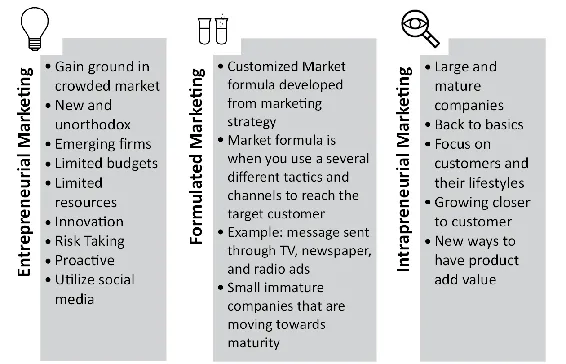
Not all marketing is greatly expensive, involving extensive research from a reputable firm and spend inordinate amounts of money on advertising and keeping up large marketing departments. Some organizations work with what they have. They stretch their current resources, maintain close relationships with customers and use information gathered to meet the customer’s needs. These organizations focus on building their brand and customer loyalty and less on advertising and PR.
Not all marketing is the same. There are three phases of marketing that can occur.
Examine the illustration below that describes the phases and their definitions.
Marketing Capacity
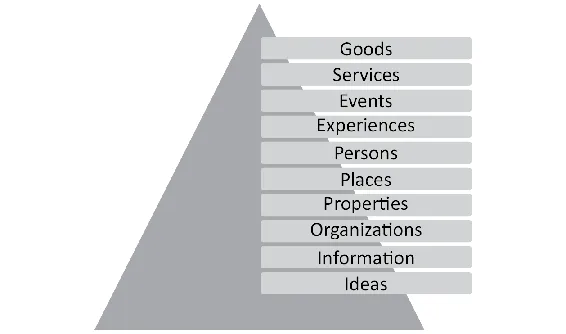
In the following section, let’s answer the questions of who what when where and why in relation to marketing. First, what is marketed?
Goods are the most commonly marketed item in the list above, they are physical in nature. Examples of goods would be cars, food, clothing, and furniture. Next are services which carry a 70-30 service to goods ratio. Examples of services would be airlines, banking, and doctors. Sometimes you see a mix of goods and services such as in construction. Events can also be marketed or promoted. Examples of events would be concerts, sports events, and performances. Experiences are another item that is commonly marketed. Experiences include a coordination of several activities to provide a specific type of experience. A great example of this is Disneyworld. They orchestrate a lot of elements to provide a magical experience. It is strange to say that marketing helps to sell people. It is, however, true if you think about it in the context of an image of a person or a brand. For example, high profile plastic surgeons sell themselves through marketing to lure in new clients. A more recent marketing effort has gone into marketing places. Doing this is promoting tourism in a specific city or state. For example, there are several commercials on TV advertising California and all it has to offer. Property marketing really falls within the realm of real estate. In order to sell a house or commercial property, an agent advertises the property on local websites or papers. Organizations often advertise for themselves to help build their brand. For example, Patagonia, advertises its social consciousness and volunteer efforts to help really show their brand to the public. Information is also marketed. For example, advertisements you see for colleges and university sell the education and information you would get from that college. Finally, ideas are marketed. For example, two famous ones are “Just Say No” and “No means No”.
Marketing Management
Marketing management is the discipline of selecting goal markets and attaining, possessing, and increasing customers through generating, distributing, and communicating higher customer value.
The above list is extensive and requires resources in order to properly market each of them. A marketer is responsible for developing this marketing. They are essentially looking for some sort of response from the consumer, also referred to as a prospect. If both the marketer and the prospect are wanting to sell one another something, they can both be termed marketers.
Demand Management
A marketer’s largest responsibility is to create demand for the item they are marketing. Essentially, marketers are demand orchestrators or demand managers. They control how much demand, timing, and logistics. Demand managers can create demand, diminish demand, and increase or decrease demand. When they are managing this demand, they must be cognizant of the different states of demand. See the list below to explain the different states.
Demands management includes customer management. Organizations need to determine if they want to create new customers or maintain repeat customers, or both. Creating a group of new customers is a costly endeavor and hard to come by due to the ever-changing environment, economy, and competition. D...