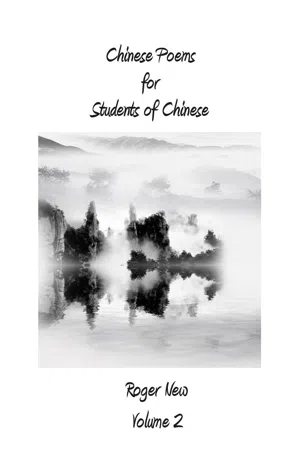
- English
- ePUB (mobile friendly)
- Available on iOS & Android
eBook - ePub
Information
Topic
EducationSubtopic
Teaching Languages1. 草 (白居易 - 唐)
Cǎo (Bái Jū Yì - Táng)
Cǎo (Bái Jū Yì - Táng)
| 离离原上草, | lí lí yuán shàng cǎo |
| 一岁一枯荣. | yī suì yī kū róng |
| 野火烧不尽, | yě huó shāo bù jìn |
| 春风吹又生. | chūn fēng chuī yòu shēng |
| 远芳侵古道, | yuǎn fāng qīn gǔ dào |
| 晴翠接荒城. | qíng cuì jiē huāng chéng |
| 又送王孙去, | yòu sòng wáng sūn qù |
| 萋萋满别情. | qī qī mǎn bié qíng |
We return, first of all, to one of the poems encountered in volume 1, Cǎo (草) by Bái Jū Yì, where just the first four lines were given. This is in total an eight-line poem, and the whole poem is set out here, although vocabulary only for the last four lines is provided.
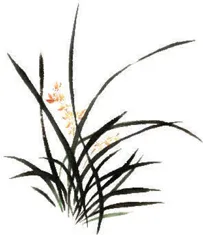
At first glance, the poem seems to turn in a different direction from that taken in the first lines - a parting from a revered friend (Wáng Sūn does not literally mean King's grandson here, but is a term of respect for someone close, found also in other poems such as Sòng Bié (送别) by Wáng Wéi).
| 远 | yuǎn | distant |
| 芳 | fāng | aroma |
| 侵 | qīn | invade |
| 古 | gǔ | old, ancient |
| 道 | dào | path |
| 晴 | qíng | clear |
| 翠 | cuì | green, emerald |
| 接 | jiē | take over |
| 荒 | huāng | desolate |
| 城 | chéng | city |
| 又 | yòu | again |
| 送 | sòng | accompany |
| 王 | wáng | king |
| 孙 | sūn | grandson |
| 去 | qù | go, depart |
| 萋 | qī | luxuriant |
| 萋 | qī | crowded |
| 满 | mǎn | full |
| 别 | bié | farewell |
| 情 | qíng | feeling |
However, closer examination shows recurrence of the same themes as introduced in the first quatrain, and can be considered an illustration and amplification of these ideas. 'Fāng' (芳) is often thought of a...
Table of contents
- Cover
- Title Page
- Copyright Page
- Preface
- Contents
- Part 1
- Part 2
- Renditions of poems in English
Trusted by 375,005 students
Access to over 1.5 million titles for a fair monthly price.
Study more efficiently using our study tools.
Frequently asked questions
Yes, you can cancel anytime from the Subscription tab in your account settings on the Perlego website. Your subscription will stay active until the end of your current billing period. Learn how to cancel your subscription
No, books cannot be downloaded as external files, such as PDFs, for use outside of Perlego. However, you can download books within the Perlego app for offline reading on mobile or tablet. Learn how to download books offline
Perlego offers two plans: Essential and Complete
- Essential is ideal for learners and professionals who enjoy exploring a wide range of subjects. Access the Essential Library with 800,000+ trusted titles and best-sellers across business, personal growth, and the humanities. Includes unlimited reading time and Standard Read Aloud voice.
- Complete: Perfect for advanced learners and researchers needing full, unrestricted access. Unlock 1.5M+ books across hundreds of subjects, including academic and specialized titles. The Complete Plan also includes advanced features like Premium Read Aloud and Research Assistant.
We are an online textbook subscription service, where you can get access to an entire online library for less than the price of a single book per month. With over 1.5 million books across 990+ topics, we’ve got you covered! Learn about our mission
Look out for the read-aloud symbol on your next book to see if you can listen to it. The read-aloud tool reads text aloud for you, highlighting the text as it is being read. You can pause it, speed it up and slow it down. Learn more about Read Aloud
Yes! You can use the Perlego app on both iOS and Android devices to read anytime, anywhere — even offline. Perfect for commutes or when you’re on the go.
Please note we cannot support devices running on iOS 13 and Android 7 or earlier. Learn more about using the app
Please note we cannot support devices running on iOS 13 and Android 7 or earlier. Learn more about using the app
Yes, you can access Chinese Poems for Students of Chinese by New Roger in PDF and/or ePUB format, as well as other popular books in Education & Teaching Languages. We have over 1.5 million books available in our catalogue for you to explore.